Hayabusa2 to Attempt One of the Closest Asteroid Flybys in Spaceflight History on July 5
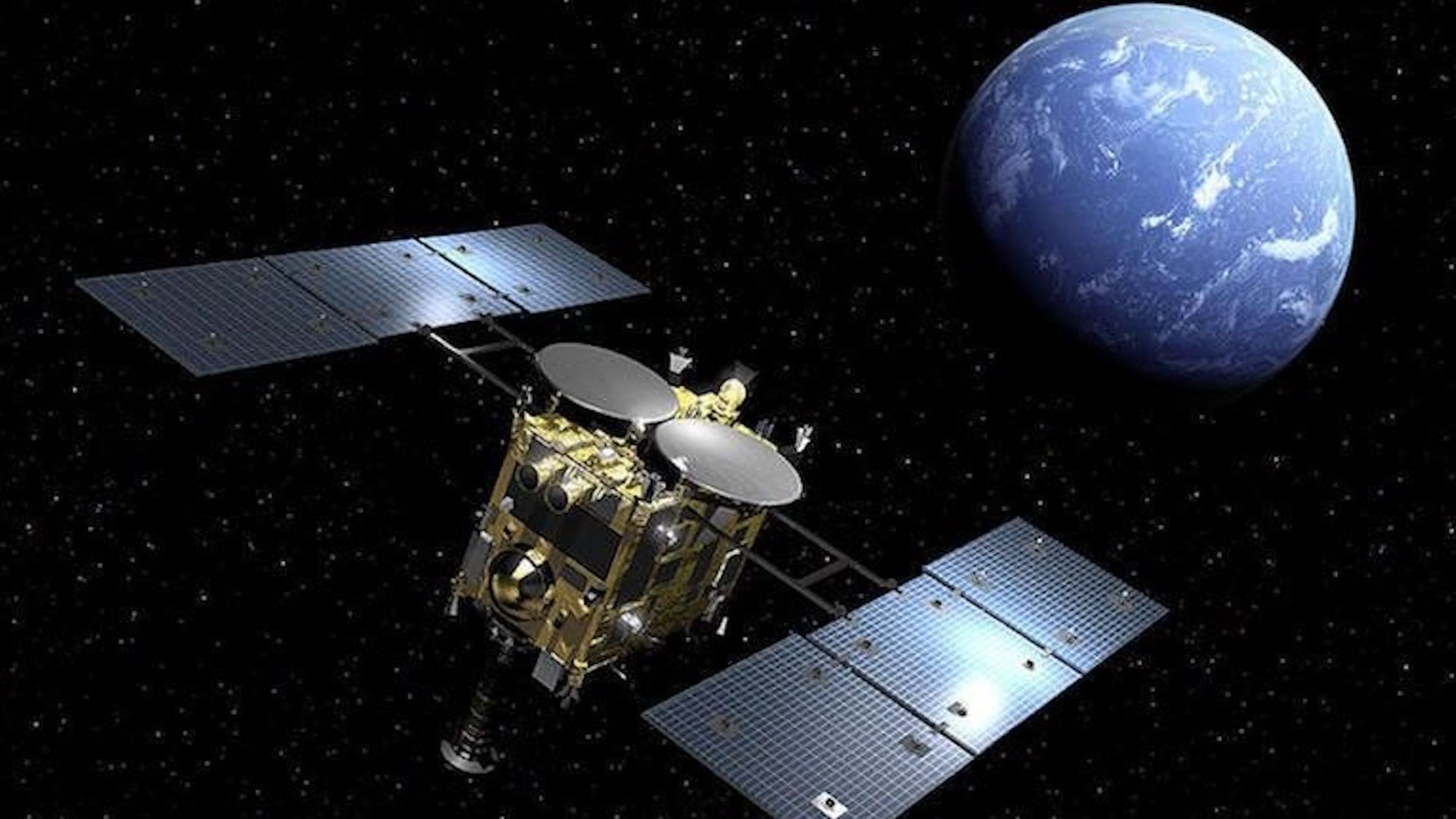
Japan's Hayabusa2 spacecraft is set to perform an exceptionally daring asteroid flyby on July 5, passing within just 1 kilometer of the near-Earth asteroid Torifune at a relative velocity of 5.3 kilometers per second. If successful, it will rank among the closest asteroid encounters ever attempted by a mission of this class.
From Sample Return to Extended Mission
Hayabusa2 launched in December 2014 and reached the asteroid Ryugu four years later, collecting samples that were returned to Earth in 2020. Having completed its primary objectives, the resilient spacecraft has continued operating on an extended mission.
Satoshi Tanaka of the Japanese Aerospace Exploration Agency (JAXA) presented details about the upcoming flyby at the 35th Meeting of NASA's Small Bodies Assessment Group (SBAG) on June 11.
A Kilometer-Range Encounter
The flyby will bring Hayabusa2 within 1 to 10 kilometers of Torifune, a roughly 450-meter-wide asteroid. The spacecraft will use its full instrument suite to study the asteroid during the rapid encounter.
"This is one of the closest asteroid encounters ever attempted by a mission of this class," Tanaka said. "By combining advanced navigation techniques and the engineering capabilities of Hayabusa2, we have made it possible to achieve a flyby at a distance of only about 1 kilometer."
Uncertainty and Risk
Torifune, originally designated 2001 CC21, is somewhat similar to Itokawa—the target of Japan's first Hayabusa mission—but little is known for certain about its characteristics.
"It's still a risky operation, because they had not planned for this," said Patrick Michel, principal investigator for ESA's Hera asteroid mission and a member of the Hayabusa2 science team. "The second thing is that we have a high uncertainty on the size of the object."
The asteroid could be a contact binary, where two separate bodies came together at low velocities. Known contact binary objects include Arrokoth, imaged by NASA's New Horizons, and comet 67P/Churyumov-Gerasimenko, visited by ESA's Rosetta spacecraft.
"We're going to discover what it looks like. And each time we have seen a new asteroid, we've been surprised," Michel said. "We're going to discover another beast to put in the zoo of asteroids."
Planetary Defense Test
While the high flyby velocity limits data collection time, the encounter provides a valuable test for planetary defense capabilities. The advanced navigation techniques used during the flyby could support rapid reconnaissance of threatening asteroids, informing kinetic impact strategies like those demonstrated by NASA's DART mission in 2022.
Long-Term Goals
During its deep space cruise, Hayabusa2 has conducted observations of zodiacal light and exoplanets. The ultimate goal of the extended mission is to visit the tiny asteroid 1998 KY26 in 2031, which would be the smallest asteroid ever visited. The spacecraft may even attempt to land on the minuscule world, just 11 meters wide.