NASA Launches Unprecedented Space Rescue: Air-Launched Rocket Takes Off to Save Swift Telescope
In the early hours of June 30, 2026, a rocket launched from an aircraft will attempt something never done before — rescue NASA's Neil Gehrels Swift Observatory from burning up in Earth's atmosphere. This mission also marks the final flight of the historic Pegasus rocket.
Background
Launched in November 2004 at a cost of $500 million, the Swift Observatory was built to study gamma-ray bursts and other high-energy events across the universe. After more than 20 years of service, the telescope is still producing valuable science, but its orbit has been steadily decaying due to atmospheric drag.
Recent solar activity has increased atmospheric drag at higher low-Earth orbit altitudes, accelerating Swift's orbital decline. Making matters worse, Swift was never designed to be serviced — it lacks the thrusters needed to raise its own orbit.
The Rescue Plan
NASA contracted Arizona-based Katalyst Space Technologies to build a robotic servicing satellite called LINK, purpose-built for this rescue mission. LINK stands about 1.5 meters tall and is equipped with three robotic arms designed to capture the 3.9-meter Swift observatory.
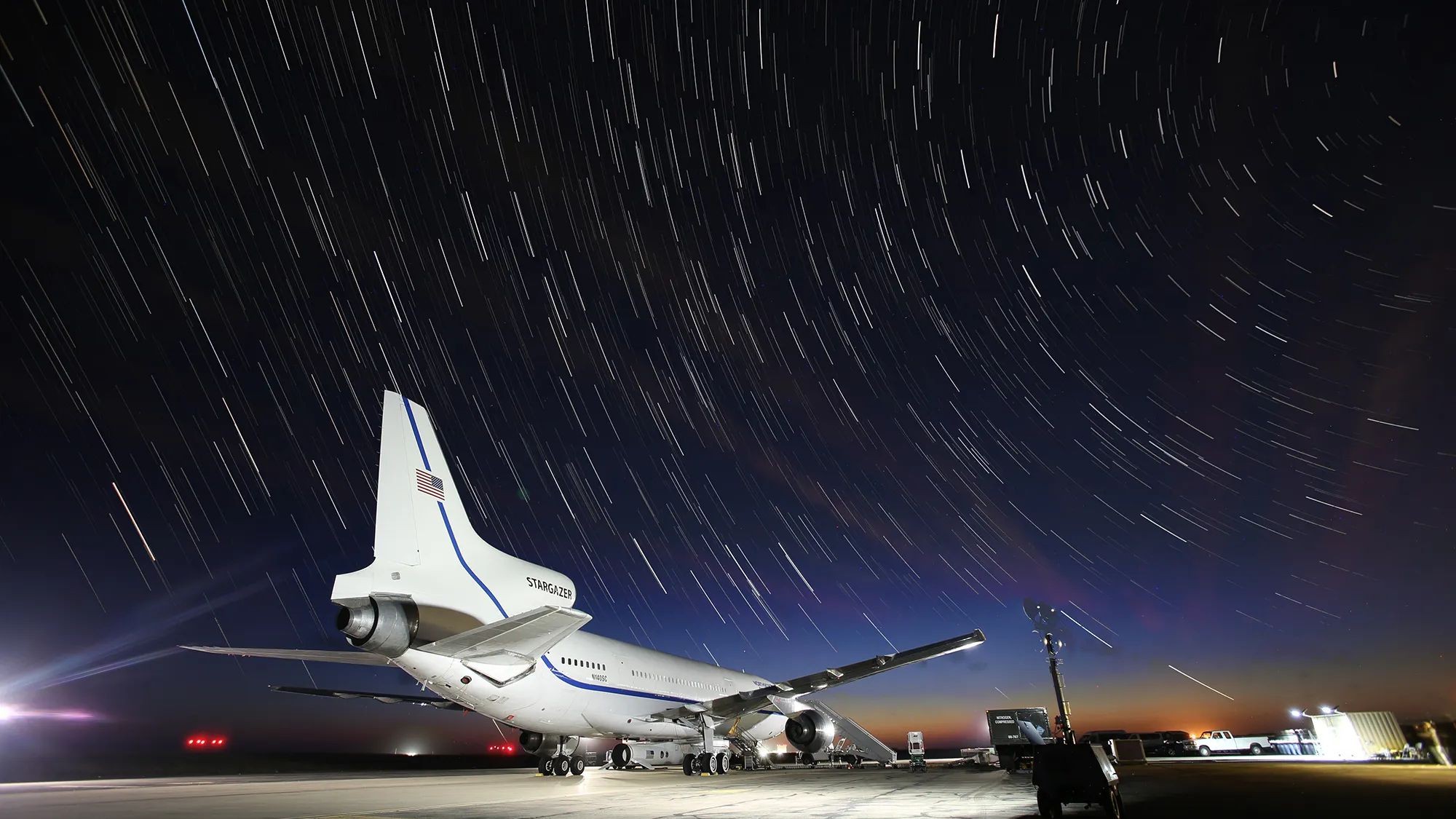
LINK is aboard a Northrop Grumman Pegasus XL rocket, launching from Bucholz Army Airfield at Kwajalein Atoll in the Marshall Islands. The Pegasus rocket is carried aloft by Northrop Grumman's L-1011 Stargazer jet. Once the aircraft reaches approximately 12,000 meters traveling at Mach 0.82, the rocket is released. Five seconds later, Pegasus ignites its engine and delivers LINK to orbit in about 10 minutes.
The Pegasus rocket has flown 45 missions since its 1990 debut. This three-stage, solid-propellant vehicle measures 16.9 meters in length and can deliver up to 454 kilograms to low Earth orbit. Its aerial deployment capability allows access to orbital inclinations that are difficult to reach from many ground-based launch sites — one of the key reasons it was selected for this mission, given Swift's low 20.6-degree inclination.
Mission Timeline
After reaching orbit and completing initial system checkouts, LINK will spend two to three weeks observing Swift to assess optimal grapple points. Once captured, LINK will activate gentle ion thrusters to slowly raise the pair's orbit over several months, targeting Swift's original design altitude of approximately 600 kilometers.
This will be the first time a private spacecraft attempts to capture an uncrewed U.S. government satellite. NASA selected Katalyst for the task in September 2025, giving the company less than a year to design, manufacture, and test the LINK satellite. The entire rescue mission and launch cost NASA just $30 million.
Is It Worth It?
NASA explained the mission's significance on its Swift Boost page: "While NASA could have allowed Swift to re-enter the atmosphere, the situation presented an opportunity to demonstrate a key capability for the future of space exploration. This daring approach also extends Swift's scientific lifetime and is more affordable than replacing the observatory's unique capabilities."
If all goes according to plan, Swift will be returned to its original orbit at approximately 600 kilometers, extending the observatory's life expectancy by several years, provided its systems continue to operate as designed.
Further Reading
Original article: https://www.space.com/space-exploration/launches-spacecraft/nasa-to-launch-ambitious-mission-to-save-a-space-telescope-from-burning-up-in-earths-atmosphere