NASA Awards Nearly $600 Million to Three Companies for Lunar Base Landers, Floats Plan to Send Spare Mars Rover to the Moon
NASA announced on June 30 the selection of three companies to fly four robotic lunar lander missions worth a combined $590.4 million, while revealing it is seriously studying a plan to send a spare Mars rover to the lunar surface.
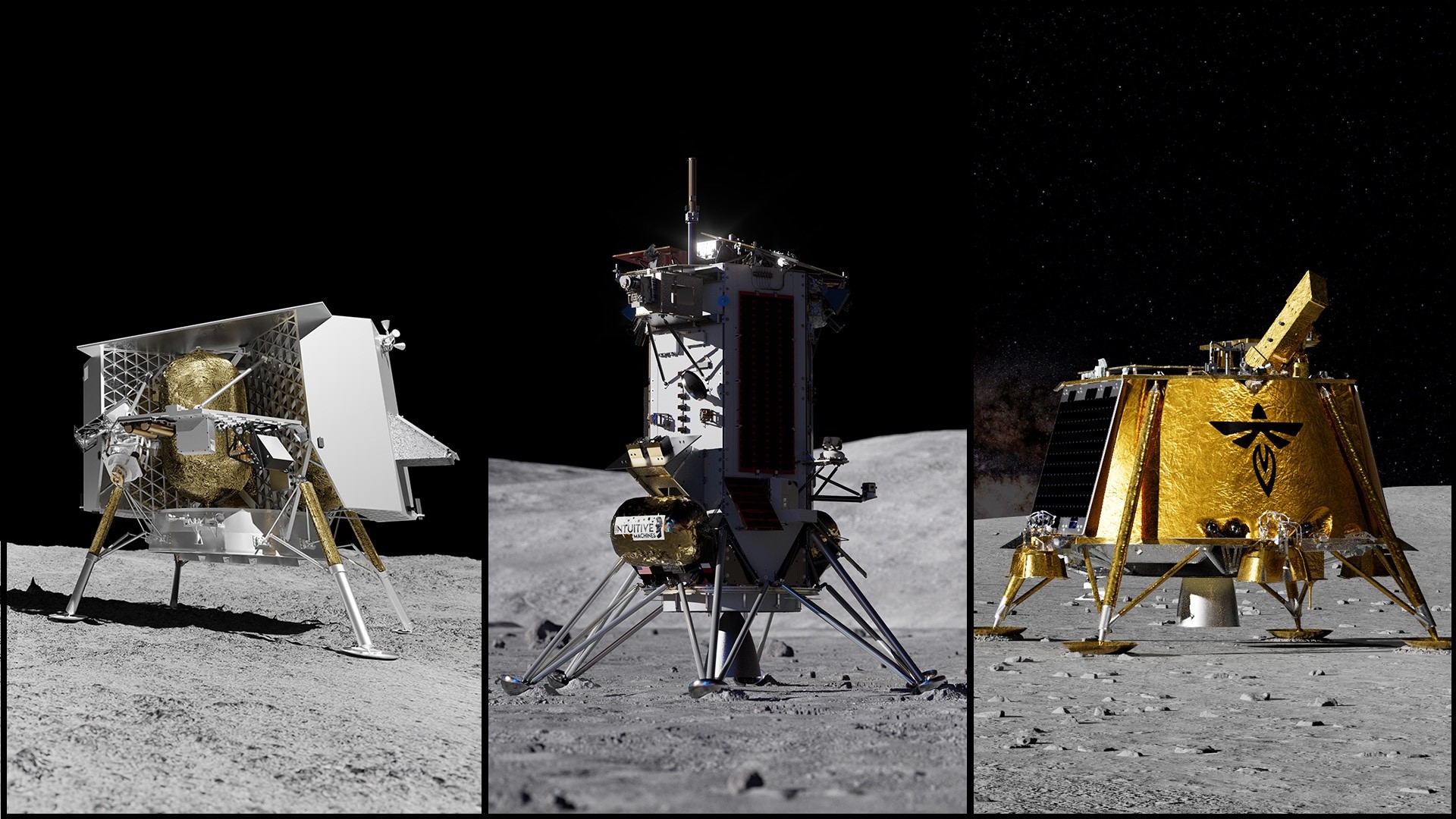
Astrobotic Technology won two flights of its Peregrine lander valued at $297.9 million. Firefly Aerospace received $144.2 million for its Blue Ghost lander. Intuitive Machines secured $148.3 million for its Nova-C lander — split into a $68.6 million base award and a $79.7 million performance incentive for demonstrating "a steady, rapid-turnaround supply of landers."
Each lander will carry an identical trio of payloads: the SCALPSS cameras to study engine plume effects on lunar soil, the LETS spectrometer to measure radiation, and a laser retroreflector array for rangefinding. "By flying the same science instruments on multiple landers, we will better understand potential hazards during landing and build out a global network of environmental data and location markers on the moon," said Joel Kearns, deputy associate administrator for exploration in NASA's Science Mission Directorate.
A Mars Rover for the Moon
The most intriguing reveal was PROMISE — the Polar Rover for Observation, Mapping, and In-Situ Exploration — an engineering model of the Curiosity and Perseverance Mars rovers currently housed at the Jet Propulsion Laboratory.
"We are thinking very hard right now about sending PROMISE to the moon," said NASA Administrator Jared Isaacman, describing it as part of an effort to "raid the pantry" for hardware that could fly on lunar missions.
PROMISE's key advantage is its nuclear power source — a radioisotope thermoelectric generator — which means it would not be constrained by solar power, unlike the VIPER rover scheduled to launch in 2027. It could survive the two-week lunar night and enter permanently shadowed regions. However, the limited supply of RTG units could create tensions with other NASA science missions, including a potential Uranus orbiter.
Blue Origin Still Plan A
Despite the May 28 explosion of Blue Origin's New Glenn rocket on its launch pad, NASA said the agency is sticking with the vehicle to launch the Blue Moon Mark 1 lander. "Plan A is very much still to launch the Mark Ones on New Glenn, and we have time," Isaacman said. "Plan A is looking a lot better today than it was weeks ago."
Garcia-Galan added that NASA could wait until mid-2027 before considering alternative launch options. Blue Origin reaffirmed its commitment to repair Launch Complex 36 and return to flight by the end of the year.