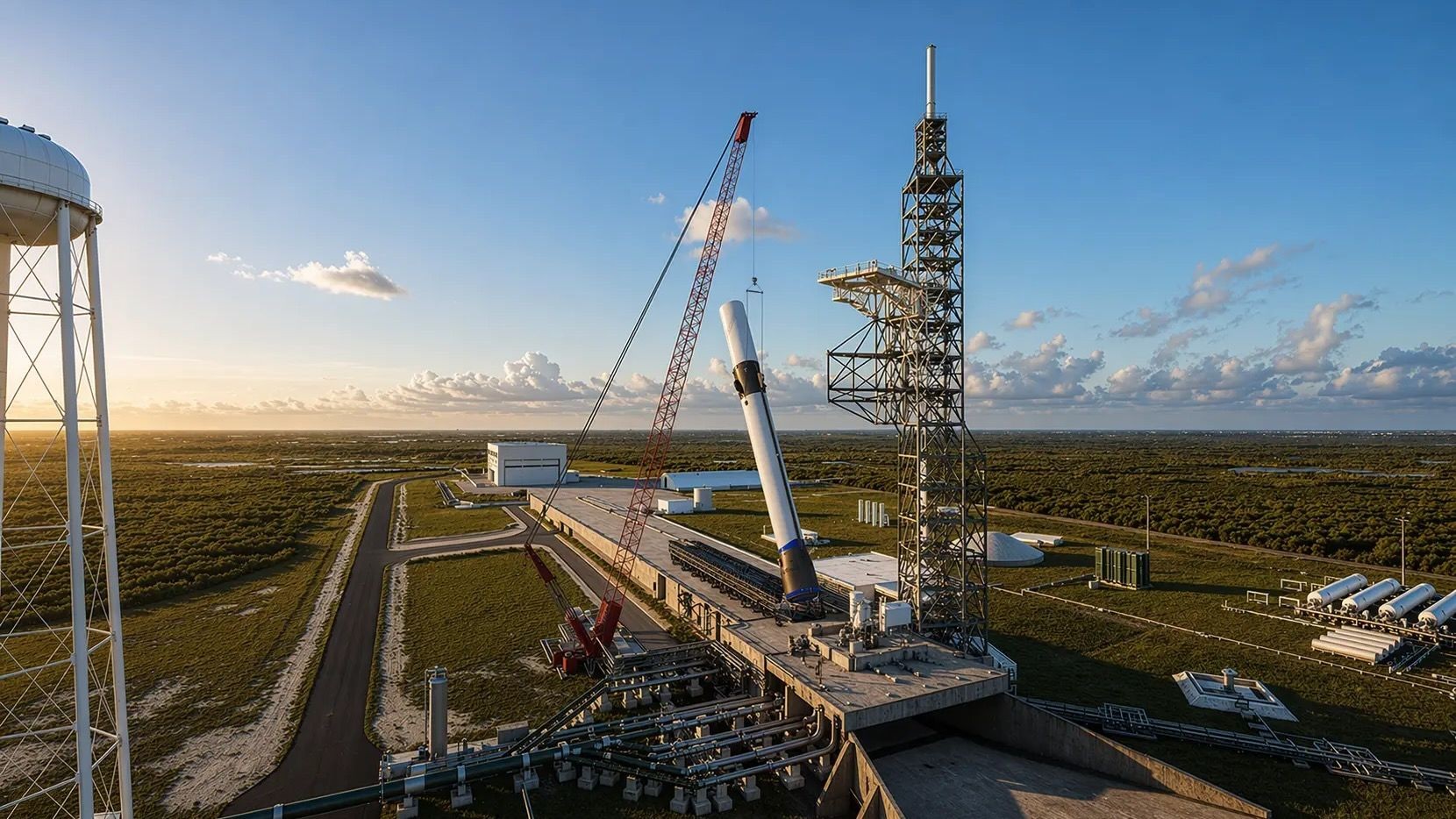
Blue Origin Begins Rebuilding Explosion-Damaged New Glenn Launch Pad — With a Completely Different Design
Blue Origin has started reconstructing the launch pad destroyed by last month's New Glenn rocket explosion, but the company is working from a fundamentally different blueprint this time around.
The company's 320-foot-tall New Glenn rocket exploded on May 28 during a routine static-fire test at Launch Complex 36A at Cape Canaveral Space Force Station in Florida. The rocket was destroyed along with critical pad infrastructure, including the lightning tower and the transporter-erector — the machine that hauled New Glenn from its integration facility to the pad and raised it vertical.
"We're moving to a horizontal/vertical hybrid configuration to get us flying again this year," CEO Dave Limp said in a June 30 statement. Under the new concept of operations, the two stages are mated horizontally inside the integration facility, then the fully integrated vehicle is rolled to the pad. A crane performs the vertical breakover, and the payload is attached after New Glenn stands upright.
This approach was originally developed for the super-heavy 9X4 version of New Glenn — featuring nine BE-4 engines on the first stage — and is now being applied to the current 7X2 variant ahead of schedule. Limp noted the hybrid method "has the added benefit of increasing our flight cadence."
Investigation Points to Aft Section
On the anomaly investigation, Limp said the vehicle was "highly instrumented with extensive data from multiple camera angles and sensors," giving the team confidence in identifying the root cause. "Early analysis points to the aft section of the first stage."
The company reaffirmed its target of returning New Glenn to flight before the end of the year. NASA, which relies on New Glenn to launch its Blue Moon lunar lander, appears willing to wait. Carlos Garcia-Galan, NASA's Moon Base program executive, said the agency could wait until mid-2027 before considering alternative launch options.
What's at Stake
LC-36A is New Glenn's only operational launch pad. Its reconstruction timeline directly affects Blue Origin's return to the commercial launch market and NASA's lunar ambitions. The decision to adopt a crane-based design rather than rebuild the transporter-erector suggests the company sees the accident as an opportunity to leapfrog to a more efficient, higher-cadence architecture that was already in its long-term plans.
Further Reading
Blue Origin starts rebuilding launch pad damaged by New Glenn rocket explosion