Tianwen-2 Arrives at Asteroid 2016HO3 as China's Deep Space Ambitions Take Shape
After a 400-day journey spanning roughly one billion kilometers, China's Tianwen-2 probe successfully rendezvoused with asteroid 2016HO3 on July 2, reaching a distance of about 20 kilometers from the surface. The China National Space Administration (CNSA) confirmed the milestone on July 6.
The target, 2016HO3 — also known as Kamo'oalewa — is a near-Earth asteroid roughly 40 to 100 meters across. It follows an orbit around the Sun that keeps it in the vicinity of Earth, earning it the label of a "quasi-satellite" or "quasi-moon." Discovered in 2016 by astronomers using the Pan-STARRS telescope at the University of Hawaii, the asteroid has intrigued scientists: some models suggest it may be a fragment of the Moon, blasted into space by an impact within the last 10 million years.
Tianwen-2 is China's first asteroid sampling mission and the second in its Planetary Exploration series, following the Tianwen-1 Mars mission. Launched on May 29, 2025, from the Xichang Satellite Launch Center aboard a Long March rocket, the spacecraft performed deep-space maneuvers and course corrections before beginning its approach sequence in early June 2026.
Key milestones in the approach: Tianwen-2 first acquired the asteroid optically on June 6. On June 7, it executed a capture burn at roughly 30,000 kilometers to match the asteroid's orbit. By June 19, it had closed to within 2,000 kilometers. The final approach placed the spacecraft in a 20-kilometer observational orbit by July 2.
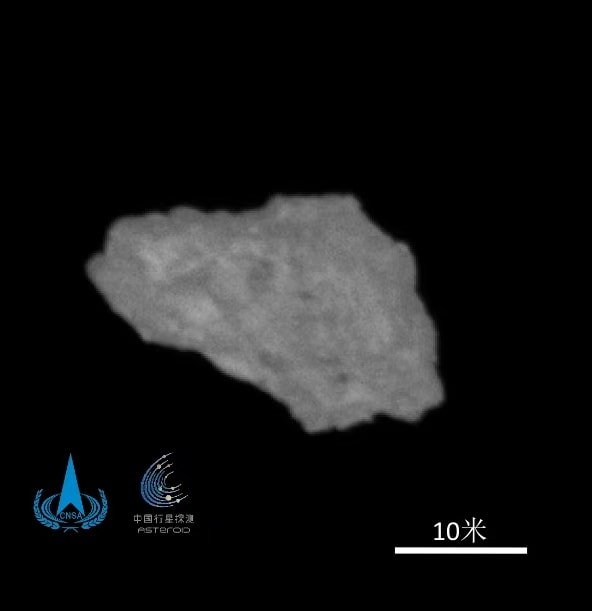
During the approach, the probe captured images of the asteroid and used onboard optical navigation data to refine the asteroid's ephemeris, reducing positional uncertainty from hundreds of kilometers to just a few kilometers. That improvement is critical for the precision maneuvers required during sample collection.
The spacecraft will spend the coming months mapping the asteroid with cameras, LiDAR, and sounding radar to identify sampling sites. The mission aims to collect at least 100 grams of surface material using multiple techniques — including touch-and-go, anchor-and-attach, and a hover-based robotic arm — to maximize the chance of success regardless of surface conditions. The sample capsule is expected to return to Earth by late 2027.
After delivering the sample capsule during an Earth flyby, the spacecraft will use a gravitational slingshot to head deeper into the Solar System. Its second target is 311P, a main-belt comet it is expected to reach after an eight-year cruise, extending the mission's total duration to roughly a decade.
If successful, Tianwen-2 will make China only the fourth entity — after JAXA's Hayabusa missions and NASA's OSIRIS-REx — to bring asteroid samples back to Earth.