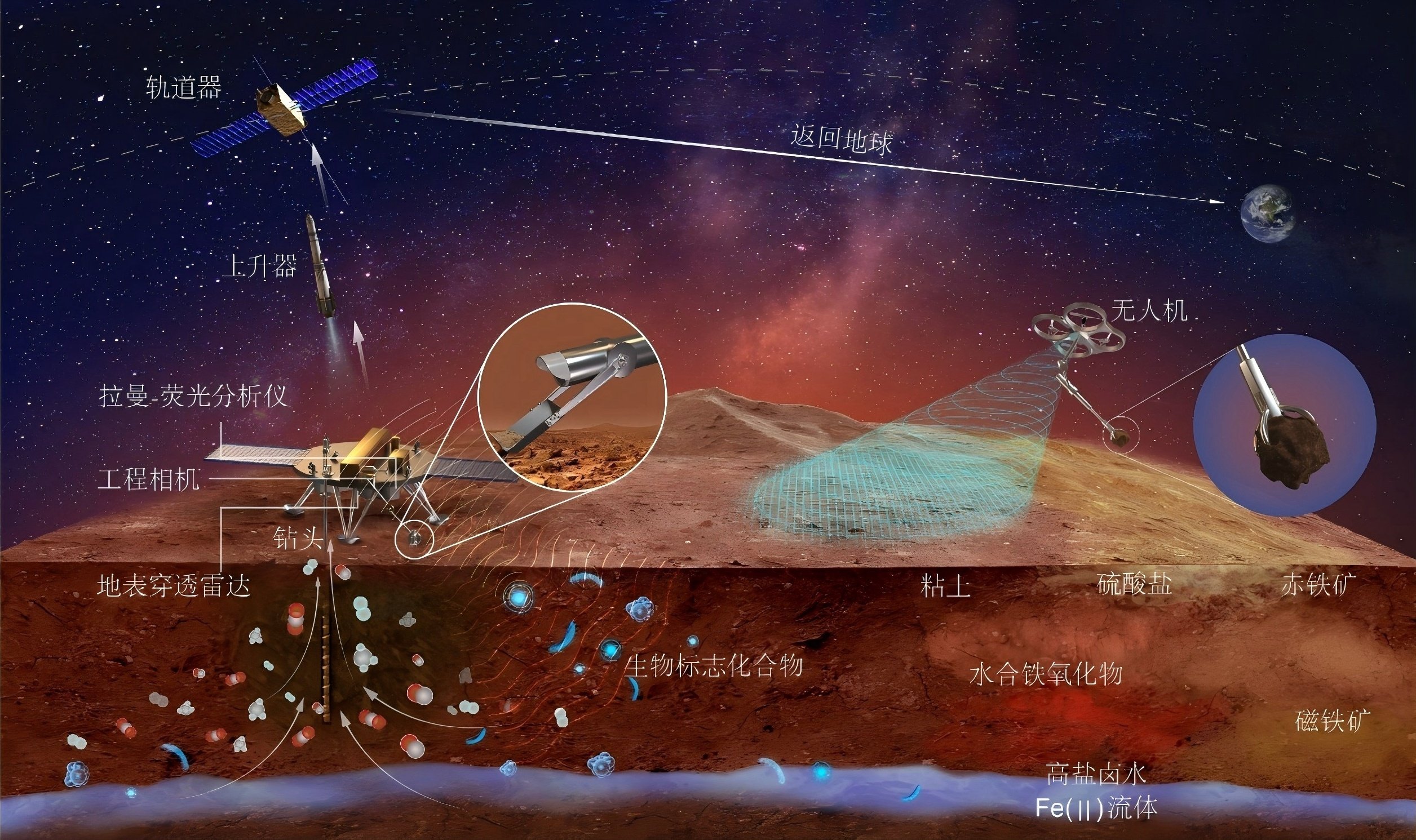
As China’s first Mars sample-return mission, Tianwen-3 is shaping a new blueprint for the country’s deep space exploration with a series of innovative designs, among which the deployment of a specialized Mars drone stands out as a key highlight. Set to replace traditional Mars rovers, this drone will serve as an important sampling assistant for Tianwen-3 on the Martian surface. Complementing surface scooping and 2-meter deep drilling technologies, it will lay a solid technical foundation for bringing back no less than 500 grams of Martian samples by 2031, propelling humanity’s Mars sampling exploration into a more flexible and diverse new phase.
Hou Zengqian, academician of the Chinese Academy of Sciences and chief scientist of the Tianwen-3 mission, revealed this design concept for the first time in a systematic manner: Tianwen-3 will forgo a Mars rover configuration and instead carry a specialized drone to conduct sample collection on the Martian surface. Capable of reaching areas within hundreds of meters of the landing site to complete sampling, the drone perfectly addresses the limitations of traditional rovers in terrain adaptability and operational range. It can even access special terrains such as canyons and cliffs that are inaccessible to rovers, acquiring samples of higher scientific value. Compared with NASA’s Perseverance rover, which only conducts shallow surface sampling, Tianwen-3’s drone-based sampling model has achieved a qualitative leap in the spatial scope and topographic coverage of Mars sampling, hailed by the international aerospace community as "opening a new dimension for Mars sample collection".
The addition of the specialized drone is a crucial component of Tianwen-3’s three-pronged sampling technology system. To ensure the diversity and scientific value of the samples, the engineering team of Tianwen-3 has designed an integrated sampling solution combining surface scooping, 2-meter deep drilling, and drone-assisted collection, with the drone undertaking the core function of a mobile sampling point. It will cooperate with the lander to collect samples of different types from various regions, echoing Tianwen-3’s world-first 2-meter deep drilling technology — the former enabling horizontal spatial expansion of sampling, and the latter achieving vertical deep sample excavation. Together, they form an all-round, multi-dimensional Mars sampling network, ensuring the returned samples not only reflect the environmental characteristics of the Martian surface but also reach ancient geological layers dating back 4 billion years, providing more comprehensive physical evidence for the search for traces of life on Mars.
This design choice also stems from Tianwen-3’s precise consideration of mission efficiency and engineering feasibility. Scheduled for implementation via two launches around 2028, the entire Tianwen-3 mission will span more than three years, involving approximately one year of exploration and sampling on the Martian surface, and ultimately achieving the integrated completion of "sampling and return". This places extremely high demands on the lightweight design and flexibility of the equipment. Compared with Mars rovers, the specialized drone boasts advantages such as a smaller size, lower energy consumption, and greater operational flexibility, making it more compatible with the mission rhythm of Tianwen-3. It can efficiently complete multi-region sampling within the limited mission time while reducing engineering risks posed by the complex terrain on the Martian surface.
The design of the drone sampling segment is also deeply integrated with Tianwen-3’s stringent planetary protection requirements. The mission will strictly abide by the planetary protection policies of the Committee on Space Research (COSPAR). During sampling, the drone will implement strict anti-contamination norms to prevent Earth’s organisms from polluting the Martian environment and ensure the collected Martian samples are free from external interference. The collected samples will be quickly sealed and then transferred to the lander, entering a full-process fidelity chain from the Martian surface to Earth-based laboratories. Eventually, they will undergo sterilization, analysis and other procedures in a newly built high-security Mars sample laboratory in China, ensuring the authenticity and reliability of scientific research results.
The research, development and application of Tianwen-3’s specialized Mars drone not only represent an innovative breakthrough in China’s Mars exploration technology but also provide a new technical approach for humanity’s Mars exploration. Working in synergy with other detection equipment of Tianwen-3, the drone will assist scientists in searching for samples with the greatest potential for traces of life within the candidate landing areas between 17° and 30° North Latitude on Mars. With the selection of the three final candidate landing sites for Tianwen-3 by the end of 2026, the specialized drone will also have more clear detection objectives, gathering key clues from Mars to solve the ultimate mystery of "whether life ever existed on Mars".
Currently, the research and development of various key technologies for Tianwen-3 are in full swing, and the relevant tests of the specialized drone are progressing steadily. This drone, entrusted with a special mission, will head to Mars with Tianwen-3, leaving the marks of China’s exploration on the Martian surface with its flexible flight path and bringing humanity one step closer to unlocking the mysteries of Mars. Moreover, Tianwen-3’s concept of fully open cooperation means the detection results of this drone will be shared with scientists worldwide in the future, becoming an important asset for humanity’s joint exploration of the universe.