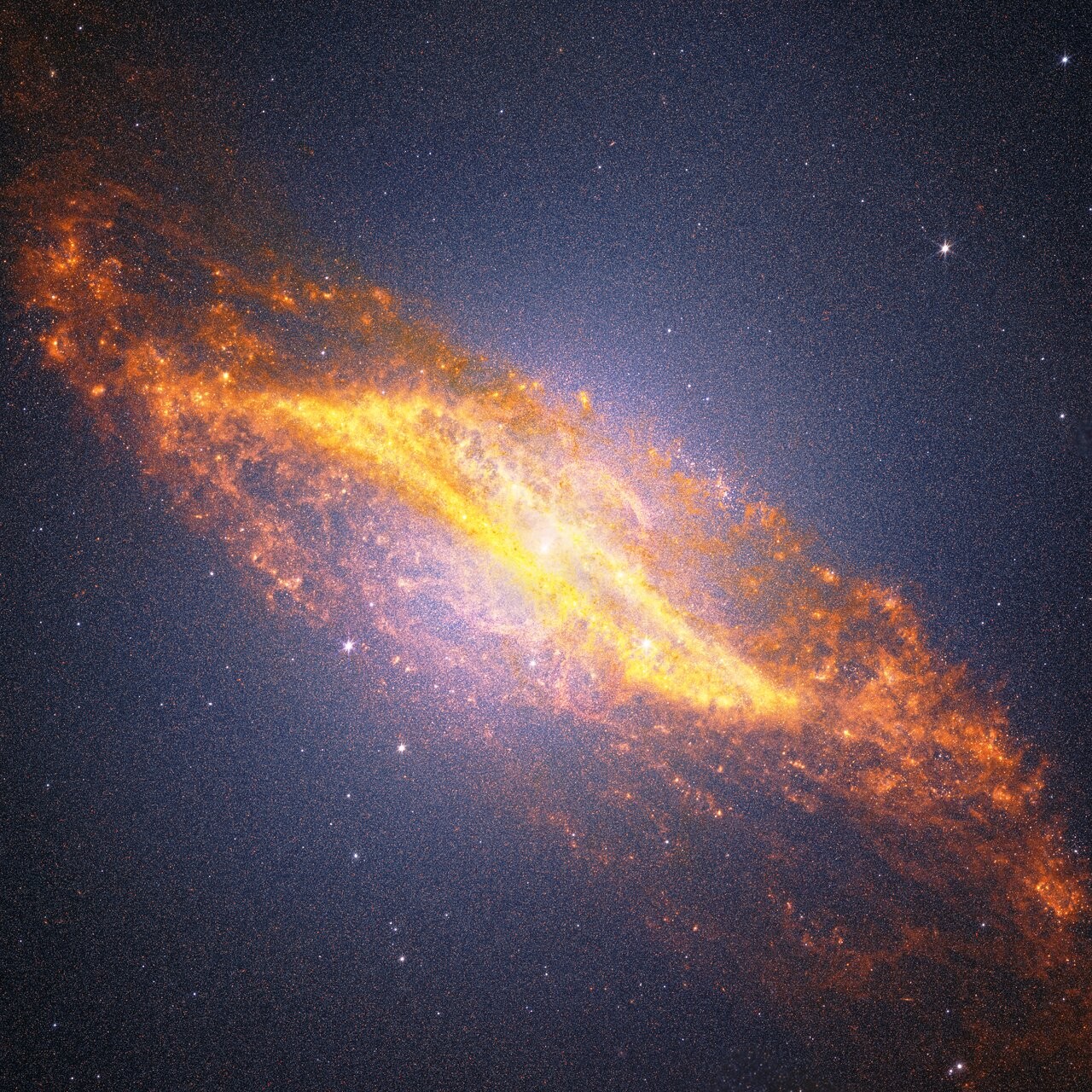
To celebrate its fourth year of science operations, the James Webb Space Telescope has turned its gaze to Centaurus A — and the result is the sharpest, most detailed view of this chaotic galaxy ever captured. By combining the near-infrared NIRCam and mid-infrared MIRI instruments, Webb pierced through the thick dust shrouding the galaxy's core for the first time, resolving what appeared as a grainy glow into millions of individually distinguishable stars.
Centaurus A sits roughly 11 million light-years from Earth — a near neighbor in cosmic terms — but it is anything but ordinary. A violent merger with another galaxy roughly two billion years ago left it with twisted dust lanes and ongoing bursts of star formation. At its center lurks an active supermassive black hole, spewing powerful jets and radiation that shape the entire galaxy's structure.
Webb's mid-infrared view reveals unexpected detail: a parallelogram-shaped dust lane cutting across the galaxy's core, with an S-shaped wisp of warm dust suspended above. Many of the glowing reddish dots are star-forming nurseries, along with the remnants of aging stars that have shed their outer layers — enriching the interstellar medium with the raw material for the next generation of stars and planets.
"No single telescope can tell the full story," said Shawn Domagal-Goldman, acting director of NASA's Astrophysics Division. "Webb has opened a window that was previously inaccessible, giving astronomers the ability to study structures and processes that other telescopes simply cannot see."
Before Webb, Hubble's visible-light observations were blocked by dust, while the retired Spitzer Space Telescope detected infrared structures but couldn't resolve individual stars. Webb combines both high sensitivity and high resolution — turning Centaurus A from a blurry smudge into a cosmic history book, where each star tells part of the story of a galaxy born from collision and still being reborn today.