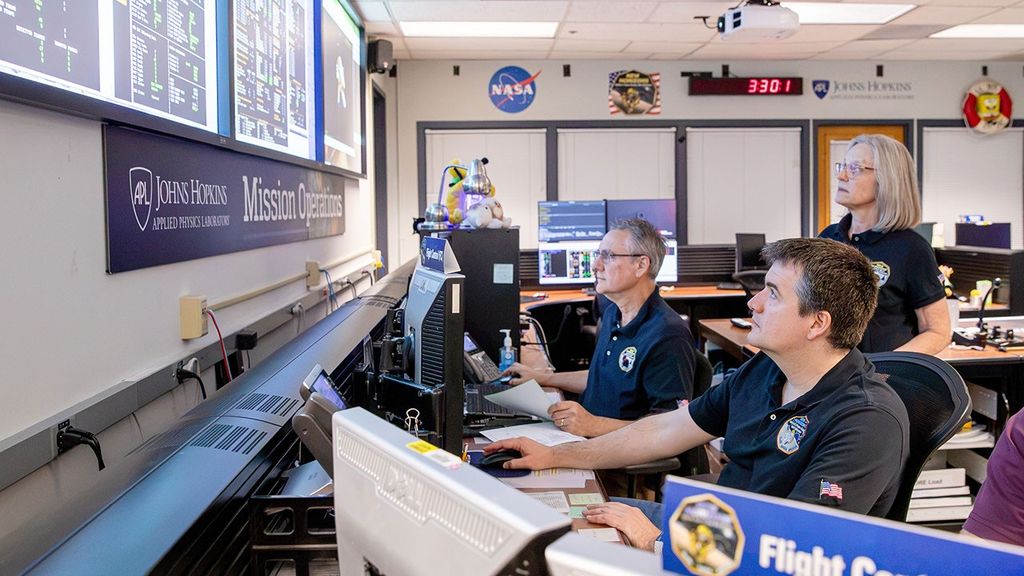
Following its longest hibernation period ever of 321 days, NASA's New Horizons spacecraft has emerged in good health and is ready to begin transmitting science data gathered in the distant Kuiper Belt.
On June 23, flight controllers at the Johns Hopkins Applied Physics Laboratory (APL) in Laurel, Maryland, confirmed the spacecraft had safely awakened. Now approximately 5.9 billion miles (9.5 billion kilometers) from Earth, the radio signals carrying that confirmation took about 8 hours and 52 minutes to reach the mission operations center via NASA's Deep Space Network.
During hibernation, the spacecraft continued gathering and storing data from its heliospheric plasma sensors, energetic particle spectrometer, and the Venetia Burney Student Dust Counter. Alice Bowman, mission operations manager at APL, said every weekly status beacon through the hibernation period was "green."
As New Horizons resumes active operations, the team will begin downlinking health data followed by the scientific measurements. In about three weeks, the Alice ultraviolet spectrograph will examine hydrogen distribution in the outer heliosphere.
Launched in January 2006, New Horizons completed the first exploration of the Pluto system in July 2015, flew by Kuiper Belt object Arrokoth in January 2019, and has since been conducting unique studies of the Sun's outer heliosphere and dozens of additional Kuiper Belt objects.