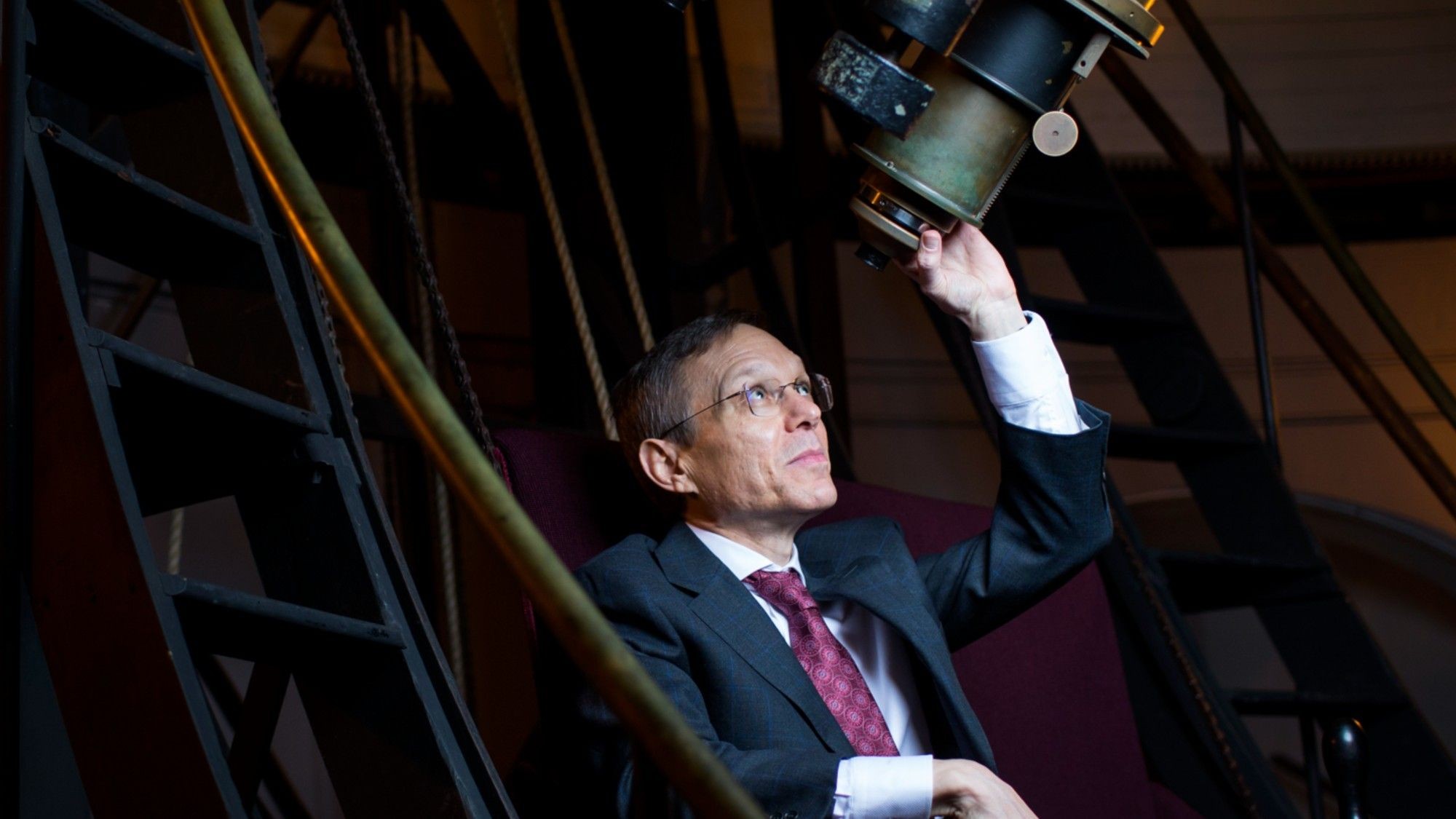
White House Appoints Harvard Astronomer Avi Loeb to Lead New UFO Study Group
The White House on July 11 appointed Harvard astrophysicist Avi Loeb as chair of the newly formed UAP Science Advisory Council. UAP, or Unidentified Anomalous Phenomena, is the modern term for what were once called UFOs, covering sightings not only in the air but also in space or underwater.
The council was established jointly by the White House, the Pentagon's All-Domain Anomaly Resolution Office (AARO), the Office of the Director of National Intelligence, the FBI, and other intelligence community members. Loeb said the group's focus is on evidence, instrumentation, data analysis, and collection standards — applying scientific rigor to a topic that has long been treated as fringe.
Loeb also co-founded and leads the Galileo Project, an initiative that aims to bring the search for extraterrestrial technological signatures "from accidental or anecdotal observations and legends to the mainstream of transparent, validated and systematic scientific research."
The council he assembled draws from a wide range of disciplines. Members include Liberty Capito, a professor of data science at Washington University in St. Louis; Carol Cleland, a philosophy professor at the University of Colorado Boulder; Richard Cloete, a computer scientist at Harvard; Omer Eldadi from the psychology department at Reichman University in Israel; retired Navy rear admiral and oceanographer Tim Gallaudet; Garry Nolan, a pathology professor at Stanford; Michael Shermer, founder of Skeptic magazine; cultural anthropologist Peter Skafish; and physicists Kevin Knuth and Matthew Szydagis from the University at Albany.
Devesh Nandal, a postdoctoral fellow at the Harvard-Smithsonian Center for Astrophysics and a council member, said the group is "focused on a data-driven and physics-based approach on the topic of UAP." He added: "We approach this topic with the same rigor we apply in our respective scientific fields and we hope to provide an unbiased analysis."
Capito described the council as "a blueprint for re-establishing the public's trust in science by having people with vastly different views, beliefs and science on it."
Not everyone is convinced the council will make a difference. Mark Rodeghier, president of the J. Allen Hynek Center for UFO Studies, said the key issue is not the credentials of the members but the structure they work within. "If the Council lacks a clear mandate, access to relevant data, a collaborative relationship with those actually grappling with the UAP problem in the government, and then a path for public reporting, its practical value may be quite limited," he told Space.com.
Robert Powell, an executive board member of the Scientific Coalition for UAP Studies, said he is adopting a "wait and see" attitude and suggested the council should push Congress to fund UAP research through the National Science Foundation.