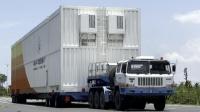
Long March 5 Y14 Arrives at Wenchang, Chang'e-7 Mission Enters Launch Countdown
The Long March 5 Y14 launch vehicle, designated for the Chang'e-7 lunar mission, arrived safely at the Wenchang Spacecraft Launch Site in Hainan on July 13, 2026 (Beijing time). The rocket will now undergo assembly and testing alongside the Chang'e-7 spacecraft, which had been delivered to the site in April via combined air and ground transport. Launch is expected in the second half of this year.
This will be another lunar exploration mission for the Long March 5, China's heavy-lift liquid-fueled launch vehicle developed by the China Aerospace Science and Technology Corporation. Previous Long March 5 launches successfully sent the Tianwen-1 Mars orbiter and rover, the Chang'e-5 near-side and Chang'e-6 far-side sample return missions, and the core module and laboratory modules of China's Tiangong space station.
Destination: The Lunar South Pole
Chang'e-7 is the centerpiece of the fourth phase of China's lunar exploration program, joining Chang'e-6 (far-side sample return, 2024) and Chang'e-8 (planned for around 2028). Its destination sets it apart from all previous Chang'e missions: the lunar south pole, a region that remains largely unexplored by robotic spacecraft.
The permanently shadowed craters at the lunar south pole are among the coldest places in the Solar System, with temperatures reaching as low as minus 233 degrees Celsius. Scientists believe water ice may have been preserved in these dark environments for billions of years. Chang'e-7's core scientific objective is to directly detect and characterize water ice in these regions.
China's lunar exploration program chief designer Wu Weiren has stated that some deep craters at the south pole may contain water ice that has never been exposed to sunlight. The mission aims to send a hopping probe into these craters for in-situ investigation.
Water ice on the Moon would be a game-changer for sustained lunar exploration. It could provide drinking water and breathable oxygen for future lunar bases, and be split into hydrogen and oxygen for rocket propellant, dramatically reducing the cost of shipping supplies from Earth.
Four Spacecraft in One Mission
Chang'e-7 comprises four major elements: an orbiter, a lander, a rover, and a hopping probe, carrying 18 scientific payloads in total. Communications are supported by the Queqiao-2 relay satellite already in lunar orbit.
The orbiter is equipped with a high-resolution stereo-mapping camera, a miniature synthetic aperture radar, a wide-band infrared mineral imaging spectrometer, and a neutron-gamma spectrometer, among other instruments. International payloads on the orbiter include an imaging spectrometer developed with Egypt and Bahrain, a Moon-based Earth radiation spectrometer involving Switzerland, and a space weather detector from Thailand.
The lander carries a lunar seismometer, a surface environment monitoring system, and international instruments including a laser corner reflector from Italy, a dust and electric field sensor from Russia, and a wide-field telescope from the International Lunar Observatory Association in Hawaii.
The rover, based on the Yutu rover design from previous missions, is equipped with a panoramic camera, magnetometer, Raman spectrometer, and lunar-penetrating radar to analyze surface and subsurface materials.
The most innovative element is the hopping probe -- a legged mini-flying vehicle carrying a water molecule analyzer. It is designed to take off from a sunlit area, fly into a permanently shadowed crater, land on steep and uneven terrain using its leg mechanism, drill for samples, and analyze them via mass spectrometry for water ice, methane, and other volatiles. After completing its work, the hopper must fly back to sunlight to recharge. It is designed for at least three flights, each covering more than 10 kilometers.
This would make the hopper the second spacecraft after NASA's Ingenuity Mars helicopter to achieve repeated flights on another celestial body, and the first mobile legged spacecraft to conduct extraterrestrial exploration.
Precision Landing: Two Orders of Magnitude Better
The lunar south pole presents formidable challenges: rugged terrain, abundant craters, extremely low solar elevation angles, and harsh temperature swings from minus 173 degrees Celsius in shadow to plus 17 degrees in sunlight.
The preferred landing site is the rim of Shackleton crater, which offers both prolonged sunlight for solar power and proximity to permanently shadowed regions.
Chang'e-7 requires a landing accuracy of better than 100 meters -- roughly two orders of magnitude improvement over previous Chinese lunar landers. To achieve this, the lander incorporates landmark image navigation, a first for Chinese deep space exploration. This high-precision capability is critical not only for mission success but also as a technology demonstration for future Chang'e-8 and crewed lunar missions.
International Collaboration and Long-term Plans
Chang'e-7 carries a substantial international payload manifest involving partners from Egypt, Bahrain, Switzerland, Thailand, Italy, Russia, and Hawaii.
Following Chang'e-7, the Chang'e-8 mission is planned for around 2028. The two spacecraft will land in relatively close proximity near the lunar south pole, where they will communicate and cooperate to form the basic configuration of the International Lunar Research Station (ILRS). The station is envisioned as a long-term platform for scientific research, resource utilization, and technology validation.
All systems at the Wenchang launch site are currently proceeding with pre-launch preparations. The arrival of the Long March 5 Y14 rocket marks the transition of the Chang'e-7 mission into the on-site implementation phase at the launch center.
Further Reading
Source: https://www.cmse.gov.cn/xwzx/202607/t20260713_57676.html