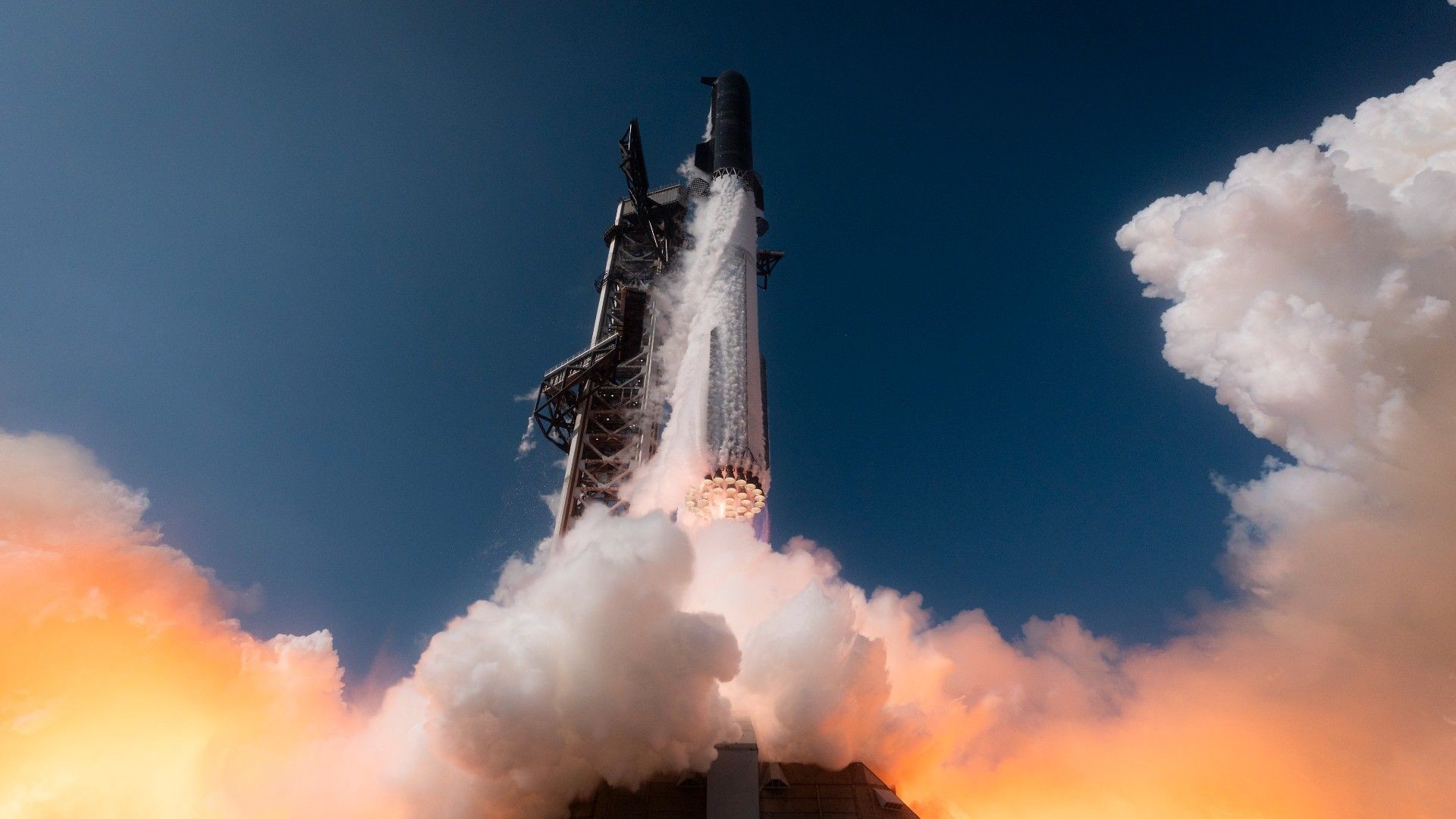
SpaceX Targets July 16 for Starship Flight 13, Reveals What Went Wrong on Flight 12
SpaceX is preparing to launch its Starship vehicle for the 13th time as early as July 16, with a 90-minute launch window opening at 6:45 p.m. EDT (2245 GMT). A livestream will begin approximately 30 minutes before liftoff on SpaceX's mission page, X profile, and Space.com.
This will be the second flight of the Starship "Version 3" (V3) configuration, coming less than two months after its debut on Flight 12. While V3's first flight demonstrated significant progress, it did not accomplish all planned objectives. SpaceX has since identified the root causes of the anomalies and implemented corrective measures.
The primary issue on Flight 12 occurred during stage separation. According to SpaceX's analysis, a sequence change in Ship's engine ignition during hot staging caused Super Heavy to experience a 90-degree orientation error after separation. Additionally, Super Heavy's boostback burn was cut short when five of its 33 engines failed to relight. SpaceX has introduced a modified startup sequence for Ship and hardware upgrades to Super Heavy to address these issues, along with updated engine alarm and abort logic calibrated for the multi-engine flight environment.
Ship itself experienced a fault on Flight 12 when one of its three vacuum-optimized Raptor engines was lost 40 seconds after stage separation. However, the spacecraft still reached its designated suborbital trajectory, demonstrating engine-out capability. The loss did prevent the planned in-space engine relight attempt. SpaceX traced the failure to interconnected causes and has implemented fixes for Flight 13, with additional Raptor reliability improvements planned for future engine versions.
Flight 13's mission objectives include a repeat of Flight 12's goals, with some key upgrades. Super Heavy's primary tasks are a successful launch and separation, a completed boostback burn, and a soft splashdown in the Gulf of Mexico. For Ship, the mission calls for deployment of 20 functional Starlink V3 satellites -- the first time Starship will carry operational Starlink satellites to space. Six of these will be equipped with cameras for heatshield tile inspection. SpaceX also plans to attempt the in-space relight of a Raptor engine, followed by Ship's descent and soft splashdown in the Indian Ocean.
Due to Starship's suborbital trajectory on this flight, all deployed satellites are expected to re-enter and burn up in Earth's atmosphere approximately 20 minutes after deployment, serving primarily for in-orbit functionality testing.
The Federal Aviation Administration (FAA) announced the closure of its Flight 12 mishap investigation on July 13, approving SpaceX's corrective actions and clearing the way for Flight 13.
If Flight 13 proceeds smoothly, it is likely that SpaceX will attempt the first V3 tower catch recovery -- for Super Heavy, Ship, or both -- on Flight 14. However, several technical milestones remain before Starship becomes fully operational, including reaching stable orbit, demonstrating rendezvous and docking, and mastering cryogenic propellant transfer and storage in zero-gravity.
SpaceX hopes to achieve all these milestones within the year. NASA has selected Starship as one of two crewed lunar landers for its Artemis program and expects a crew-capable version to be ready by 2028 for the Artemis IV mission.