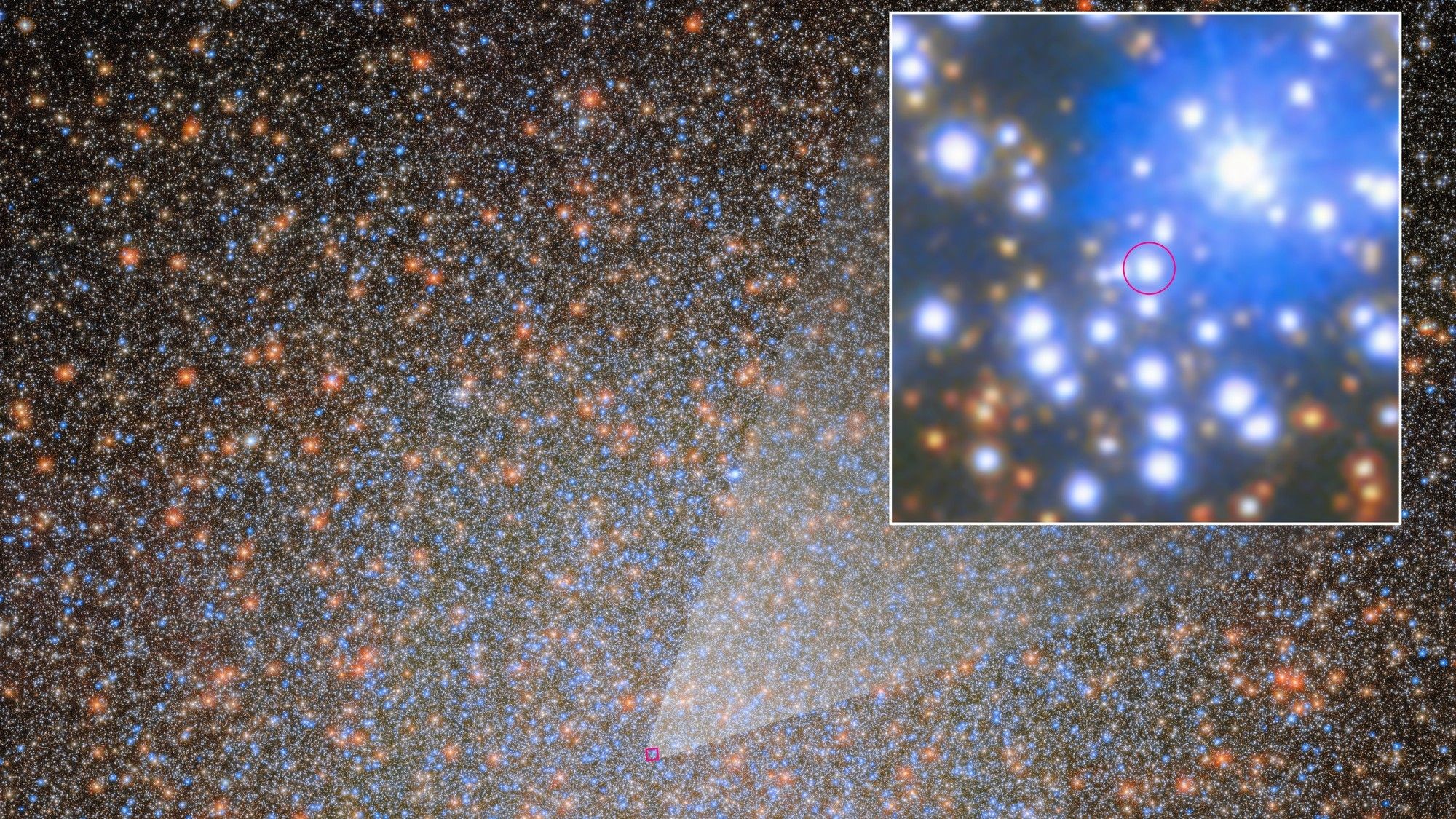
Hubble and Webb Find First 'Missing' Black Hole in Omega Centauri
Astronomers have discovered the first stellar-mass black hole in the Omega Centauri globular cluster, using 20 years of archival data from the Hubble Space Telescope and precise follow-up measurements from the James Webb Space Telescope. The cluster is predicted to harbor about 10,000 such black holes, but none had been directly detected until now.
Designated oMEGACat BH-2, the black hole has a mass of 4.46 times that of the Sun, placing it in a so-called "mass gap" between the upper limit for neutron stars (around 2.5 solar masses) and the typical mass range of stellar-mass black holes. The findings were published July 13 in The Astrophysical Journal Letters.
Led by Matthew Whitaker of the University of Utah in Salt Lake City, the team employed astrometry — the precise measurement of stellar positions — to track the motion of a companion star orbiting the invisible object. The star, with 78% of the Sun's mass, completes a 94-year orbit around the black hole, making this the widest stellar-mass black hole binary system ever found. The researchers identified the black hole by observing the star's accelerated motion during its closest approach.
Omega Centauri is the Milky Way's largest globular cluster, containing approximately 10 million stars some 18,000 light-years from Earth. Astronomers believe it is the stripped core of a dwarf galaxy consumed by the Milky Way. In 2024, Hubble found evidence of an intermediate-mass black hole (about 8,200 solar masses) at the cluster's center, strengthening that hypothesis.
The discovery is notable not only for being the first of its kind in Omega Centauri, but also because oMEGACat BH-2 sits in a mass range rarely observed in gravitational wave detections. This raises questions about how black holes form and evolve in dense stellar environments. The team continues to search for more black holes in the cluster, and NASA's upcoming Nancy Grace Roman Space Telescope is expected to dramatically accelerate the hunt.