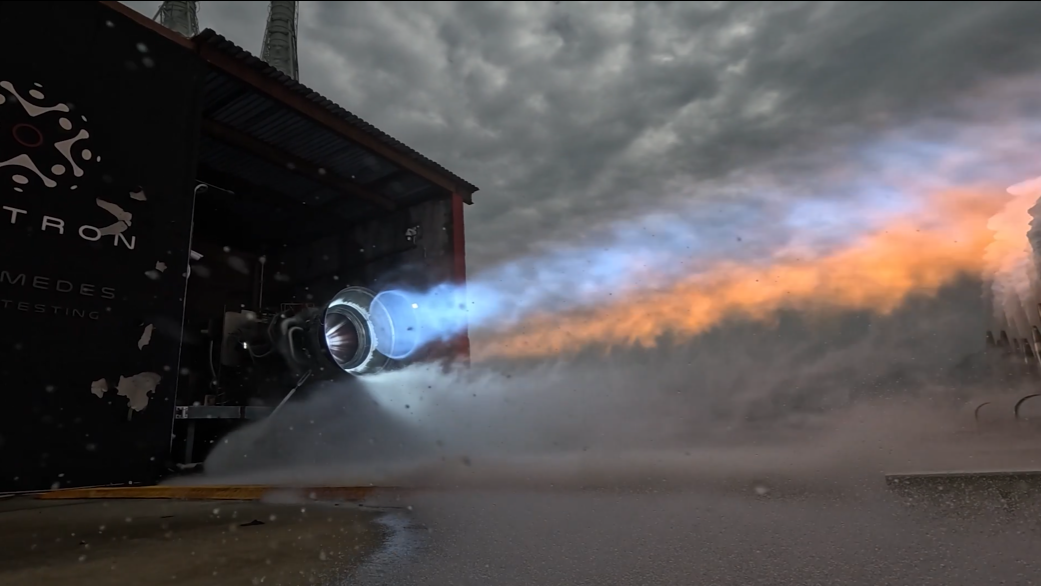
Rocket Lab completes full-duration Archimedes engine test, clearing path for Neutron debut
Rocket Lab has successfully completed a full-duration hot-fire test of its vacuum-optimized Archimedes engine (AVac) at NASA's Stennis Space Center in Mississippi, marking a major milestone for the company's next-generation Neutron launch vehicle.
The test, conducted on July 13, lasted approximately five and a half minutes, simulating flight-like conditions. "What a thing of beauty," the company said in a social media post announcing the success, calling it a "critical preparation for Neutron's first flight." Because the vacuum engine's extended nozzle cannot be tested at full length at sea level, engineers installed a shorter "stub skirt" to compensate, anchoring their analysis for how the engine will perform with the full nozzle in vacuum.
Neutron's first stage is powered by eight Archimedes engines, delivering nearly 1.5 million pounds of thrust at liftoff -- roughly comparable to the Falcon 9's Merlin 1D engines per unit. Like the Falcon 9, Neutron's first stage is designed for reusability, capable of returning to its launch site or landing on an autonomous droneship at sea.
What sets Neutron apart is its unconventional payload fairing design. Instead of traditional fairings that are jettisoned after launch, Neutron's fairing halves open like a clam shell -- a system Rocket Lab has dubbed the "Hungry Hippo." The rocket's second stage emerges from the open jaws to deliver its payload to orbit. Powered by a single vacuum-optimized Archimedes engine with a nozzle bell about 2.5 meters (8 feet) taller than the first-stage engines, the AVac produces 1.2 times the thrust of its sea-level counterpart in vacuum conditions.
Rocket Lab continues to fly regular missions with its workhorse Electron rocket while pushing Neutron toward its debut. The rocket was originally targeted for late 2025 but was pushed to the first half of 2026, and suffered a setback in January when a main stage tank ruptured during a pressure test at the company's Wallops, Virginia launch facility. Despite the delays, founder and CEO Peter Beck has consistently stated that the team is focused on reaching orbit when the vehicle is ready, not on meeting an arbitrary deadline.
Further reading Original article: Space.com - Watch Archimedes burn! Rocket Lab fires up engine for its powerful next-gen Neutron launcher