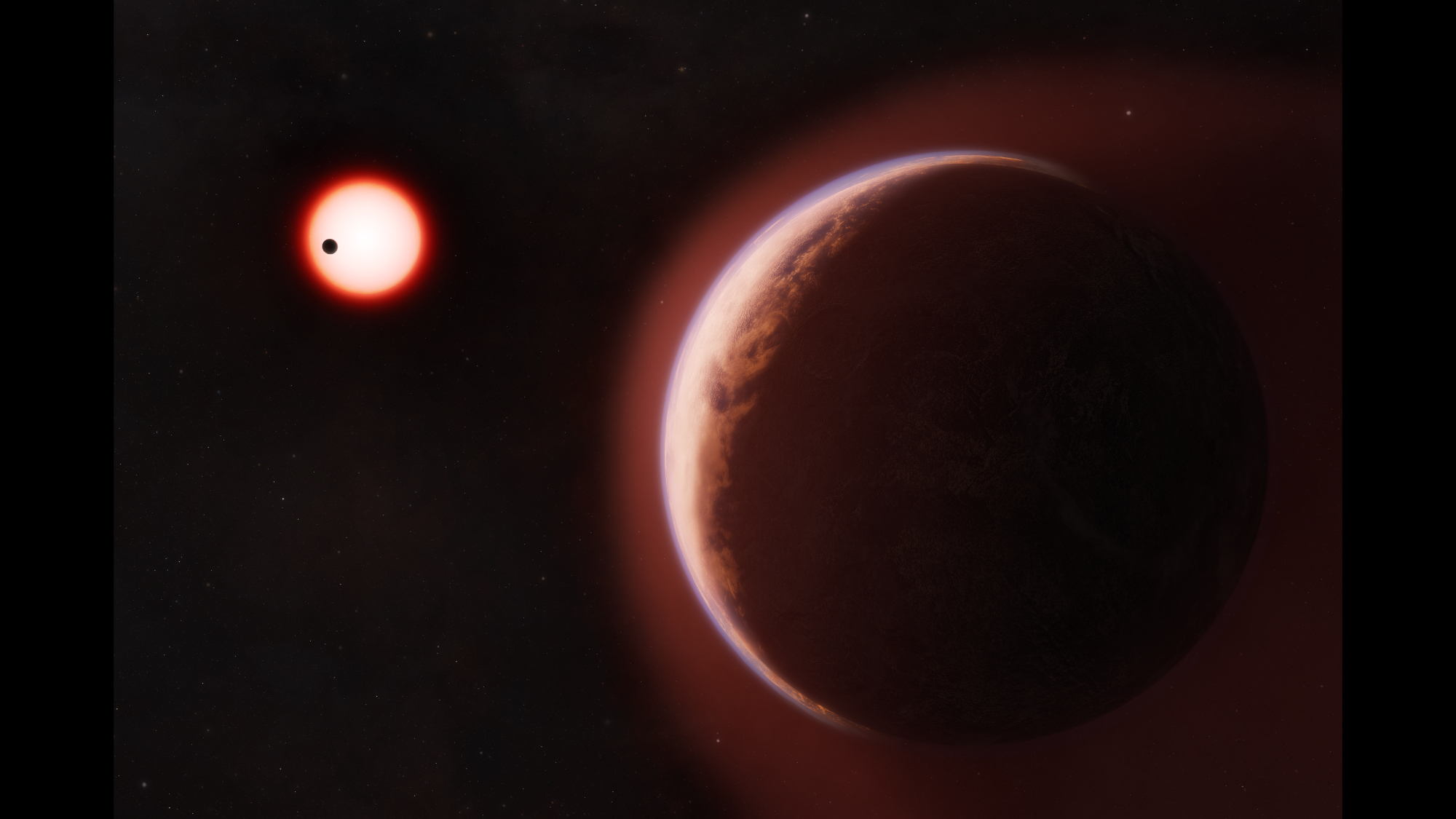
Astronomers Detect First Atmosphere on Rocky Exoplanet in Habitable Zone
Astronomers have directly detected an atmosphere around LHS 1140 b, a rocky Earth-like exoplanet located 48 light-years away, marking the first time an atmosphere has been confirmed on a rocky planet orbiting within its star's habitable zone. The findings were published in the journal Science.
LHS 1140 b, first discovered in 2017, orbits a red dwarf star roughly one-third the size of the Sun. Unlike many exoplanets discovered to date, this one checks three critical boxes: it is rocky (with an iron core and solid surface), it lies within the habitable zone (where liquid water could potentially exist), and it now has a confirmed atmosphere containing helium.
The detection was made using the WINERED spectrograph on the Magellan Observatory in Chile. As the planet transited across its star, the team identified the clear spectral signature of helium in its atmosphere. "We have actually detected directly the helium present in the atmosphere itself, and that's the first direct detection for any rocky exoplanet," said lead author Collin Cherubim, who recently earned his Ph.D. from Harvard University.
Red dwarf stars are known for their intense radiation activity, which typically strips atmospheres from orbiting planets. This has long led astronomers to question whether any rocky planet around such a star could retain an atmosphere. LHS 1140 b provides a definitive answer: yes, at least under the right conditions.
"This discovery is a big deal because it's showing that at least this rocky planet has retained an atmosphere over billions of years," Cherubim said. The planet's star is roughly 6 billion years old, meaning its most active radiation phase has passed, allowing the atmosphere to survive.
The researchers believe LHS 1140 b likely has abundant water on its surface. With its atmosphere providing some greenhouse effect, surface conditions could be suitable for liquid water, a key ingredient for life as we know it. However, the team stopped short of making any claims about habitability or life. "I'm not claiming this planet has life," Cherubim made clear.
The study represents a rare full-circle moment in the scientific method. Cherubim developed a theoretical planetary evolution model during his Ph.D. that predicted LHS 1140 b should have an atmosphere. He then designed and executed the observations to test his own prediction. "I made this measurement that was actually consistent with my prediction, and it was really nice to kind of close the whole loop of the scientific method," he said.
Further observations could help identify what other gases might be present in the planet's atmosphere and confirm whether water exists, pushing the search for life beyond Earth one step closer.
Further Reading
Original article: https://www.space.com/astronomy/exoplanets/astronomers-discover-1st-atmosphere-around-a-rocky-earth-like-planet-in-the-habitable-zone