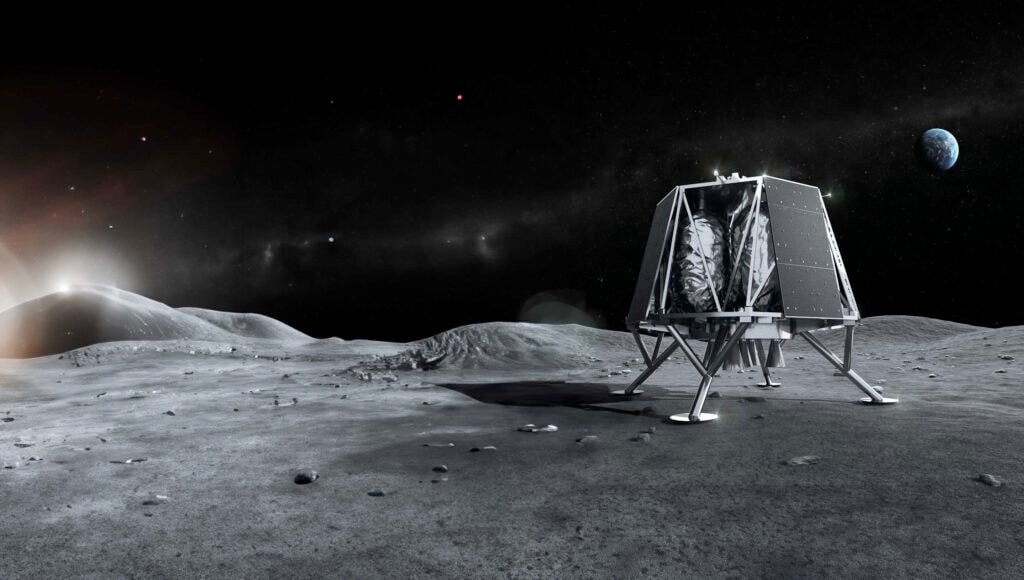
NASA and Draper have mutually agreed to terminate a $73 million lunar lander mission task order, citing significant delays caused by repeated redesigns of the spacecraft that pushed the projected landing date to 2030 or 2031.
The task order, designated CP-12, was awarded to Draper in July 2022 under NASA's Commercial Lunar Payload Services (CLPS) program. Japanese lunar lander developer ispace revealed that its U.S. subsidiary, ispace-U.S., served as Draper's subcontractor to provide the lander. With the termination of the prime contract, ispace's subcontract with Draper has also been canceled.
NASA confirmed the termination in a July 17 response, stating the decision was made "due to delays associated with the lander redesign" for the mission. "Future milestones were projected to take years to complete, leading to a landing date in 2030 or 2031," the agency said. Of the original $73 million task order value, $43 million had been paid to Draper for successfully completed milestones.
Three Design Overhauls in Four Years
The trajectory of the CP-12 mission illustrates how technical complexity can derail even well-funded lunar programs:
- 2023: ispace-U.S. redesigned the lander to accommodate NASA payload requirements, slipping the launch from 2025 to 2026
- May 2025: The company switched the lander's engine, pushing the launch to 2027
- March 2026: ispace announced it would merge its U.S. and Japanese lander designs into a single platform called "Ultra," with the Draper mission lander delayed to 2030, pending two flights of the Japanese-built Ultra design
Three Science Payloads in Limbo
The terminated mission was to deliver three experiments to the far side of the moon, targeting the Schrodinger Basin within the South Pole-Aitken Basin:
- Farside Seismic Suite (FSS): Seismometers to measure lunar seismic activity
- Lunar Interior Temperature and Materials Suite (LITMS): Instruments to measure subsurface heat flow and electrical conductivity
- Lunar Surface Electromagnetics Experiment-Lite (LuSEE-Lite): A package to measure electric and magnetic fields
NASA said it remains committed to flying these already-developed instruments and "will work to deliver these already-developed instruments to the moon at the earliest opportunity through future CLPS landings." However, the four lunar lander missions NASA awarded on June 30 to Astrobotic (now Voyager Lunar Systems), Firefly Aerospace, and Intuitive Machines are primarily destined for the near side, which would not accommodate the FSS seismometers designed for far-side deployment.
A Pattern of CLPS Attrition
Draper's termination is not the first time a CLPS task order has ended before reaching the launch pad. In 2019, Orbit Beyond withdrew from a CLPS award less than two months after receiving it, citing "internal corporate challenges." Masten Space Systems filed for bankruptcy in 2022, and its CLPS task order was terminated by NASA despite Astrobotic acquiring most of Masten's assets.
ispace said it remains committed to the CLPS program and will pursue opportunities under the new CLPS 2.0 contract vehicle for more advanced lander missions. "ispace-U.S. remains dedicated to providing high-quality, high-frequency and low-cost transportation services to the lunar surface for the American market," said Elizabeth Kryst, chief executive of ispace-U.S.
Further Reading
Original article: NASA terminates Draper lunar lander mission