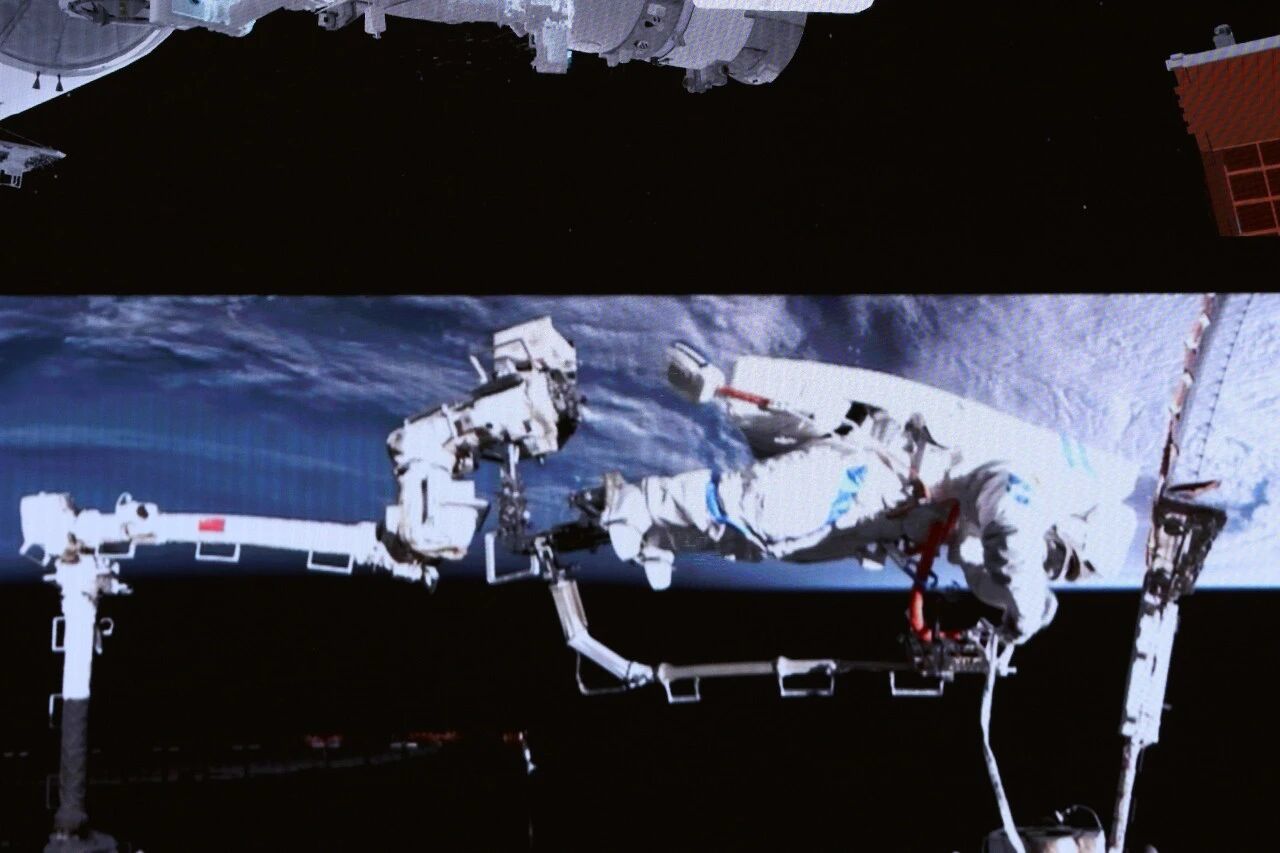
At 19:35 Beijing Time on March 16, 2026, the second extravehicular activity (EVA) performed by the Shenzhou-21 crew concluded successfully. Following seven hours of intensive EVA operations, taikonauts Zhang Lu, Wu Fei and Zhang Hongzhang operated in seamless coordination, assisted by the space station’s robotic arm and full support from ground control teams.
The crew accomplished all planned tasks, notably the installation of space debris shielding hardware. EVA taikonauts Zhang Lu and Wu Fei safely re-entered the Wentian Experiment Module, bolstering the long-term safe in-orbit operation of the China Space Station (CSS).
This latest EVA has set a new milestone for China’s human spaceflight extravehicular operations. As mission commander, Zhang Lu has logged a total of six spacewalks following this mission, making him one of China’s most experienced taikonauts in EVA execution to date.
Each spacewalk poses an extreme test of taikonauts’ physical endurance, technical skill and teamwork. Behind the seven-hour EVA lies countless hours of rigorous ground simulation training, flawless space-to-ground communications, and the unwavering pursuit of excellence by China’s aerospace workforce.
Since completing their first EVA on December 9, 2025, the Shenzhou-21 crew has maintained a steady rhythm of in-orbit operations. Aboard the station, the three taikonauts have diligently performed routine duties including hardware checkout and maintenance, environmental monitoring, and personal health monitoring.
They have also conducted a series of in-orbit training drills covering rendezvous and docking, medical support, emergency egress and survival procedures, laying a firm foundation for the station’s long-term stable operations.
In parallel, a diverse suite of space science investigations has proceeded on schedule. Experiments across multiple disciplines—including space life sciences and human research, microgravity physics, and advanced space technologies—have been executed methodically by the crew.
These investigations not only deepen the understanding of space environment phenomena but also gather valuable data and experience for China’s future human spaceflight programs and applied space research. Notably, the crew also celebrated the Year of the Horse Spring Festival aboard the CSS, carrying Chinese New Year traditions into low Earth orbit—a distinctive sentiment cherished by China’s space community.
Having arrived at the space station in October 2025, taikonauts Zhang Lu, Wu Fei and Zhang Hongzhang have now spent more than four months in orbit. Over these 100-plus days, they have operated far from Earth, completing a series of demanding tasks in a microgravity environment, embodying the spirit of China’s human spaceflight through dedication and perseverance.
This EVA stands as just one milestone in the Shenzhou-21 mission. Per the flight plan, the crew will carry out additional extravehicular activities in the subsequent mission phase, continuing relevant science investigations and technology demonstrations.
The global space community looks forward to further accomplishments by the Shenzhou-21 crew, as they write new chapters for the development of the China Space Station and the sustained advancement of China’s human spaceflight enterprise.
Space exploration knows no bounds, and China’s space program continues to forge ahead steadily. Every EVA and every scientific breakthrough represents a solid stride toward deeper space exploration.
Salute to the taikonauts stationed aboard Tiangong, and to all researchers and personnel who contribute silently to China’s human spaceflight endeavors. May China’s space program continue to shine brightly across the cosmos.