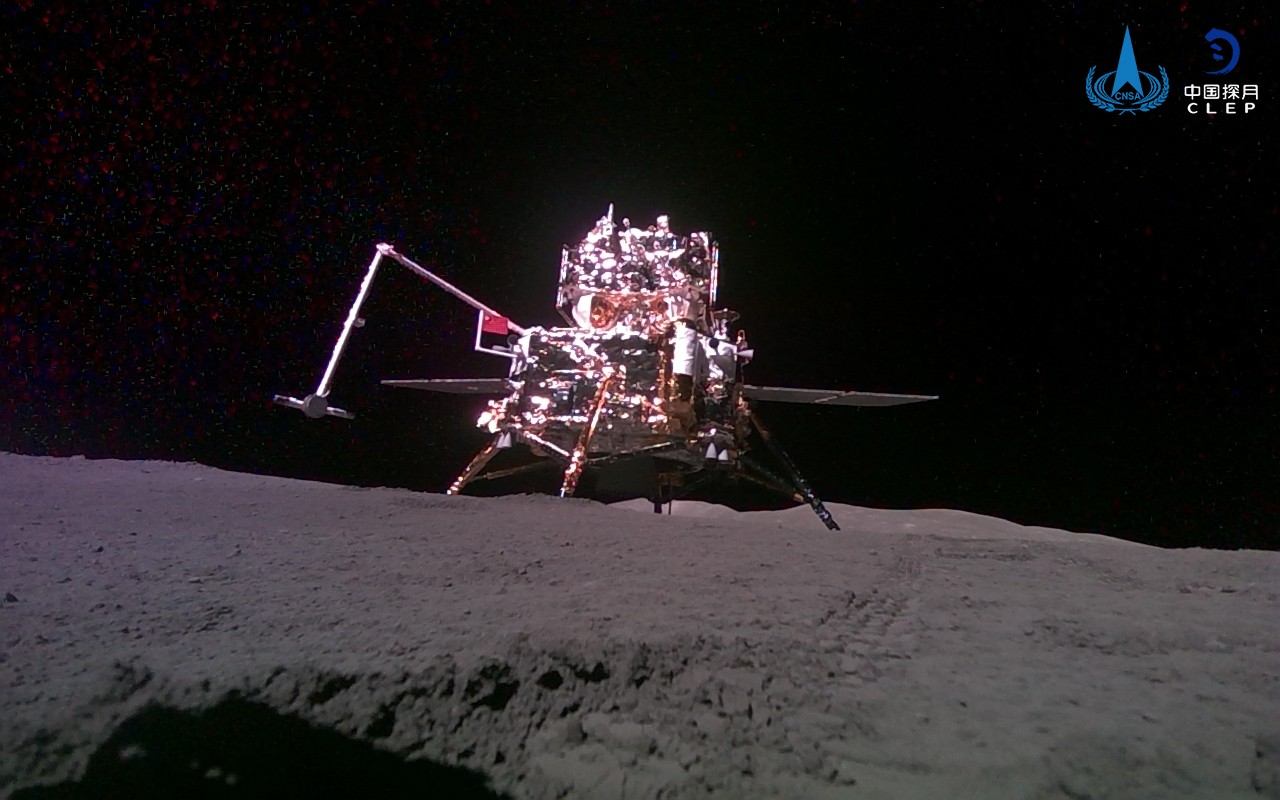
The Moon, Earth’s closest celestial neighbor, has always held countless unsolved cosmic mysteries. The existence and origin of negative ions have long been a key question hanging over the space science community. It was not until the Chang’e-6 lander, carrying the world’s first extraterrestrial space-specific Negative Ion Analyzer (NILS), touched down on the lunar surface that humanity finally completed direct detection of negative ions on the Moon. This achievement has lifted the veil shrouded by the solar wind and opened a brand-new window for understanding the lunar plasma environment.
Negative ions are not rare in the universe; they can be found in the solar atmosphere, early cosmic nebulae, and planetary ionospheres. Yet these particles are inherently "fragile"—they easily lose electrons through photodesorption by sunlight, with lifetimes measured in milliseconds. In lunar orbit, the lifetime of hydrogen negative ions is a mere 0.07 seconds, meaning they vanish almost as soon as they form. Previous lunar orbital missions operated dozens or even hundreds of kilometers above the surface. By the time signals reached those detectors, these short-lived negative ions had long since disappeared, keeping lunar negative ion detection stuck in theoretical prediction and becoming a major scientific puzzle.
The breakthrough solution from Chang’e-6 centers on "in-situ detection." As a lander, it reaches the lunar surface directly, positioning itself near the very source of negative ion generation. This allows the NILS to capture particles the moment they are born, breaking through the bottleneck of orbital detection. During two days of lunar surface observations, NILS delivered on its promise, successfully acquiring six valid spectra of hydrogen negative ions—humanity’s first-ever in-situ measurements of negative ions from the Moon’s surface, laying the most critical foundation for follow-up research.
Behind these precious data lie the core laws of the Moon’s interaction with the solar wind. After comparing NILS data with contemporaneous solar wind parameters observed by Europe’s ARTEMIS satellites, researchers identified a strong positive correlation: the flux and energy of hydrogen negative ions closely match those of the solar wind. During peak solar wind periods, negative ion flux reached three times that of the weakest periods. This pattern is no coincidence, providing the most direct observational evidence that lunar negative ions originate from solar wind bombardment of the lunar surface.
Further spectral analysis precisely reconstructed the formation process of hydrogen negative ions: their average energy centers at 200–300 electron volts, indicating they do not form spontaneously. Instead, solar wind protons strike the lunar regolith at high speed, and upon scattering back, "capture" a second electron from the regolith surface, forming negatively charged hydrogen negative ions. Uncovering this process gives us a more concrete understanding of solar wind–lunar surface interactions—the solar wind does not simply "impact" the Moon, but drives complex particle reactions that generate new particle components.
The significance of Chang’e-6’s detection extends far beyond confirming "the presence of negative ions on the Moon." From the perspective of space physics, it fills a gap in lunar plasma environment research, revealing that negative ions are an important component of the lunar space environment alongside known positive ions, electrons, and neutral atoms, completing humanity’s overall understanding of the lunar space environment.
This discovery also offers fresh perspectives for two major research fields. For lunar space weathering studies, the formation and motion of hydrogen negative ions may participate in microscale reactions within regolith grains—such as injecting electrons into the regolith and promoting local reduction reactions—potentially explaining the formation mechanism of nanophase iron in lunar soil. For lunar exosphere studies, the presence of negative ions provides a new direction for investigating particle composition and dynamics, and even clues to the potential sources of lunar water: some research suggests hydrogen negative ions could chemically form hydroxyl (OH⁻) or molecular hydrogen (H₂), representing a new pathway for lunar water formation.
Notably, the NILS instrument used in this detection was jointly developed by the National Space Science Center of the Chinese Academy of Sciences and the Swedish Institute of Space Physics, making it the world’s first dedicated negative ion detector for extraterrestrial space. It not only withstood the extreme lunar surface environment but also collected valid data in an extremely short observation window, demonstrating a technological breakthrough in in-situ detection equipment for extraterrestrial bodies and setting an excellent example for international space science cooperation.
From Chang’e-4’s historic landing on the far side of the Moon to Chang’e-6 completing far-side sample return and direct negative ion detection, China’s lunar exploration program has steadily ventured into the Moon’s unknowns. This breakthrough in lunar surface negative ion detection not only solves a long-standing scientific puzzle but also provides key reference for future studies of negative ion generation and spatial distribution on airless celestial bodies—Mercury, asteroids, and even the icy moons of Saturn and Jupiter, all directly bombarded by solar wind, may host similar negative ion reaction processes.
The essence of space exploration is moving from the known to the unknown, from macroscopic observation to microscopic decryption. That fleeting negative ion signal captured by Chang’e-6 on the lunar surface may seem tiny, yet it connects the solar wind, the Moon, and the cosmic plasma environment in multiple ways. And this discovery is merely another starting point for China’s lunar exploration program. With the upcoming implementation of Chang’e-7 and -8, we will ultimately unlock more of the Moon’s microscopic secrets and travel farther and more steadily on the path of cosmic exploration.