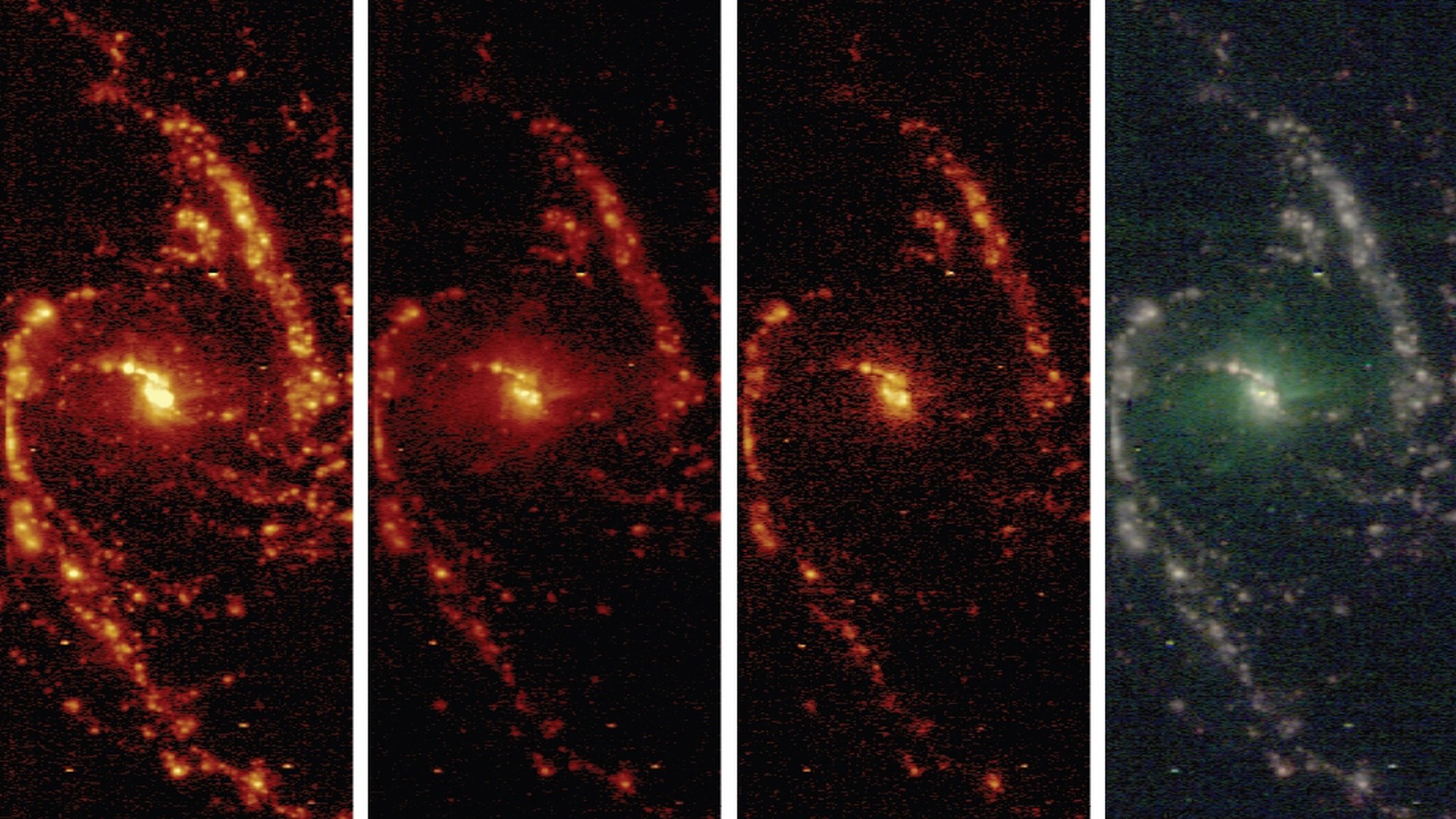
What untold stories of growth lie within galaxies beyond the Milky Way? Recently, a team led by Jeff Rich from the Carnegie Institution for Science, in collaboration with researchers from the Center for Astrophysics | Harvard & Smithsonian, has applied galactic archaeology techniques to extragalactic celestial studies for the first time. By decoding the chemical fossil record of the barred spiral galaxy NGC 1365, they have reconstructed the galaxy’s 12-billion-year evolutionary journey. Dubbed "extragalactic archaeology", this groundbreaking research is published in Nature Astronomy, opening a new window for humanity to explore the universal growth laws of galaxies in the cosmos.
Extragalactic Archaeology: A New Key to Unlocking Galactic History
Prior to this, galactic archaeology techniques were predominantly used to study the Milky Way itself—tracing its formation and evolution by analyzing the chemical abundances of stars and gas within it. The breakthrough of this new study lies in elevating the precision of this method to a level capable of resolving extragalactic galaxies.
Lisa Kewley from the Center for Astrophysics | Harvard & Smithsonian, the lead author of the study, stated that this marks the first time chemical archaeology has been applied at such a fine scale outside the Milky Way. The core enabler of this achievement is the invaluable dataset accumulated by the Carnegie-led TYPHOON survey, which conducted systematic observations of 44 nearby galaxies using the du Pont Telescope at the Las Campanas Observatory in Chile, ultimately producing "data cubes" that integrate both spatial and spectral information.
Jeff Rich from the Carnegie Institution for Science vividly described these data cubes as "3D high-definition photocopies of galaxies": each pixel contains both the celestial object’s spatial position and detailed chemical composition. Compiled by Carnegie astronomers over several years, this dataset is now open to the global scientific community, offering an unprecedentedly detailed perspective for galactic research. The core technology behind the TYPHOON survey—the "step-and-stare" method—was developed by Barry Madore, a retired Carnegie astronomer, and has become the linchpin for constructing high-resolution data cubes.
Focus on NGC 1365: Tracing Evolutionary Traces in Chemical Fingerprints
The primary observational target of this study is NGC 1365, a barred spiral galaxy approximately 56 million light-years from Earth, located in the constellation Fornax and also known as the "Great Barred Spiral Galaxy". With a diameter of about 200,000 light-years—twice that of the Milky Way—and a bar-shaped central structure much like our own galaxy, it serves as an ideal sample for studying galactic evolution.
Astronomers selected oxygen as the core research clue: as the most abundant heavy element in the universe after hydrogen and helium, the distribution of oxygen acts as a "living fossil" of galactic evolution. Oxygen concentrations are higher in galactic centers and relatively sparse in the outer regions, a distribution pattern shaped by a combination of processes including star formation, supernova explosions, gas flows, and galactic mergers.
Hot, young stars excite surrounding gas with ultraviolet radiation, and different elements exhibit unique spectral features detectable by telescopes. By capturing oxygen’s spectral signals in NGC 1365, the research team created a detailed oxygen distribution map of the galaxy. These observational data were then precisely compared with galactic simulation results from the Illustris Project—one of the most advanced galactic evolution simulation frameworks to date, which models the entire process of gas motion, star formation, black hole activity, and chemical evolution in galaxies from shortly after the Big Bang to the present.
To find an evolutionary model matching NGC 1365, Lisa Kewley’s team sifted through approximately 20,000 simulated galaxies and finally identified a sample that highly aligns with the observational data, thereby inferring the galaxy’s growth trajectory over 12 billion years.
A 12-Billion-Year History: From a Small Galaxy to a Giant Barred Spiral via Mergers
Combining observational data and simulation analyses, the research team has fully reconstructed NGC 1365’s evolutionary story: what is now a massive barred spiral galaxy began as a small galaxy, and grew to its current size over 12 billion years of cosmic time through multiple mergers with dwarf galaxies.
Several key evolutionary details have been clearly uncovered:
Early Core Formation: NGC 1365’s central region formed in the early stages of the galaxy’s evolution and rapidly accumulated large amounts of oxygen, becoming the chemical core of the entire galaxy.
Slow Peripheral Accumulation: Over 12 billion years, the gas in the galaxy’s outer regions gradually accumulated through continuous collisions and mergers with small dwarf galaxies, with heavy element abundances rising slowly.
Late Spiral Arm Formation: The galaxy’s outer spiral arms formed relatively recently, taking shape only in the last few billion years. Their gas and stars are primarily derived from merged dwarf galaxies, which gives the outer spiral arms a more diverse chemical composition.
NGC 1365’s iconic bar-shaped core has also played a pivotal role in its evolution—the gravitational field of the bar structure channels gas and dust toward the galactic center, driving intense star formation activity and simultaneously supplying material to the supermassive black hole at the center. This process has profoundly shaped the distribution of oxygen within the galaxy.
Beyond NGC 1365: Establishing a New Template for Galactic Evolution Research
For the entire astrophysics community, the significance of this research extends far beyond decoding the growth history of a single galaxy.
The similarities between NGC 1365 and the Milky Way make its evolutionary trajectory a crucial reference for humanity to understand the Milky Way’s past and future. Astronomers hypothesize that the Milky Way may have undergone similar multiple merger events, and the methods of this study are expected to be applied to more refined research on the Milky Way’s evolution in the future.
Meanwhile, the research team hopes that the validated extragalactic archaeology method will become a universal template for galactic evolution studies. With the popularization of high-resolution observational equipment, this research approach combining chemical fingerprint decoding and numerical simulation will be applied to more galaxies, helping humanity sort out the universal laws of galactic evolution in the universe.
Mark Seibert, a participant in the study, noted that once such high-precision observational methods are widely adopted by the astronomical community, humanity’s understanding of galaxy formation and evolution will experience a new leap forward.
From stellar archaeology within the Milky Way to chemical analysis of extragalactic galaxies, humanity’s perspective in exploring cosmic evolution is constantly expanding. The unlocking of NGC 1365’s 12-billion-year evolutionary code is not only a technological breakthrough but also a reminder that every galaxy in the universe has written its own growth epic in its chemical composition—and the task of astronomers is to learn to read these words hidden in starlight.