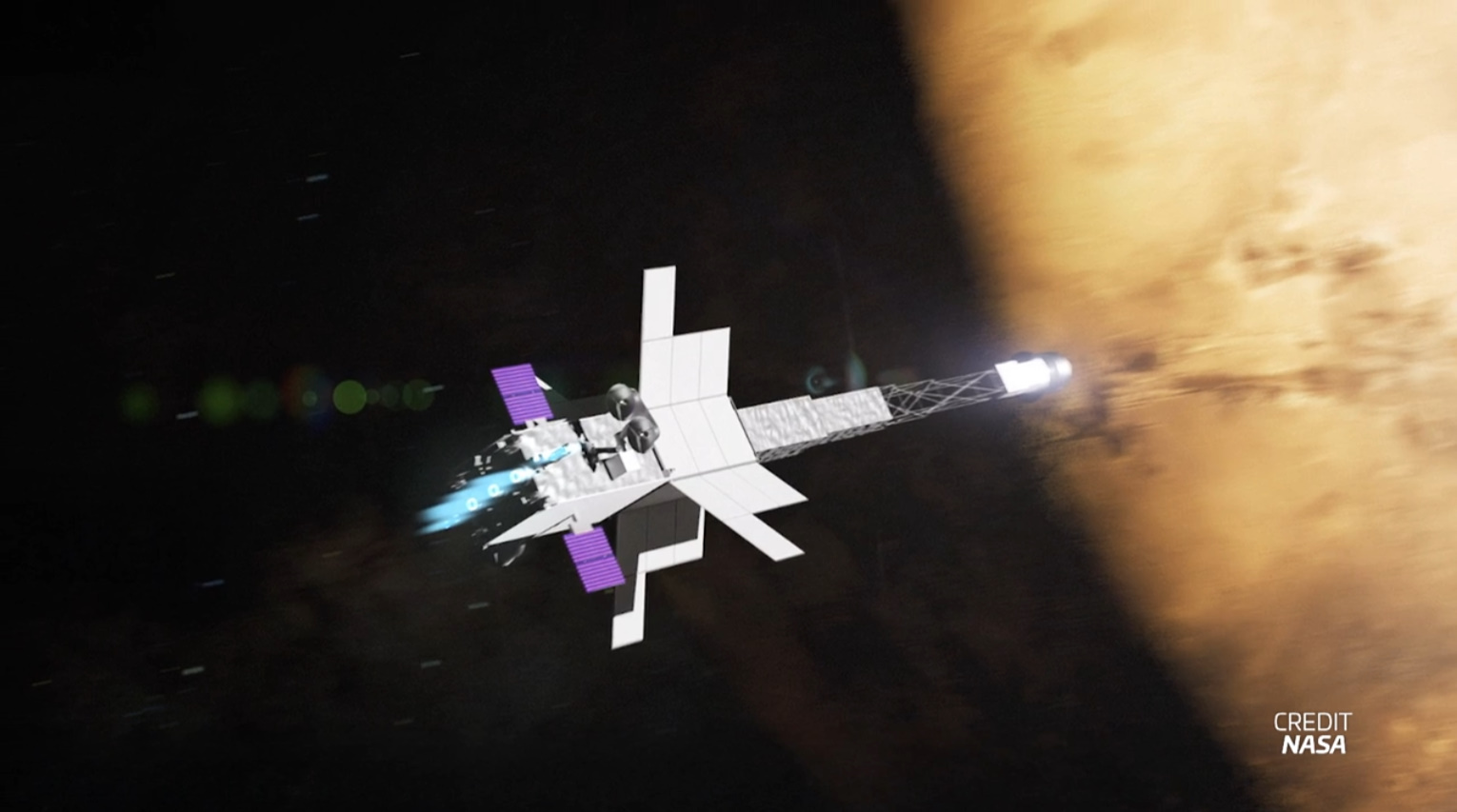
As the speed bottleneck of chemical propulsion rockets becomes a constraint on deep space exploration, the maturation of nuclear power and propulsion technology is opening an unprecedented pathway for humanity to venture to Mars and beyond the solar system. NASA has recently announced that it will advance the national space objectives set by President Trump with nuclear power and propulsion technology at its core, planning to launch the SR-1 Freedom mission in 2028 to conduct the world’s first on-orbit demonstration of nuclear electric propulsion (NEP) and deliver the SkyFall helicopters to the Martian surface. This initiative, a deep collaboration with the U.S. Department of Energy (DOE), represents not only a pivotal breakthrough in the application of nuclear technology in space but also marks the official entry of human deep space exploration into a new nuclear-powered era.
Nuclear Electric Propulsion: Solving the Speed and Endurance Dilemmas of Deep Space Exploration
Chemical fuel rockets have long been the mainstream propulsion method in space exploration, yet they suffer from inherent limitations of low energy efficiency and limited endurance. Despite their high thrust, they cannot support long-duration deep space voyages, with a one-way trip to Mars typically taking 6 to 9 months. The lengthy journey not only increases health risks for astronauts but also poses numerous challenges for mission logistics and orbital planning.
The advent of nuclear electric propulsion technology is fundamentally transforming this landscape. Unlike traditional chemical propulsion, NEP harnesses thermal energy generated by nuclear reactors to produce electricity, which in turn powers electric propulsion systems such as ion thrusters to generate continuous and highly efficient thrust—its energy efficiency is more than three times that of chemical fuel rockets. While NEP delivers lower instantaneous thrust than chemical rockets, it can accelerate continuously over long-duration flights, drastically shortening deep space travel times and reducing fuel payloads. This frees up space for spacecraft to carry more scientific instruments and life support systems.
The core objective of the upcoming SR-1 Freedom mission is to verify the reliability and stability of NEP systems on-orbit. As a dedicated nuclear-powered test platform developed by NASA for deep space exploration, the spacecraft will complete a series of propulsion tests from low Earth orbit to the Earth-Moon transfer orbit. These tests will validate the operation of nuclear reactors in the extreme space environment, the thrust output efficiency of electric propulsion systems, and the compatibility between nuclear power systems and other spacecraft subsystems. Success in this demonstration mission will lay the core technical foundation for subsequent crewed Mars missions and deep space probe expeditions, making human travel to Mars more efficient and secure.
The Dual Missions of SR-1 Freedom: Breakthroughs in Both Technology Demonstration and Mars Exploration
The 2028 SR-1 Freedom mission is not a single technical test but a composite endeavor integrating nuclear electric propulsion verification and Martian aerial exploration. Its payload, the SkyFall helicopters, represents another major milestone for NASA in Martian aerospace exploration following the Ingenuity helicopter.
Back in 2021, NASA’s Ingenuity helicopter achieved the first controlled powered flight by humans on an extraterrestrial planet on Mars, proving the feasibility of aerial flight in Mars’ thin atmosphere—with a density merely 1% of Earth’s. Ingenuity’s success accumulated critical aerodynamic and power system design experience for more complex future Martian aerial exploration missions. The SkyFall helicopters bound for Mars are undoubtedly an upgraded version of Ingenuity: unlike Ingenuity, which was solely a technology demonstration, SkyFall will feature enhanced flight capabilities, longer endurance, and a more comprehensive suite of scientific detection functions. It is poised to become an "air reconnaissance scout" on the Martian surface, providing terrain exploration, path planning, and environmental monitoring support for rovers and future crewed landers.
SR-1 Freedom will leverage the high-efficiency payload capacity of its nuclear electric propulsion system to precisely deliver the SkyFall helicopters to Martian orbit and complete their landing and deployment. This process is both a real-world test of the NEP system’s deep space transportation capabilities and the first integration of nuclear power technology with Martian aerial exploration. In the future, nuclear-powered spacecraft will serve as the core transportation platform for exploration missions to Mars and more distant celestial bodies, while Martian aerial vehicles represented by SkyFall will form a three-dimensional detection network with rovers and landers, significantly boosting the efficiency of human exploration of Mars.
Cross-Agency Collaboration: NASA and DOE Jointly Overcome the Challenges of Space Nuclear Technology
The research and development of space nuclear power and propulsion technology cannot be accomplished by a single institution. It involves multiple cutting-edge fields including nuclear reactor miniaturization, space nuclear safety, waste heat management, and radiation protection, requiring the deep integration of aerospace engineering and nuclear engineering. The core of NASA’s nuclear-powered space program lies in its strategic cooperation with the U.S. Department of Energy, where the two parties perform their respective duties and complement each other’s strengths—this synergy is the key to technological breakthroughs.
The U.S. Department of Energy boasts world-class nuclear technology R&D capabilities, with extensive experience in nuclear reactor miniaturization, nuclear material safety, and nuclear power system integration. It will provide NASA with support in core nuclear reactor design, technological R&D, and safety verification. NASA, on the other hand, focuses on the adaptation of nuclear power systems to spacecraft, system debugging in the space environment, and orbital and payload planning for deep space missions. This cross-agency collaboration has allowed the R&D of space nuclear technology to bypass the technical bottlenecks of single disciplines and achieve full-chain technological breakthroughs from nuclear reactor development to spacecraft integration.
In fact, NASA is no stranger to the application of nuclear technology in space. Previous deep space probes such as the Voyager and Curiosity rovers have all been equipped with Radioisotope Thermoelectric Generators (RTGs) to provide continuous power. However, the current R&D of nuclear electric propulsion technology marks the first large-scale application of nuclear technology in space propulsion. Unlike RTGs, which only generate electricity, NEP systems need to achieve efficient conversion from nuclear energy to electricity and then to thrust, representing a geometric increase in technical difficulty. The partnership between NASA and the DOE is the core guarantee for solving this challenge.
Nuclear Power: Unlocking a Brand-New Future for Deep Space Exploration
The proposal of the SR-1 Freedom mission is not only a concrete measure for NASA to implement national space strategies but also a symbol of humanity’s official entry into the nuclear age of deep space exploration. In future space exploration, nuclear power technology will become an indispensable core support, with its application scenarios extending from propulsion systems to energy supply for deep space bases.
Currently, NASA has proposed a plan to build a nuclear reactor on the Moon, aiming to deploy a 100-kilowatt nuclear reactor by 2030 to provide continuous and stable power for lunar bases. Unlike solar energy, which is affected by the Moon’s day-night cycle, nuclear reactors can deliver 24/7 uninterrupted power in extreme environments, supporting all missions of lunar bases including life support, scientific experiments, and resource development. The verification of nuclear electric propulsion technology will form a technical complement to the lunar nuclear reactor plan, making nuclear technology a "universal energy source" for exploration of the Earth-Moon system, Mars, and deeper space.
From Mars exploration to interstellar travel, the maturation of nuclear power technology will completely redefine the boundaries of human space exploration. With nuclear electric propulsion systems, the one-way travel time to Mars is expected to be shortened to 3 to 4 months, greatly improving the feasibility of crewed Mars missions. The high-efficiency payload capacity of nuclear-powered spacecraft will also make it possible to launch large payloads to celestial bodies such as Mars and the asteroid belt, laying the foundation for the construction of deep space bases and the development of interstellar resources.
The 2028 launch of SR-1 Freedom may seem like a single space mission, but it is in fact a pivotal step for humanity in deep space exploration. When the nuclear-powered engines roar in space and the SkyFall helicopters hover over the Martian sky, humanity’s footsteps in exploring the universe will go further and steadier, propelled by nuclear energy. The collaboration model between NASA and the DOE also provides an important reference for cross-disciplinary and cross-agency synergy in the global aerospace sector. On the road to deep space exploration, only by integrating the technical strengths of all humanity can we solve one technical challenge after another and ultimately realize the dream of venturing to the stars and seas.
A new chapter in deep space exploration is being written by nuclear power. In 2028, we await the launch of SR-1 Freedom, ready to witness nuclear power technology open a brand-new door for human Mars exploration.