All times in this article are in Eastern Daylight Time (EDT).
On March 25, 2026, NASA officially released the complete coverage and event schedule for Artemis II, confirming the launch window for humanity’s first crewed lunar orbit mission since the Apollo program: from 6:24 p.m. on April 1 to April 6. The entire mission will be broadcast globally across multiple platforms. As the first crewed test flight of the Artemis program, the mission will carry four astronauts on a approximately 10-day lunar orbit flight, validating the Orion spacecraft’s life support systems in crewed deep-space conditions, and laying critical technical groundwork for future crewed lunar landings, lunar base development, and eventual Mars exploration.
Mission Core: First Crewed Lunar Orbit Since Apollo, Setting New Deep-Space Flight Records
Artemis II will lift off from Launch Complex 39B at NASA’s Kennedy Space Center in Florida, propelled by the Space Launch System (SLS) rocket carrying the Orion spacecraft with four astronauts aboard.
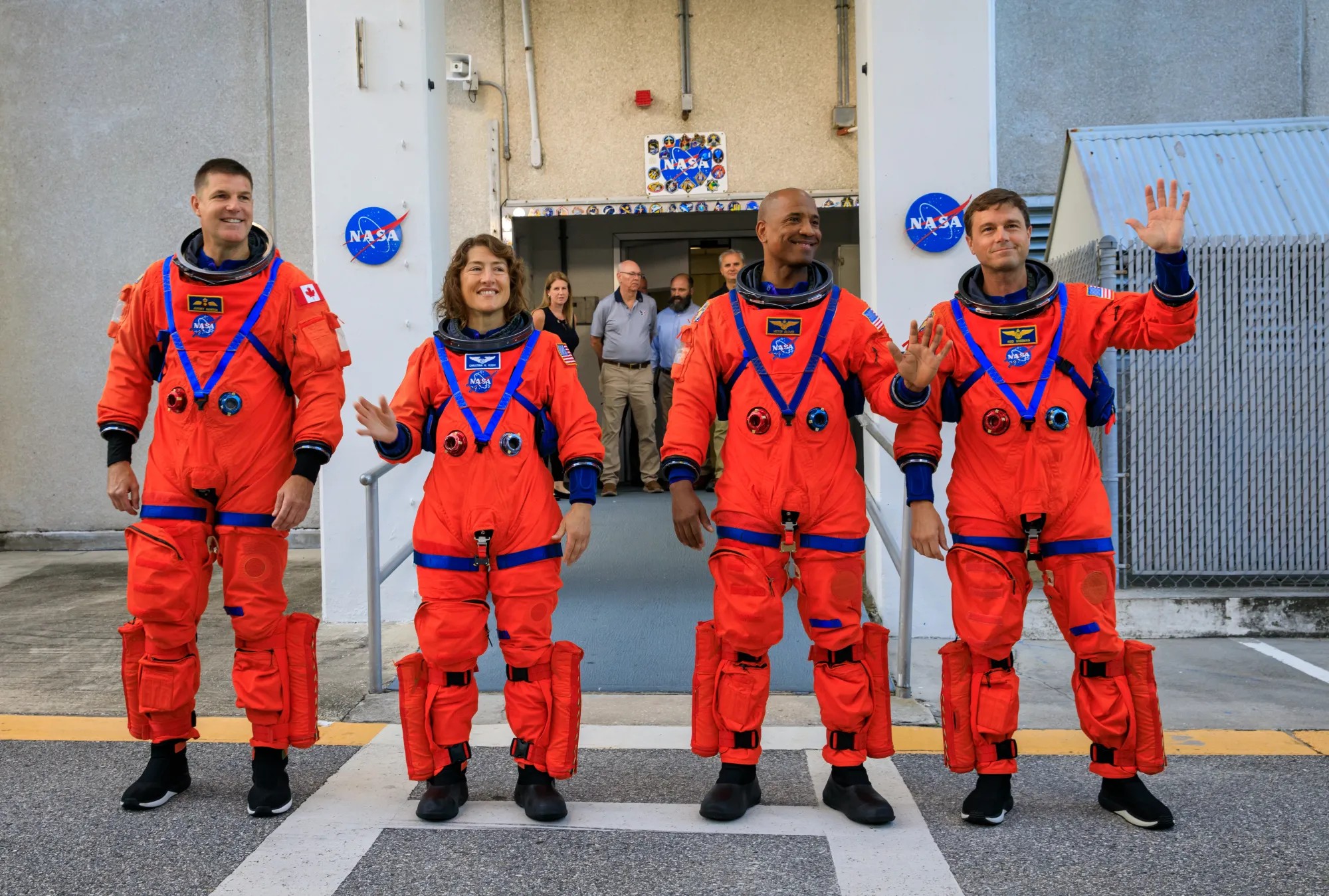
The crew consists of three NASA astronauts and one Canadian Space Agency (CSA) astronaut, all with extensive spaceflight experience:
Reid Wiseman – Commander
Victor Glover – Pilot
Christina Koch – Mission Specialist
Jeremy Hansen – Mission Specialist
Notably, Koch will be the first woman to fly around the Moon, and Hansen will become the first Canadian astronaut to reach lunar orbit, marking a major milestone in U.S.-Canadian space cooperation.
Compared to Apollo lunar orbit missions, Artemis II expands exploration boundaries further. If launched as scheduled on April 1, the crew will reach a maximum distance of approximately 248,655 miles from Earth during lunar flyby, breaking the human deep-space distance record set by Apollo 13.
No lunar landing will be attempted; instead, the mission uses a free-return trajectory, using lunar gravity to loop around the Moon and return to Earth. The flight will fully test Orion’s core systems—including navigation, communications, and life support—under crewed deep-space operations.
Full-Cycle Coverage Plan: Multi-Platform Live Streams from Launch to Splashdown
To let global audiences witness this historic space event, NASA has built a multi-channel, around-the-clock coverage system covering five phases: pre-launch preparations, liftoff, deep-space cruise, lunar flyby, and Earth return. All times are EDT and subject to change based on actual launch timing.
Pre-Launch: Briefings and Final Preparations
Beginning March 27, NASA will host a series of specialized briefings and media events to detail mission readiness and crew status:
March 27, 2:30 p.m. – The Artemis II crew arrives at Kennedy Space Center and takes questions from accredited media alongside NASA Administrator Jared Isaacman and CSA President Lisa Campbell. This marks the crew’s first public appearance before launch.
March 29, 9:30 a.m. – Crew members answer media questions virtually from quarantine, sharing pre-launch health and preparation updates.
March 29, 2:00 p.m. – NASA provides a launch readiness update, with leaders of the Orion and SLS programs in attendance.
March 30, 5:00 p.m. – Post-key mission review news conference, where mission management leadership announces final launch readiness status.
March 31, 1:00 p.m. – Final pre-launch briefing focusing on countdown status and launch weather, with the 45th Weather Squadron meteorologist analyzing conditions.
Launch Day: Live Coverage from Propellant Loading to Liftoff
Coverage for launch day on April 1 begins in the early morning, focusing on the full SLS countdown sequence:
7:45 a.m. – Live coverage of rocket propellant loading begins, with real-time visuals and expert commentary.
12:50 p.m. – NASA+ launches full launch coverage; once Orion’s solar arrays deploy, the stream continues on NASA’s YouTube channel.
Approx. 2.5 hours after liftoff – Following SLS upper stage orbital insertion and Orion deployment to high Earth orbit, NASA holds a post-launch news conference with Administrator Isaacman and key leaders reviewing initial mission status.
Mission in Progress: Daily Briefings and Crew Downlinks, Lunar Flyby Highlights
During the 10-day deep-space mission, starting April 2, NASA will host daily mission status briefings at Johnson Space Center in Houston (paused April 6 for lunar flyby), providing real-time updates on spacecraft performance, astronaut activities, and mission progress.
The crew will conduct multiple live downlink events with ground control. The Canadian Space Agency will host two exclusive downlinks to highlight international collaboration.
The mission’s peak moments occur on April 6:
12:45 p.m. – NASA+ begins exclusive live coverage of Orion’s lunar flyby.
1:45 p.m. – The spacecraft reaches its maximum distance from Earth, setting a new human deep-space record.
Note: During lunar flyby, Orion will pass through a lunar eclipse zone, which may temporarily affect video transmission. Communication with Earth will also be briefly lost while the spacecraft is behind the Moon—normal for deep-space missions.
Return Phase: Live Splashdown and Recovery Coverage
On April 10, Orion will return to Earth with the four-person crew, with full live coverage:
6:30 p.m. – NASA+ begins live Earth return coverage, tracking reentry, parachute deployment, and other critical events.
8:06 p.m. – Expected splashdown in the Pacific Ocean. NASA and U.S. military personnel will conduct recovery operations, assisting the crew to exit the spacecraft and board the recovery vessel.
10:35 p.m. – Post-splashdown news conference at Johnson Space Center, summarizing the mission and reporting on crew health. Details on the crew’s return to Houston will be released separately.
Multi-Channel Viewing: Live Streams, Virtual Guest Program, and Audio Access
To serve global audiences, NASA offers three primary viewing channels:
Core Live Platforms: Key events—launch, lunar flyby, splashdown—stream live on NASA+ and Amazon Prime. NASA’s YouTube channel provides 24/7 continuous coverage with real-time spacecraft and crew updates.
Virtual Guest Program: The public can register via NASA’s website for virtual viewing privileges, including exclusive mission resources, notifications, and a virtual visitor passport stamp upon successful launch.
Audio Access: Media may dial 256-715-9946 (passcode: 682 040 632) for audio-only coverage of propellant loading and launch. Viewers in Brevard County, Florida, can tune in to VHF 146.940 MHz and UHF 444.925 MHz for local launch updates.
NASA will also post real-time countdown and flight updates on the official Artemis blog, release high-resolution imagery via Artemis II Multimedia, and maintain the tracking site nasa.gov/trackartemis for global audiences to monitor Orion’s position in space.
Mission Significance: A Critical Step for Artemis, Opening a New Era of Deep-Space Exploration
As the Artemis program’s first crewed mission, the success of Artemis II will stand as a landmark in human spaceflight. It will not only validate the crewed reliability of next-generation deep-space systems including the SLS rocket and Orion spacecraft, but also signal humanity’s shift from the Apollo-era one-off lunar visits to a sustainable model of lunar exploration and development.
According to NASA, the mission’s core objectives are to build operational experience for Artemis III (crewed lunar landing), Artemis IV (lunar Gateway assembly), and ultimately long-term human presence on the Moon. Using the Moon as a stepping stone, NASA aims to enable crewed missions to Mars.
The mission’s international cooperation framework also sets a foundation for global deep-space collaboration: Canada’s participation establishes a new model for lunar exploration partnerships, with ESA and JAXA set to join the Artemis program in future phases to build an international lunar exploration coalition.
From Apollo’s “brief visits” to Artemis’s “long-term presence,” humanity’s lunar exploration is entering a new chapter.
The launch of Artemis II represents not only the execution of NASA’s deep-space strategy, but another decisive step forward for humanity into the solar system.
As the April launch window approaches, the world’s attention will turn to Kennedy Space Center to witness a space milestone for all humankind.
Related Links:
https://www.nasa.gov/news-release/nasa-sets-coverage-for-first-artemis-crewed-mission-around-moon/