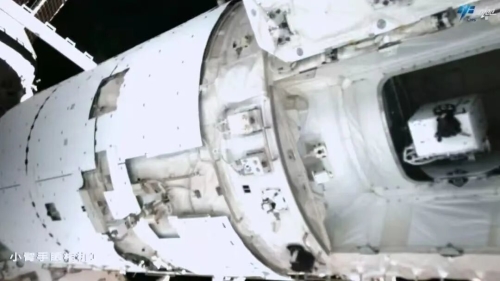
The extreme space environment serves as a natural test field for evaluating aerospace material properties, which directly determines the stability, reliability and service life of spacecraft in orbit. In March 2026, the fourth extraterrestrial material exposure experiment is steadily underway aboard the China Space Station (CSS). Covering 26 sample units across 8 scientific research projects, this mission marks another key exploration since the deployment of the space station’s material exposure experiment facility.
Since the facility was launched aboard Tianzhou-5 cargo spacecraft in 2022, China has completed three batches of sample exposure experiments, achieving multiple world-first results that lay a solid material foundation for domestic aerospace material research and development as well as the implementation of major aerospace projects.
What is Extraterrestrial Exposure Experiment? A Material Test in Extreme Space Environments
While the microgravity environment inside the space station enables various scientific experiments hard to conduct on the ground, it is far from sufficient for aerospace material research and development. During orbital operation, aerospace equipment is exposed to complex harsh conditions including ultra-high vacuum, intense cosmic radiation, extreme temperature differences of plus or minus 100 degrees Celsius, atomic oxygen corrosion, and micrometeoroid impacts.
These extreme conditions can cause structural damage, performance degradation, and even functional failure of materials, directly shortening the service life of spacecraft. The extraterrestrial exposure experiment places test materials directly in the real space environment outside the spacecraft cabin, utilizing multiple complex space influencing factors to observe physical and chemical changes of materials.
Astronauts and ground scientific research teams collect experimental data synchronously to analyze sample change mechanisms and interpret underlying laws. To meet such experimental requirements, researchers have specially designed an extraterrestrial exposure platform for the space station, acting as a core carrier for material science and radiation biology experiments. This platform also enables China to carry out high-precision empirical space material research in low-Earth orbit.
The CSS extraterrestrial exposure platform mainly supports two categories of research: material experiments and biological experiments. The material exposure experiment facility focuses on space-applied materials such as lubrication materials, thermal control materials, film coatings, shape memory materials, functional coatings, polymers and composite materials.
It conducts tests on space damage and service performance, as well as tribological experiments of space lubrication materials under microgravity and vacuum conditions. Through the complete process of "extraterrestrial placement - space exposure - ground retrieval and testing", researchers evaluate the corrosion resistance of materials to space environments, and further develop targeted new aerospace materials with superior performance.
Four Batches of Experiments in Four Years: Steady Progress in Space Station Material Research
The material exposure experiment facility was launched into orbit aboard the Tianzhou-5 cargo spacecraft on November 12, 2022, marking the start of routine extraterrestrial material exposure research for the China Space Station. To date, three batches of sample experiments have been completed, and the fourth batch is being carried out as scheduled.
Over the past four years, a total of 24 scientific research projects and 107 passive sample units have been tested, forming a progressive and in-depth research rhythm. The four batches of missions are detailed as follows:
First Batch: 407 samples were transported via Tianzhou-5, and installed outside the cabin by the Shenzhou-15 astronaut crew on March 8, 2023. This marked the first breakthrough of extraterrestrial material exposure experiments on the China Space Station, focusing on testing structural damage and performance degradation mechanisms of various materials under high-energy particle radiation and extreme temperature differences, accumulating valuable basic data for subsequent experiments.
Second Batch: Samples were delivered via Tianzhou-7 cargo spacecraft, and installed by the Shenzhou-18 crew on May 8, 2024. The samples covered passive radiation cooling materials, polyimide fiber materials, optical fiber materials, optical thin film materials and solid-liquid composite lubrication materials for space use, further expanding the types of test materials and research directions.
Third Batch: Transported aboard Tianzhou-8, these samples were installed externally by the Shenzhou-19 crew on November 21, 2024. Complementing the second batch, this batch enriched the performance research samples of different materials in the space environment.
Fourth Batch: The currently ongoing fourth batch includes 26 sample units, delivered in batches via Tianzhou-8 and Tianzhou-9 cargo spacecraft. Covering 8 projects including service characteristics and improvement strategies of space monocrystalline silicon solar cells, these samples will undergo long-term exposure experiments of 1 to 2 years according to research needs, focusing on exploring long-term orbital service performance of core aerospace materials.
From short-term exposure to long-term observation, and from single material to multi-material system, the continuous advancement of the China Space Station’s extraterrestrial material exposure experiments has allowed researchers to gradually clarify the performance evolution laws of different materials in the space environment, providing direct experimental basis for optimizing the space applicability of materials.
Multiple World-First Achievements Solidify the Foundation for Aerospace Material R&D
Through in-depth exploration of the first three batches of experiments, the China Space Station’s extraterrestrial material exposure experiments have achieved a series of remarkable results, with multiple research initiatives ranking among the world’s first. These achievements not only fill research gaps in relevant fields, but also lay a solid theoretical and experimental foundation for the development of new domestic aerospace materials, with some results showing clear engineering application prospects.
High-Performance Space Radiation-Resistant Magnesium Alloy: A New Material Option for Lightweight Satellites
This is the world’s first exposure experiment of high-performance stainless magnesium alloy carried out in space, which successfully verified the service reliability and stability of the material in extreme space environments. Featuring light weight, high strength and radiation resistance, this material can be applied to the electronic control systems and heat dissipation components of China’s lightweight satellites in the future, helping realize lightweight satellite design and improve orbital operation efficiency.
Gel Composite Lubricating Material: Ensuring Long Service Life of Lunar Rover Moving Mechanisms
This marks the world’s first extraterrestrial exposure experiment and bearing tribology test of liquid-containing gel lubricating materials. Experimental data confirms that the service life of gel/thin film composite lubricating materials in real space environments is significantly longer than that of currently used solid lubricating films.
This achievement lays a foundation for the design and development of new long-life space lubricating materials, strongly supporting the demand for high-performance lubricating materials in aerospace technology development. It will also be applied to lunar rover moving mechanisms in the future, solving lubrication problems of moving parts in the extreme lunar environment.
Solid-Liquid Composite Lubricating Material: Achieving Near-Zero Wear in Space Environments
The world’s first tribological experiment of oil-based superlubricity/near-zero wear lubricating materials in real space environments has been completed. Through a solid-liquid composite lubrication strategy, near-zero wear of sliding friction pairs has been successfully achieved, and the solid-liquid composite lubrication mechanism in the space environment has been revealed for the first time.
This research can guide the development and synthesis of future space superlubricated oil-based lubricating materials, supporting the advancement of aerospace lubrication materials and technology, while promoting the wide application of near-zero friction and wear materials in high-end equipment, advanced manufacturing and other civilian fields.
Shape Memory Polymer Composite: Meeting the Needs of Deployable Structures in Major Aerospace Projects
By conducting exposure experiments of shape memory polymers and their composite materials on the space station, researchers have revealed the performance evolution laws and space adaptability of various such materials, and selected optimal base materials applicable to deployable structures and locking-release mechanisms.
Structures developed based on these materials, including hinges, locking-release mechanisms and flexible solar cell systems, can be widely used in major aerospace projects such as the China Space Station, lunar exploration program, crewed lunar landing and planetary exploration in the future, providing new material solutions for lightweight, miniaturized and deployable design of aerospace equipment.
Materials First: Building a Solid Technical Foundation for Deep Space Exploration
In aerospace engineering, materials take precedence. The performance of aerospace materials directly defines the technical upper limit of aerospace equipment, and serves as the core foundation for accomplishing deep space exploration missions such as crewed lunar landing and planetary exploration.
The continuous implementation of extraterrestrial material exposure experiments on the China Space Station has not only enabled China to obtain massive material performance data in real space environments, but also established a complete research system covering material experimentation, mechanism analysis, new material development and engineering application.
The ongoing fourth experiment focuses on the long-term service performance of core aerospace materials such as space monocrystalline silicon solar cells. Such research is directly related to the orbital reliability of spacecraft energy systems and detection systems, providing a key basis for material selection of deep space exploration equipment in China’s future missions.
As the experiments continue, the performance of more new aerospace materials will be verified, and more mechanisms of space material evolution will be analyzed. These achievements will continuously support the independent research and development and innovation of China’s aerospace materials, and promote technological upgrading in the domestic aerospace material sector.
Humanity’s pace of space exploration is advancing further, from low-Earth orbit space stations to deep space celestial bodies including the Moon and Mars, raising increasingly stringent requirements for aerospace materials. The extraterrestrial exposure experiments on the China Space Station represent a critical approach to verifying aerospace material properties in extreme space environments.
Through continuous space testing and research, more reliable, advanced and adaptable aerospace materials will be developed to support the high-quality development of China’s aerospace industry and the in-depth advancement of human deep space exploration.