In the development of aerospace propulsion technology, on-board propellant capacity has long been a core constraint limiting spacecraft orbital lifespan and mission scope. The Air-Breathing Ion Engine (ABIE), proposed and developed by the Japan Aerospace Exploration Agency (JAXA), adopts an innovative concept that uses rarefied space atmosphere as propellant, breaking the dependence of traditional aerospace propulsion on ground-carried fuel.
As a key platform for verifying this technical principle, the Air-Breathing Ion Engine On-Orbit Demonstration System (ABIE-X) has entered a critical research and development phase, scheduled to be carried aboard the third HTV-X resupply spacecraft for on-orbit testing. This technology is regarded as a major prospective technical direction for Very Low Earth Orbit (VLEO) exploration and atmospheric planetary exploration.
Core Concept of ABIE: Utilizing Rarefied Space Atmosphere as Aerospace Propellant
Conventional satellites and deep space probes must carry sufficient chemical fuel or inert gas propellant before launch, generating thrust by consuming propellant during orbital operations. Once propellant is depleted, the spacecraft’s mission lifecycle comes to an end. The ABIE air-breathing ion engine developed by JAXA subverts this traditional model entirely, putting forward an innovative propulsion strategy of in-situ propellant utilization in space.
The core technical principle involves collecting rarefied atmospheric particles—long considered a source of orbital drag—via a specialized device, directly using them as propellant for the ion engine, and producing thrust through ionization, acceleration and ejection. Compared with traditional propulsion systems, ABIE eliminates the need to carry large volumes of propellant pre-launch, significantly reducing spacecraft launch payload and cost, while enabling continuous propellant replenishment, theoretically supporting long-term or even semi-permanent orbital operations of spacecraft.
At present, ABIE technology targets two major application scenarios: the first is Very Low Earth Orbit (VLEO) around Earth, where extremely rarefied oxygen, nitrogen and other particles remain collectible, marking an emerging strategic orbit for modern aerospace exploration. The second is planetary exploration missions to Mars, Venus and other atmospheric celestial bodies, where probes can directly utilize the target planet’s atmosphere for propulsion without carrying specialized propellants, greatly improving the flexibility and feasibility of deep space exploration missions.
The ABIE-X system serves as JAXA’s on-orbit experimental platform built to validate core ABIE technologies, with the primary goal of completing the world’s first on-orbit demonstration of atmospheric compression and ionization—an unachieved technical breakthrough in global aerospace research, laying an experimental foundation for the subsequent development of practical ABIE engines and satellite platforms.
ABIE-X System Composition: Full-Process Measurement & Control from Atmospheric Capture to Ionization
The ABIE-X system consists of nine core components, forming a complete technical chain from atmospheric capture, compression and ionization to parameter monitoring. Coordinated operation of all modules completes critical technical verification while collecting comprehensive data on the orbital atmospheric environment and system operating status.
The system workflow starts with atmospheric capture and compression: a dedicated streamlined intake captures rarefied orbital atmospheric particles, designed to prevent backflow of incoming particles and enable natural accumulation and compression inside the device. To accurately evaluate compression performance, researchers have installed two ionization gauges inside and outside the intake respectively, monitoring atmospheric pressure and density changes in real time to obtain core compression efficiency data.
Compressed atmosphere is then fed into the ion source integrated within the intake for ionization, converting neutral atmospheric particles into plasma—the critical step transforming atmosphere into usable propellant. ABIE-X is equipped with multiple sensors and observation devices for post-ionization plasma: sensors measure key parameters including plasma current and particle composition in real time, while high-definition cameras capture plasma morphology to visually record the actual ionization process.
In addition, the system carries a professional mass spectrometer for precise detection of orbital atmospheric composition, collecting data on particle makeup of propellant-grade atmosphere at varying altitudes and environmental conditions. This data supports not only experimental analysis for ABIE-X, but also provides critical orbital environmental references for subsequent ABIE technology optimization, intake design improvements and ion source upgrades.
Three-Stage Testing Protocol: Full On-Orbit Verification Aboard HTV-X3
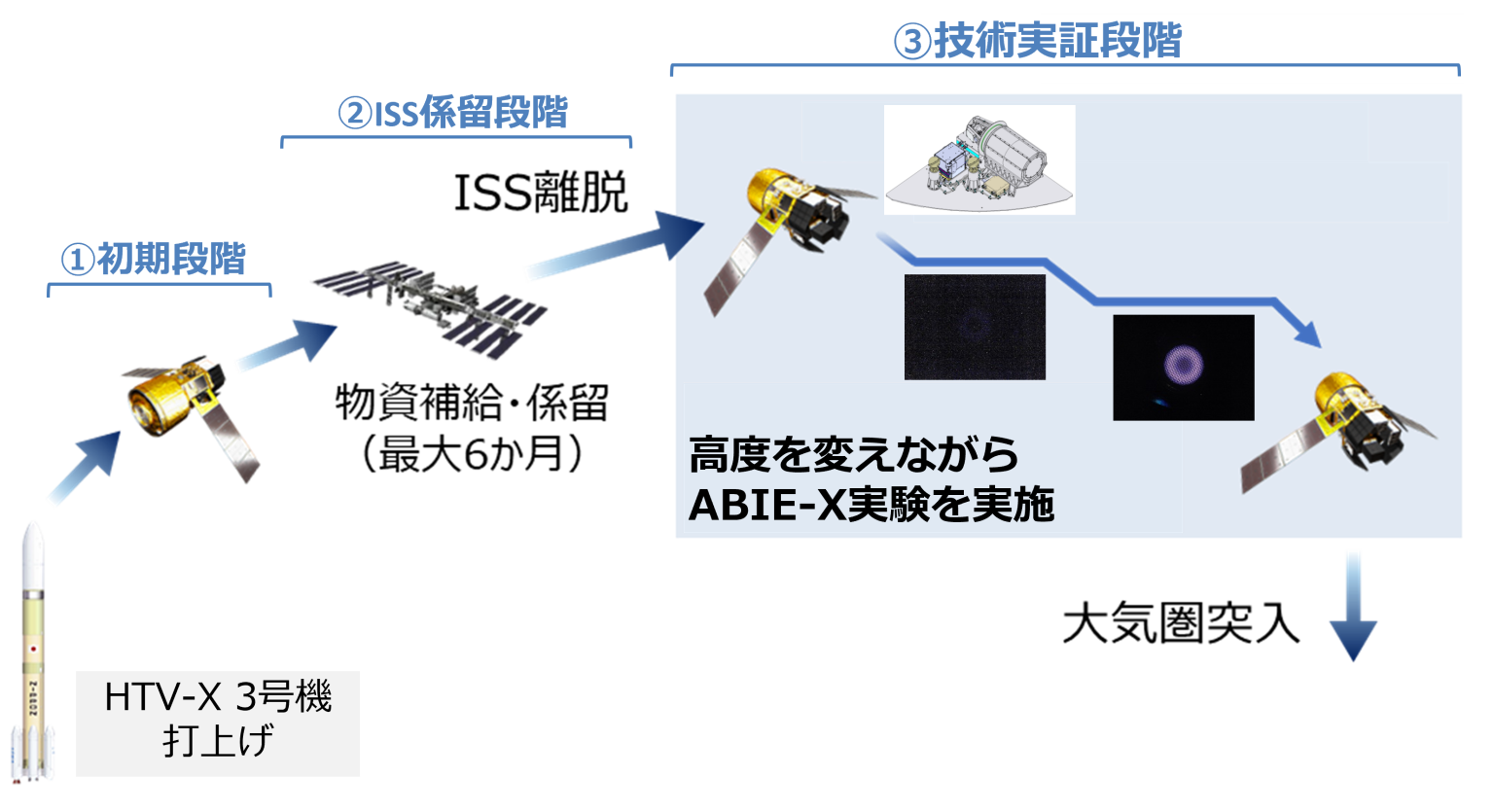
ABIE-X on-orbit testing will be conducted aboard JAXA’s next-generation HTV-X3 resupply spacecraft, a new cargo platform developed for International Space Station (ISS) logistics support, featuring long-duration orbital flight and multi-payload carrying capabilities. The entire ABIE-X testing sequence is divided into three phases, spanning the full lifecycle of HTV-X3 from launch to atmospheric reentry, with all experiments executed autonomously in unmanned mode.
Initial Phase: On-Orbit Functional Check Before ISS Docking
After the HTV-X3 spacecraft carrying ABIE-X is launched into orbit, the system will initiate initial on-orbit functional verification during the transit phase to the ISS. Ground controllers will conduct comprehensive diagnostics of the nine core components via remote commands, verifying power supply, communication and basic operational status, ensuring no mechanical damage from launch and stable data transmission and telemetry links ahead of formal testing.
Standby Phase: Survival Mode During ISS Berthing
Once HTV-X3 docks with the ISS and enters the logistics berthing phase, ABIE-X will switch to Survival Mode. During this phase, the system only maintains basic thermal insulation operations, suspending all experimental functions until the spacecraft completes resupply missions and departs the ISS, awaiting formal test activation commands. This phase prioritizes power conservation to sustain stable performance of critical equipment during extended standby.
Demonstration Phase: Core Testing From ISS Undocking to Atmospheric Reentry
This represents the most critical technical verification phase of ABIE-X. Starting from HTV-X3’s undocking from the ISS until prior to atmospheric reentry and disposal, ground controllers will maneuver the spacecraft to maintain flight at varying orbital altitudes, activating all ABIE-X experimental functions simultaneously.
During testing, the system will sequentially complete the full process of atmospheric capture, compression and ionization across varying orbital altitudes, collecting massive experimental data via onboard monitoring devices. By adjusting the spacecraft’s holding altitude, researchers will obtain system operational parameters under varying atmospheric density and composition conditions, validating ABIE technology adaptability across diverse orbital environments and completing the world’s first on-orbit demonstration of atmospheric compression and ionization.
Future Development: From Principle Verification to Practical Propulsion, Exploring Semi-Permanent Orbital Satellites
Current R&D and testing of ABIE-X focus on on-orbit verification of plasma generation from rarefied atmospheric particles, the first critical step toward practical ABIE technology deployment. JAXA plans to use performance data and low-orbit atmospheric pressure/composition survey results from this on-orbit test to further develop ABIE engine systems capable of generating usable thrust, solving core technical challenges from plasma generation to thrust output.
In parallel with engine system development, JAXA will advance the design and development of ABIE-equipped satellites, integrating mature ABIE technology with satellite platforms to develop new satellites optimized for VLEO operations. These satellites eliminate the need for large propellant loads, effectively reducing launch costs, while continuously compensating for VLEO atmospheric drag via sustained atmospheric collection and propulsion to achieve long-term stable orbital flight.
In the long term, mature ABIE technology will not only facilitate commercial and scientific applications in VLEO—delivering higher resolution and lower latency for Earth observation, communication and navigation satellites—but also provide a novel propulsion solution for deep space exploration of Mars, Venus and other atmospheric planets. While technical challenges remain, including efficient capture of extremely rarefied atmosphere, improved ionization efficiency and long-term equipment stability in space, this innovative propulsion approach has opened a new technical pathway for aerospace advancement.
Moving forward, successful completion of ABIE-X on-orbit testing and subsequent technical optimization will enable spacecraft to achieve self-sufficiency in space, advancing semi-permanent orbital satellites from conceptual design to engineering reality, and providing new technical support for expanding the depth and breadth of human space exploration.
https://www.satnavi.jaxa.jp/ja/project/abie-x/