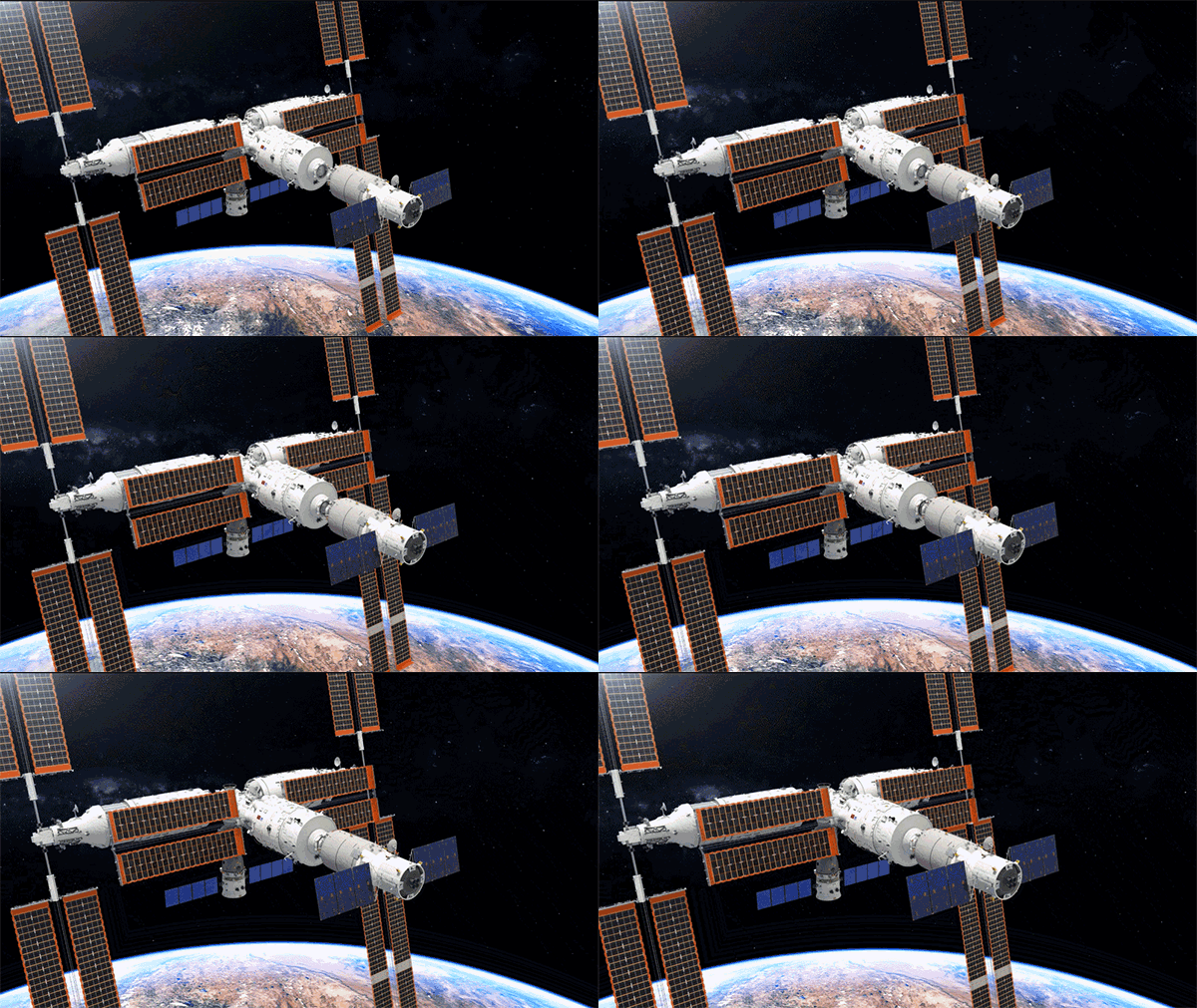
As the core vehicle for Earth-to-space cargo transportation supporting the China Space Station (CSS), the Tianzhou cargo spacecraft undertakes critical missions including material delivery, propellant refueling, and orbit and attitude maintenance. The key technology enabling its precise and efficient docking with the space station is full-phase autonomous rapid rendezvous and docking.
Since Tianzhou-2, this technology has eliminated launch-phase constraints, allowing autonomous docking across a full 0–360° phase range. It has reduced space cargo delivery timelines from days to hours, laying a solid technical foundation for the stable construction and routine operation of the China Space Station.
Full-Phase Autonomous Docking: Breaking Orbit Constraints for Precision Targeting in Space
Space rendezvous and docking is a foundational prerequisite for in-orbit assembly, resupply, and maintenance of space stations. The full-phase autonomous rapid rendezvous and docking strategy adopted by Tianzhou spacecraft represents a major advancement over conventional methods: it removes dependence on injection phase, enabling fully autonomous space "delivery."
Regardless of injection angle, the onboard navigation and control system can sense relative position, phase angle, altitude difference, and other key parameters relative to the space station in real time, and autonomously plan the optimal docking trajectory without continuous ground guidance. This flexibility supports resupply under diverse launch windows and orbital conditions, significantly improving mission adaptability and fault tolerance.
Full-phase autonomous rapid rendezvous and docking consists of two core sequential phases:
Long-Range Autonomous Guidance Phase: Acting as the navigation and positioning stage, the spacecraft autonomously calculates total rendezvous duration and timing of orbital maneuver impulses based on phase and altitude differences. It navigates from hundreds of kilometers away to a designated hold point behind and below the station, with guidance error controlled at the kilometer level. This phase is fully autonomous, eliminating reliance on ground-updated commands.
Close-Range Autonomous Control Phase: The core of precision docking. Under close-range hold constraints, the spacecraft performs sequential maneuvers including homing, approach, flyaround, and translational docking. It accommodates multiple station ports and supports port reconfiguration. Using high-precision sensors for continuous tracking, the two high-speed spacecraft achieve smooth docking.
Three Docking Modes: Building a Flexible Space Logistics Timeline
Supported by full-phase autonomous technology, Tianzhou cargo spacecraft have established three standardized rapid rendezvous and docking profiles: 6.5 hours, 3 hours, and 2 hours. Each is optimized for speed, propellant usage, and operational robustness, mirroring tiered terrestrial logistics services to form a highly adaptable space transportation system.
6.5-Hour Mode: Mature Baseline Profile
The 6.5-hour profile was the first rapid docking mode demonstrated in orbit. Initially tested on Tianzhou-1 and operationally implemented on Tianzhou-2, it has been repeatedly validated on Tianzhou-3, -4, and -6. With high stability and tolerance to orbital deviations and equipment variations, it serves as the baseline resupply mode, accumulating extensive engineering data for faster profiles.
2-Hour Mode: World-Record Ultra-Fast Docking
The 2-hour mode represents an extreme technical challenge, requiring unprecedented precision across all systems. In March 2022, Tianzhou-2 demonstrated the 2-hour profile during a post-mission re-docking test.
In November 2022, Tianzhou-5 achieved the world’s fastest operational rendezvous and docking using the 2-hour profile. This capability enables timely delivery of time-sensitive and cryogenic experiment payloads and strengthens emergency logistics support for crew safety.
3-Hour Mode: Balanced Speed and Reliability for Routine Operations
The 3-hour mode combines the stability of the 6.5-hour profile with the efficiency of the 2-hour mode, creating an optimal balance for routine missions. It reduces stringency on launch injection accuracy, ground tracking, sensor performance, and guidance precision while retaining rapid delivery advantages, greatly enhancing overall mission reliability.
In 2025, Tianzhou-7 and -8 demonstrated the 3-hour profile. Tianzhou-9, launched in July 2025, further validated the mode under new orbital altitudes and solar incidence angles, confirming its robust performance across complex conditions. The 3-hour profile has since become the standard rendezvous and docking mode for Tianzhou spacecraft. Tianzhou-9 also introduced a 3-month emergency launch capability, strengthening the space station’s logistics resilience.
Technical Innovations: Improved Guidance Precision for Reduced Docking Time
Early Chinese rendezvous and docking missions relied on 2–3 day phasing, with long-range guidance fully planned and uploaded from the ground. Reducing this timeline to hours required a step-change in long-range guidance terminal accuracy.
Two key optimization strategies enabled this breakthrough:
Reducing error propagation time through improved maneuver planning algorithms, eliminating unnecessary holds and trimming total rendezvous duration.
Minimizing the number of maneuver impulses in the long-range phase, simplifying operations, reducing cumulative error, and boosting orbital maneuver efficiency.
These improvements delivered dramatic gains in terminal guidance precision, enabling sustained rapid rendezvous performance. Across multiple Tianzhou missions, all full-phase autonomous profiles have exceeded design requirements, demonstrating stable, repeatable in-orbit performance and placing China’s rendezvous and docking capability among the world’s most advanced.
Conclusion
From 2–3 day conventional rendezvous to routine 6.5-hour and 3-hour rapid docking, and the record-breaking 2-hour profile, the evolution of Tianzhou’s full-phase autonomous rendezvous and docking technology reflects the iterative advancement of China’s human spaceflight program.
Continued refinement and application of this technology will sustain routine operations of the China Space Station, provide valuable technical heritage for future crewed lunar landing and deep-space exploration programs, and strengthen China’s space logistics system with greater efficiency, reliability, and operational flexibility.
https://www.cmse.gov.cn/xwzx/202603/t20260327_57364.html