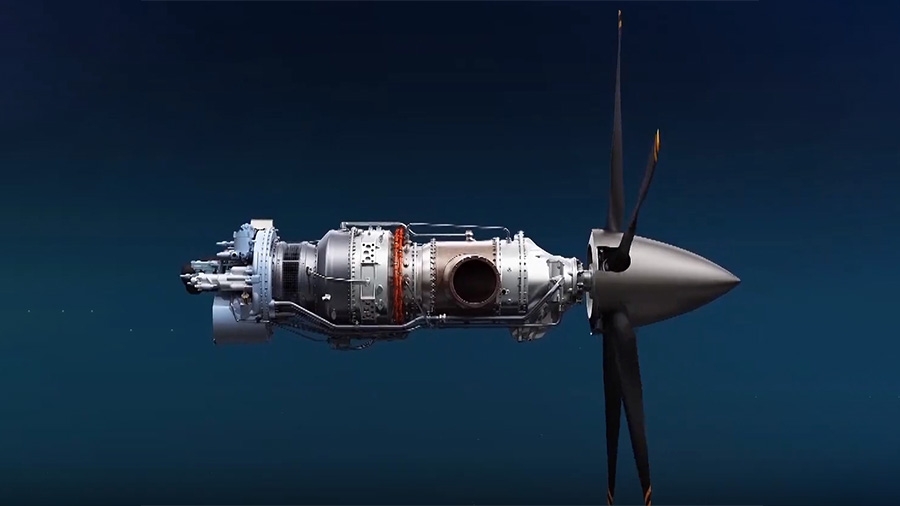
In March 2026, China Aero Engine Group Corporation (AECC) announced a major technological breakthrough: the AEP100 liquid hydrogen-fueled turboprop engine, independently developed by the Hydrogen Energy Aviation Power Team of AECC Aviation Powerplant Research Institute, has successfully completed ground ignition and performance commissioning tests. Throughout the tests, all indicators of the engine itself and the liquid hydrogen transportation system remained within the normal range, with stable full-state operation, marking the first time in China that a megawatt-class liquid hydrogen-fueled aero-engine has met the overall performance standards. This achievement signifies that China has officially mastered the key technologies for liquid hydrogen-fueled aero-turbine power, filling the domestic technological gap in this field and laying a solid core technical foundation for the transformation of liquid hydrogen aviation power technology from the laboratory test phase to the engineering application phase.
Liquid Hydrogen: An Ideal Path for Deep Decarbonization of Aviation, with Technological Breakthrough Boasting Crucial Industrial Value
Driven by the global "dual carbon" goals and the green transformation of the aviation industry, the search for clean and efficient alternative aviation fuels has become a core R&D direction in the aviation power sector. Liquid hydrogen, with its core characteristics of ultra-high energy density and zero carbon emissions, is recognized as an ideal technical path to achieve deep decarbonization of the aviation industry. Its only combustion product is water, which fundamentally solves the carbon emission problem caused by the combustion of traditional aviation kerosene. Meanwhile, its energy density far exceeds that of traditional fossil fuels and other hydrogen storage and transportation forms, making it more suitable for the lightweight and high-efficiency requirements of aviation equipment for power systems.
However, the R&D of liquid hydrogen-fueled aero-engines is no easy task. The ultra-low temperature characteristic of liquid hydrogen (with a boiling point of about -253℃) places extremely high demands on the low-temperature resistance of engine materials, sealing technology, and the low-temperature adaptability of fuel transportation systems. In addition, issues such as power matching and combustion efficiency optimization of turboprop engines have become core difficulties in the R&D of liquid hydrogen aviation power technology. The successful ground test of the AEP100 liquid hydrogen-fueled turboprop engine has not only verified the feasibility of China's core technologies in the overall design of liquid hydrogen aero-engines, low-temperature fuel transportation, and combustion control, but also achieved performance compliance at the megawatt-class power level. This provides crucial technical support for the practical application of liquid hydrogen power in the aviation field and a brand-new technical solution for the green transformation of China's aviation industry.
Independent R&D Achieves Technological Breakthrough, Full-System Performance Validates Engineering Potential
The AEP100 liquid hydrogen-fueled turboprop engine that completed the tests this time was independently developed throughout the process by the Hydrogen Energy Aviation Power Team of AECC Aviation Powerplant Research Institute. Independent technological research and development have been realized in all core links, including the overall structural design of the engine, R&D of the low-temperature fuel supply system, ignition control, and performance commissioning. During the tests, the R&D team focused on verifying the ignition reliability, full-working-condition operation stability of the engine in the ground environment, as well as key indicators such as low-temperature sealing and fuel delivery efficiency of the liquid hydrogen transportation system. All test items met the preset standards, fully proving that the engine has the basic conditions for engineering R&D and subsequent applications.
The core value of this breakthrough lies in the achievement of overall performance compliance of a megawatt-class liquid hydrogen-fueled aero-engine. The megawatt-class power level is adapted to the power demand of mainstream application scenarios such as medium and short-haul air transportation and air logistics. This technological achievement enables liquid hydrogen aviation power to move beyond the stage of small-power test prototypes and possess the key capability for transformation to actual engineering applications. At the same time, the stable performance of the liquid hydrogen transportation system in the tests has also solved the supporting technical problems in the application of liquid hydrogen aviation power, providing important system technical support for the overall R&D and integration of subsequent liquid hydrogen aviation equipment.
Phased Application in Multiple Scenarios Expected, Unleashing a Trillion-Yuan Green Hydrogen Industry Chain
Relying on the technological breakthrough of the AEP100 liquid hydrogen-fueled turboprop engine, the industrial application path of liquid hydrogen aero-engine technology has gradually become clear. According to the R&D plan, the technology will follow the application principle of phased advancement and scenario adaptation, initially targeting unmanned air logistics and regional aviation for commercial application. The flight distance and load requirements of such scenarios are highly matched with the power level of the AEP100 engine, and the application of unmanned equipment can further reduce the technical verification cost of the initial application of liquid hydrogen aviation power, accumulating actual operation data for subsequent technical optimization.
On the basis of the mature application of initial scenarios, liquid hydrogen aero-turbine power technology will gradually extend to the trunk aviation field. Through technological upgrades such as power level improvement and engine model adaptation, it will meet the power demand of large civil airliners, and ultimately realize the large-scale transformation of the aviation industry from traditional fossil fuels to liquid hydrogen clean fuels.
More importantly, the breakthrough in liquid hydrogen aviation power technology is not a technological progress in a single field, but will drive the coordinated development of the entire green hydrogen industry chain, activating the layout of the whole industry chain from green hydrogen production, hydrogen liquefaction, low-temperature storage and transportation to aviation hydrogen refueling infrastructure, and forming a trillion-yuan industrial development space. At the same time, the technical demand for low-temperature resistant new materials, high-precision seals, low-temperature measurement and control equipment generated in the R&D process of liquid hydrogen aero-engines will further promote technological innovation in the high-end equipment manufacturing and new materials industries, forming an industrial pattern led by the breakthrough of advanced aviation power technology and driving the coordinated development of multiple strategic emerging industries.
Technological Breakthrough Establishes Industrial Status, Accelerating the Green Transformation of China's Aviation Industry
The mastery of key technologies for liquid hydrogen-fueled aero-turbine power this time is an important milestone in the R&D of green power in China's aero-engine field. It not only enables China to occupy an important technological position in the global R&D of liquid hydrogen aviation power technology, but also fills the core technical gap in the field of aviation clean power in China, breaking the leading advantage of foreign countries in aviation low-carbon power technology.
Currently, the global aviation industry is accelerating its green transformation. European and American aviation powers have listed liquid hydrogen aviation power technology as a core R&D direction, and the R&D progress of liquid hydrogen engines has become an important indicator to measure the technological innovation capability of aviation power technology in various countries. The successful ground test of China's AEP100 liquid hydrogen-fueled turboprop engine has enabled China to achieve track-side competition with the international advanced level in the R&D of liquid hydrogen aviation power, laying a technical foundation for subsequent participation in the formulation of technical standards and industrial cooperation for the global green transformation of the aviation industry.
From the perspective of industrial development, this technological breakthrough will further accelerate the green transformation process of China's aviation industry, making liquid hydrogen one of the core paths for the decarbonization of the aviation industry, while driving the development of related industries such as green hydrogen energy and high-end equipment manufacturing, and forming a positive cycle of technological innovation and industrial development. In the future, with the continuous optimization and engineering application of liquid hydrogen aviation power technology, China will gradually build an independent and controllable industrial system for liquid hydrogen aviation power, providing core technical support for the sustainable development of the aviation industry and contributing Chinese technical solutions to the deep decarbonization of the global aviation industry.