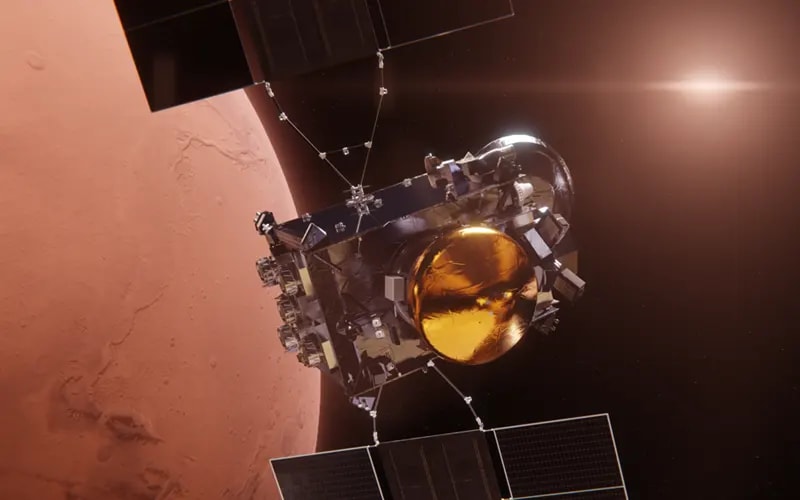
On March 28, 2026, the European Space Agency (ESA) announced following its 345th Council Meeting that member states have formally proposed the cancellation of the Earth Return Orbiter (ERO) program. As ESA’s centerpiece contribution to the joint NASA-ESA Mars Sample Return (MSR) campaign, the termination of ERO effectively grounds one of the most ambitious deep-space cooperation projects in history, placing humanity’s first attempt to return Martian samples to Earth on indefinite hold.
ERO: ESA’s Core Contribution to Mars Sample Return
The Earth Return Orbiter was designed as the critical link in closing the Mars sample return chain: its mission was to reach Mars orbit, capture the sample canister launched from the Martian surface, and deliver it safely back to Earth.
In October 2020, ESA awarded a €491 million contract to Airbus Defence and Space for the development, construction, and delivery of ERO. Planned to feature advanced autonomous rendezvous and docking systems, electric propulsion, and specialized sample recovery hardware, the orbiter was intended to be the first spacecraft dedicated to Martian sample return. Under the original partnership framework, NASA would handle surface sampling, encapsulation, and launch from Mars, while ESA was responsible for the orbital transfer and Earth return phase.
Budget Overruns and Schedule Delays Lead to Program Collapse
The collapse of MSR was not sudden, but the result of years of unsustainable cost growth and schedule slippage. A turning point came in September 2023, when an independent NASA review board labeled the program’s cost and timeline assumptions unrealistic, warning of spiraling expenses and unachievable deadlines.
Despite repeated architectural reviews and attempts to simplify the mission, fundamental budget and technical hurdles remained unresolved. In January 2026, the U.S. Senate voted to eliminate all funding for Mars Sample Return, effectively terminating NASA’s role in the program. The cut came amid a broader FY2026 NASA budget realignment that prioritized programs like Artemis while abandoning the over-budget MSR effort.
Following NASA’s withdrawal, Daniel Neuenschwander, ESA’s Director of Human and Robotic Exploration, publicly stated that no further work on Mars Sample Return was planned, yet left the fate of ERO ambiguous for months. That uncertainty ended at the March 2026 ESA Council, where member states formally moved to cancel the orbiter program, bringing the transatlantic partnership to a definitive close.
ESA Pursues Technology Reuse to Mitigate Program Loss
Even with ERO’s cancellation, ESA is moving to salvage investments from years of development. Daniel Neuenschwander confirmed that ESA has begun formal discussions with prime contractor Airbus Defence and Space to manage the program’s wind-down and maximize return on technical investment.
A primary focus will be the reuse of ERO’s electric propulsion system, developed for long-duration, low-thrust deep-space missions. This high-performance system is adaptable to lunar exploration, asteroid missions, and large near-Earth spacecraft, offering direct value for ESA’s future exploration roadmap.
Additional technologies under review for reuse include autonomous rendezvous and docking, deep-space navigation, and cryogenic propellant storage. ESA intends to repurpose these MSR-derived capabilities for its domestic lunar and planetary exploration programs, turning cooperative investment into strengthened independent capacity.
A Setback for International Deep-Space Collaboration
The cancellation of ERO represents more than a delay in Martian science; it marks a significant setback for large-scale international space collaboration. MSR’s failure exposes recurring vulnerabilities in multinational deep-space projects: extreme technical complexity, long development cycles, massive upfront costs, and sensitivity to shifting national fiscal and strategic priorities.
Technically, Mars Sample Return ranks among the most challenging missions ever conceived, requiring precision surface operations, interplanetary launch, deep-space rendezvous, and high-speed Earth reentry. Any single point of failure or cost escalation could destabilize the entire architecture.
Cooperation-wise, the program suffered from an imbalance in funding and decision-making, with NASA providing the bulk of financial support. When U.S. funding ended, ESA could not justify bearing the full cost of ERO and subsequent mission phases alone, highlighting the fragility of dependency structures in large collaborative programs.
While the pause in sample return slows progress in understanding Martian geology, climate history, and potential past life, the technologies matured under MSR—from NASA’s sampling and encapsulation systems to ESA’s orbital and propulsion technologies—remain as a durable legacy for future Mars exploration.
For ESA, the end of ERO reinforces a shift toward more autonomous, European-led exploration programs to reduce reliance on international partnerships. For the global space community, the episode underscores the need for stronger cost governance, risk mitigation, and shared governance structures in future large-scale collaborations.
Mars sample return will likely remain a long-term goal for human space exploration. When it proceeds, the lessons from the NASA-ESA MSR effort—both technical and organizational—will shape how the next generation of missions is designed, funded, and governed.