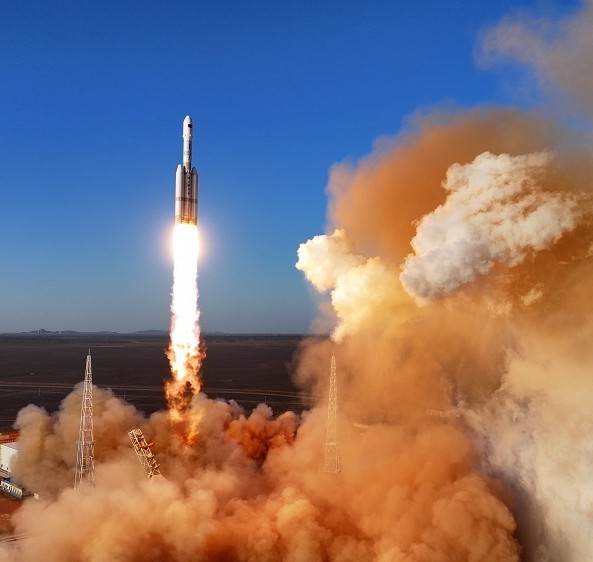
At 19:00 on March 30, 2026, the Lijian-2 Y1 carrier rocket lifted off from the Dongfeng Commercial Aerospace Innovation Test Zone. The rocket maintained a stable flight throughout the mission and successfully placed three payload satellites—the New Journey-01, New Journey-02 and Tianshi-01—into their preset orbit as scheduled, marking the complete success of its maiden flight test mission. The achievement adds a key new model to China’s commercial aerospace launch vehicle family, further enhancing the country’s commercial space launch capabilities and bolstering the diversified layout of its commercial aerospace launch system.
The launch was conducted at the Dongfeng Commercial Aerospace Innovation Test Zone, a core site for commercial space launches in China. Equipped with comprehensive hardware and software support capabilities adaptable to a variety of commercial carrier rockets, the zone delivers efficient and flexible launch services for commercial aerospace missions. The successful maiden launch of the Lijian-2 Y1 rocket has once again validated the zone’s mature mission support capabilities and standardized operational standards for commercial space launches, laying a solid on-site foundation for the regular conduct of subsequent commercial launch tasks.
Adopting a one-rocket, three-satellite launch mode, all three payloads on this mission are commercial aerospace application satellites, set to undertake missions such as commercial communications and remote sensing observation after entering orbit. In the follow-up, the three satellites will complete on-orbit testing as planned and be officially put into commercial operation upon passing all tests, providing professional technical support and high-quality data services for commercial aerospace applications in relevant fields and facilitating the improvement and upgrading of China’s commercial aerospace application industry chain.
The successful maiden flight test of the Lijian-2 carrier rocket represents another important breakthrough in the research and development of China’s commercial aerospace launch vehicle technology. The rocket’s official commissioning has enriched the spectrum layout of China’s commercial aerospace launch vehicles, filled the gap in commercial launch services for relevant payload capacity ranges, and laid a solid technical foundation for the large-scale and regular implementation of China’s commercial space launch missions. Currently, China’s commercial aerospace industry is in a phase of rapid development. The continuous breakthroughs in launch vehicle technology and steady improvement of launch capabilities will further drive the development of downstream application fields such as commercial communications, commercial remote sensing and low-Earth orbit communication constellation construction, propelling China’s commercial aerospace industry toward high-quality and large-scale development.
Going forward, the Lijian-2 carrier rocket will leverage its mature technical system and supporting launch guarantee capabilities to undertake more commercial space launch missions for domestic and international clients, delivering high-reliability and cost-effective launch services to the global commercial aerospace market. Meanwhile, the rocket will form a payload capacity complement with other existing commercial carrier rockets in China, jointly building a diversified and multi-level commercial aerospace launch system. This will inject new impetus into the international development of China’s commercial aerospace industry and provide more Chinese solutions and support for the growth of the global commercial aerospace market.