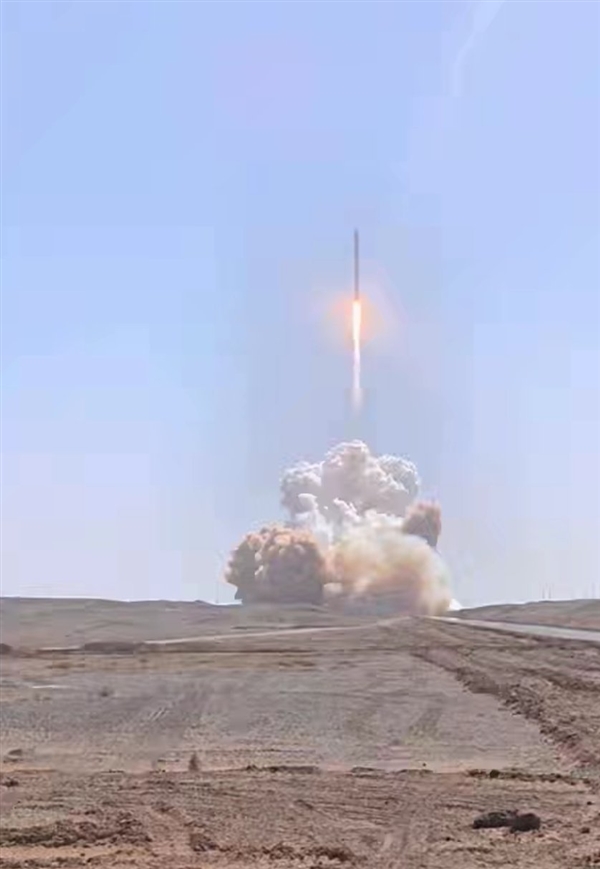
On April 3, 2026, at 12:17 Beijing Time, the Tianlong-3 Y1 carrier rocket developed by Space Pioneer experienced an in-flight anomaly shortly after liftoff from the Jiuquan Satellite Launch Center, resulting in the failure of its maiden flight test. The company issued a statement immediately, confirming it was launching a joint expert investigation and would implement a full failure review and correction process in line with aerospace engineering standards. It also apologized to its partners and the public.
As a key heavy-lift reusable launch vehicle in China’s commercial space sector, the Tianlong-3 failure is more than a technical setback for Space Pioneer. It offers a clear window into the challenges of rapid industry expansion: as China moves from follower to competitor in global space, technical trial and error becomes both inevitable and essential to building long-term reliability.
Tianlong-3: A Heavy-Lift Ambition for Commercial Space
Tianlong-3 was designed to address a critical gap in China’s commercial launch capacity: heavy lift. Standing 72 meters tall with a liftoff thrust of 840 tons and a mass of 600 tons, it aimed for 17–22 tons to LEO and 10–17 tons to 500 km SSO, with reusability built into its design.
This filled a real market need. With the rapid growth of low-Earth orbit constellations, commercial remote sensing, and space-based computing, demand for heavy launch has surged beyond what small–medium commercial rockets can support. Tianlong-3 represented one of the most ambitious attempts by a private Chinese firm to break into this high-value segment.
Its core Tianhuo-12 engine, delivering 93 tons of sea-level thrust with a thrust-to-weight ratio of 163, was a major in-house development. The in-flight anomaly thus highlights the steep technical challenges in large-thrust liquid engines and heavy-lift vehicle integration — challenges that extend far beyond small launcher development.
Third-Party Perspective: Failure Is Normal in High-Growth Commercial Space
From an industry-wide perspective, the Tianlong-3 failure is not an isolated incident, but part of a global pattern in fast‑expanding space sectors. In 2025 alone, launch failures occurred across nations — including Chinese Long March and Gravity Force models, Japan’s H3, and India’s PSLV. Most stemmed from propulsion, avionics, integration, or quality control.
Technically, heavy-lift rockets involve extreme environments: high temperature, pressure, vibration, and dynamic loads. A minor flaw in any subsystem can escalate into mission failure. Worldwide, over 54% of launch failures are propulsion-related. For a first-flight heavy-lift liquid rocket, anomalies are statistically normal.
Commercially, China’s private space industry is in an unprecedented acceleration phase. Policy support, faster licensing, and investment have pushed numerous new rockets toward maiden flights in a short window. This “rapid develop–rapid test” model brings agility but also pressure. Many companies operate with tighter budgets, less testing infrastructure, and shorter timelines than traditional state programs. Trial and error is part of the cost of innovation.
Space Pioneer’s achievement in reaching the launch pad at all with a heavy rocket is significant. Failure, while disappointing, is a typical stage in maturing advanced launch systems.
Failure Review: The Foundation of Reliability
Space Pioneer’s commitment to a full failure review and correction process is the industry’s gold standard. Rooted in decades of Chinese aerospace practice, this system requires:
Accurate fault location
Clear physical mechanism
Reproducibility
Valid corrective actions
Cross-system prevention
How thoroughly the company completes this process will directly shape its future credibility. Past international cases show that incomplete reviews lead to repeated failures. For commercial launch providers, technical accountability is inseparable from market trust.
A transparent, rigorous review will help stabilize partner and investor confidence — critical in an industry where schedule and payload safety are paramount.
Industry Takeaway: Balancing Speed and Reliability
The Tianlong-3 failure underscores a central challenge for China’s commercial space: sustaining growth without compromising reliability.
The market is expanding quickly, with demand driving pressure for faster development and more launches. Yet aerospace remains a high-risk, high-reliability industry. Speed cannot override engineering discipline.
Internationally, the cautionary example of Japan’s Space One — which suffered multiple explosions due to insufficient risk management — shows the danger of prioritizing speed over robustness.
For Chinese private rocket companies:
More ground testing, not less, is essential
Full-system integration tests cannot be rushed
Quality control must cover components, assembly, and launch operations
From an ecosystem perspective, regulators and industrial partners can help by sharing test data, improving standards, and supporting cross-company experience exchange. Investors also play a role by accepting realistic development timelines.
Conclusion: Failure Is Not the End, but a Step Forward
The Tianlong-3 failure is a setback for Space Pioneer, but not a roadblock for China’s commercial space.
SpaceX’s Falcon 1 failed three times before success. Those failures laid the foundation for Falcon 9 and Falcon Heavy. Similarly, China’s private sector will learn and improve through real-flight experience.
What matters now is a thorough root-cause analysis, effective corrections, and sustained engineering discipline. With these, Tianlong-3 may yet succeed in future flights.
In the longer term, China’s commercial space industry needs both ambition and rigor. Companies that master trial and error, balance speed and reliability, and invest in real technology will lead the next generation of global launch.
The Tianlong-3 failure will be remembered not as a defeat, but as a necessary lesson in building a truly competitive, reliable, and world-class commercial space industry.