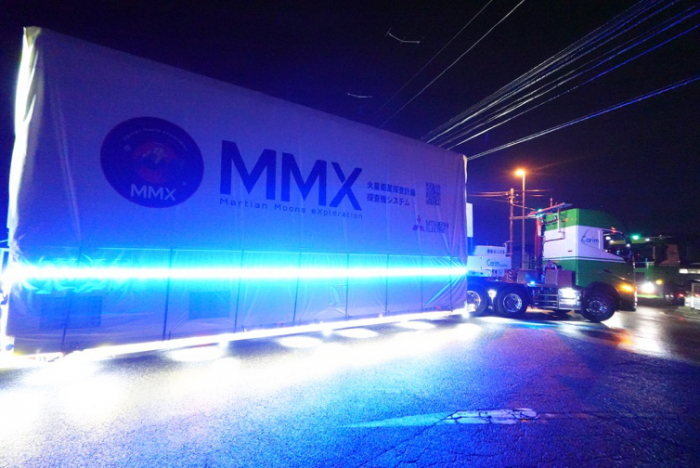
On March 31, 2026, the Japan Aerospace Exploration Agency (JAXA) announced that the spacecraft for the Martian Moons eXploration (MMX) mission had arrived at the Tanegashima Space Center in Kagoshima Prefecture. The milestone marks the start of final assembly and system testing for the world’s first Mars moon sample‑return mission, ahead of its scheduled launch in fiscal 2026.
Built and tested by Mitsubishi Electric, the MMX spacecraft departed its Kamakura facility on March 28, transported by sea to Tanegashima’s Shimokoshi Port, then moved to the Spacecraft Test and Assembly Building 2 (STA2). Over the coming weeks, it will undergo full Proto‑Flight Testing (PFT) to validate performance in simulated space environments.
MMX represents JAXA’s next major deep‑space endeavor following the successful Hayabusa2 asteroid sample return. By targeting Phobos and Deimos, the mission aims not only to resolve longstanding scientific questions but also to establish technical foundations for future cislunar and Mars exploration architectures.
Industry & Engineering Perspective: A Testbed for Deep‑Space Capabilities
MMX’s delivery to Tanegashima underscores Japan’s mature end‑to‑end spacecraft development and project management. Mitsubishi Electric’s role as prime contractor — from system design and integration to environmental testing — reflects a robust industrial base built on prior missions including Hayabusa, Akatsuki, and planetary exploration satellites.
The sea transport and handling process follows strict contamination and vibration controls typical for high‑precision deep‑space vehicles. Once inside STA2, the spacecraft will be subjected to thermal vacuum, vibration, and electromagnetic testing to verify flightworthiness.
Technically, MMX builds directly on Hayabusa2’s proven sampling and reentry technologies, while upgrading guidance, navigation, and control for the weak gravity and unique orbital dynamics of Phobos. The upcoming PFT campaign will be critical in qualifying these upgrades for the multi‑year interplanetary cruise.
Resolving the Origin of the Martian Moons
From a global planetary science perspective, MMX addresses one of the most consequential unresolved questions in inner solar system history: are Phobos and Deimos captured asteroids, or remnants of a giant impact on Mars?
The two moons exhibit contradictory properties:
Low density, dark surface, and composition resembling carbonaceous asteroids, supporting the capture hypothesis
Near‑circular, low‑inclination orbits aligned with Mars’ equator, consistent with an impact‐debris origin
Without actual surface material, debate has continued for decades. MMX is designed to settle this by collecting and returning ≥10 grams of soil and subsurface samples from Phobos. Laboratory analysis on Earth will determine isotopic fingerprints, mineralogy, and organic content — providing definitive evidence for either formation scenario.
Beyond origin science, Phobos likely contains material ejected from Mars’ surface by impacts. As such, MMX could effectively return Martian surface samples at lower cost and risk than a Mars lander, complementing NASA’s Perseverance‑Mars Sample Return campaign.
A Stepping Stone to Human Mars Exploration
MMX is more than a science mission; it functions as a critical technology pathfinder for sustainable Mars exploration.
Key challenges include:
Precision landing and hovering in Phobos’ extremely low gravity (about 1/1000 of Earth’s)
Reliable sampling and containment in vacuum and low‐gravity conditions
Long‑duration deep‑space communication with long light‑time delays
Earth reentry at speeds exceeding 13 km/s
Success will validate systems directly applicable to future lunar and Mars crew missions. Strategically, Phobos is widely viewed as an ideal stepping stone for human missions: low escape velocity, unobstructed line‑of‑sight to Mars, and potential in‑situ resource utilization (ISRU) if water ice is confirmed. MMX’s mapping and surface measurements will directly support future base planning.
International Collaboration and Broader Impact
MMX embodies the increasingly collaborative nature of deep‑space exploration. The mission includes contributions from:
European Space Agency (ESA): scientific instruments and communications support
NASA: instruments and navigation support
French, German, and Italian research institutions
This international partnership places MMX within a coordinated global Mars exploration strategy, alongside NASA’s Artemis and Mars exploration programs.
Conclusion
The arrival of the MMX spacecraft at Tanegashima signals that humanity’s first attempt to return samples from a Mars moon is now within months of launch. More than a Japanese national mission, it is a global scientific and engineering milestone that will shape our understanding of solar system formation and lay groundwork for human exploration of the Mars system.
Following launch in fiscal 2026, MMX will reach Mars orbit after approximately one year, conduct 3 years of observation and sampling, and return samples to Earth in 2031. When those samples arrive, they will not only reveal the truth about Phobos — they will open a new era in Mars system science.