Against a backdrop of intensifying global space competition and growing pressure on international scientific and technological cooperation, a joint space science mission developed by the European Space Agency (ESA) and the Chinese Academy of Sciences (CAS) is approaching a critical milestone. The SMILE (Solar wind–Magnetosphere–Ionosphere Link Explorer) satellite was originally scheduled for launch on 9 April 2026 aboard a Vega‑C rocket from the European Spaceport in Kourou, French Guiana. The launch has since been delayed due to manufacturing and technical issues with subsystems of the launch vehicle. A new launch date will be confirmed following further coordination between Avio and ESA.
More than a routine satellite launch, this mission represents a landmark in full-cycle, deep cooperation between China and Europe in space science. It will use innovative observation methods to address fundamental questions in solar–terrestrial physics, providing critical support for global space weather forecasting and aerospace safety.
Mission Overview: Launch Profile and Orbital Deployment
SMILE is a flagship joint mission under ESA’s Cosmic Vision programme and the Strategic Priority Research Programme on Space Science (Phase II) of the Chinese Academy of Sciences. It also stands as another landmark project in solar–terrestrial physics following the Double Star Project between China and ESA.
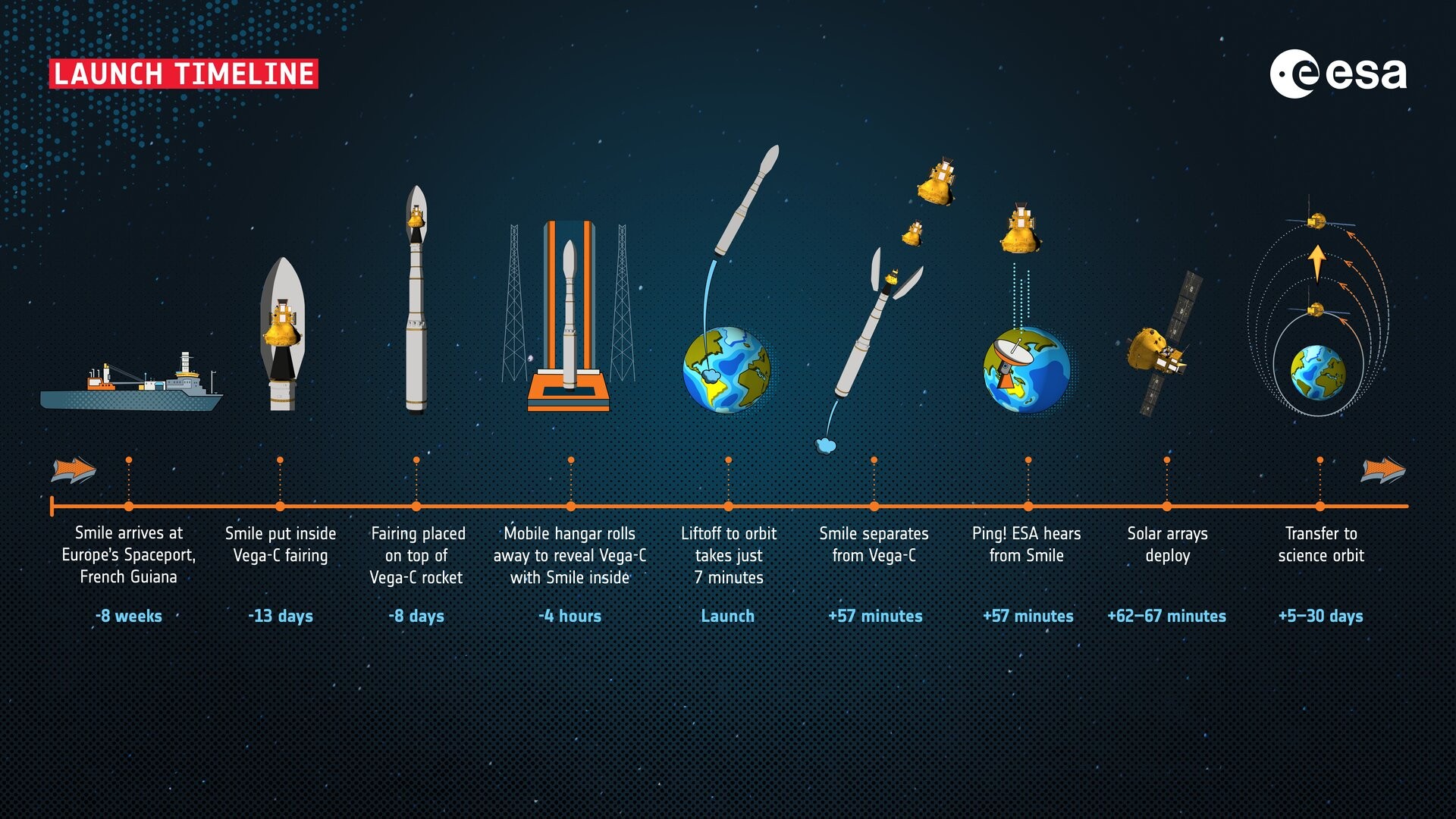
Based on the pre-launch timeline released by ESA, the entire launch sequence lasts approximately 1 hour and 56 minutes, with well-defined key events:
Liftoff: 08:29 CEST
Stage separation of solid rocket boosters: approximately 7 minutes after liftoff
Two upper-stage orbit insertion burns: 20 and 52 minutes after liftoff
Satellite separation from the launcher: 09:25 CEST
Solar array deployment: 09:32 CEST (critical milestone for mission success)
After separation, SMILE will perform 11 orbital manoeuvres over 25 days to transition from an initial 700 km circular orbit to a highly elliptical polar orbit. The orbit will reach an apogee of 121,000 km over the Arctic and a perigee of 5,000 km over the Antarctic, enabling full global coverage of the magnetopause, cusp regions, and auroral zones. The nominal scientific operational lifetime in orbit is three years.
Scientific Breakthrough: A Paradigm Shift from Local In-Situ Measurements to Global Imaging
For decades, studies of the solar wind–magnetosphere interaction have relied heavily on point-like in-situ measurements and numerical simulations, lacking large-scale, dynamic, and global observational data.
The core innovation of SMILE lies in its combination of soft X-ray imaging and ultraviolet auroral imaging, effectively performing a 'CT scan' of Earth’s magnetosphere. The mission aims to directly resolve three fundamental scientific questions:
The mechanisms of energy and mass exchange between the solar wind and Earth’s magnetopause
The initiation and evolution of intense geomagnetic storms, with the goal of improving forecasting lead times
The physical origin of irregular disturbances in Earth’s nightside magnetosphere
From an independent scientific perspective, this advancement carries profound significance:
It fills the long-standing gap in global imaging of the magnetopause, challenging traditional paradigms in magnetospheric physics
It provides real-world global constraints for space weather models, directly supporting the safety and resilience of satellites, power grids, and navigation systems
Joint payload design and open data sharing between China and Europe are driving solar–terrestrial physics into an era of coordinated observation and global collaborative research
Cooperation Model: A New Benchmark for China–Europe Space Collaboration
SMILE marks the first full-cycle deep space science cooperation between China and ESA, with a clear division of responsibilities and complementary strengths:
ESA: responsible for the payload module, soft X-ray imager, launch vehicle, assembly, integration and testing, and in-orbit operations support
CAS: responsible for the satellite platform, ultraviolet imager and three other scientific payloads, and leading the development of selected on-board systems
The international space community widely regards this model as highly instructive:
Cooperation is based on scientific objectives without political preconditions, emphasizing equal partnership and shared results
It establishes end-to-end coordination from scientific goal definition and payload development to data application
Amid tightening global controls on space technology exports, it offers a viable framework for large-scale international collaboration in space science
Industrial and Practical Value: Beyond Fundamental Science
SMILE’s value extends far beyond basic research, with tangible implications for aerospace engineering and societal applications:
Space weather resilience: Intense geomagnetic storms can cause satellite anomalies, navigation errors, and power grid disruptions. SMILE data will significantly improve early warning capabilities and protective measures
Technology demonstration: The mission validates advanced technologies for high-orbit long-life scientific satellite platforms, precise attitude control, and long-distance telemetry and telecommand
International standardisation: Jointly developed data formats and calibration methods for magnetospheric observations have the potential to become internationally accepted standards
For the commercial space sector, improved access to space weather data and enhanced models driven by SMILE will directly reduce operational risks for low-Earth orbit constellations and improve the stability of global communications, navigation, and remote sensing services.
Independent Perspective: A Collaborative Model for Both Large and Small Space Nations
From a viewpoint of global space governance, SMILE offers three key lessons:
Basic science as a stabiliser for international cooperation: In competitive domains, pure scientific missions offer the greatest potential for consensus and collective action
Differentiated specialisation over redundant development: ESA focuses on scientific instruments and launch capabilities, while China leads platform development and in-orbit operations, enabling efficient resource integration
Data sharing maximises scientific returns: Open access to SMILE data for the global research community accelerates breakthroughs in solar–terrestrial physics, embodying the universal nature of space exploration
While the launch delay introduces uncertainty, it also allows for more thorough troubleshooting and process refinement. For high-value scientific satellites, mission reliability is more important than meeting an accelerated schedule.