In a groundbreaking study featured yesterday in SciTechDaily, astronomers have utilized the unparalleled precision of the James Webb Space Telescope (JWST) to conduct a comprehensive "chemical physical" on one of the most enigmatic worlds discovered to date: TOI-5205 b.
Commonly referred to as the "Forbidden Planet," this gas giant is currently forcing scientists to reconsider everything they thought they knew about how planetary systems are born.
The Cosmic Mismatch: A David and Goliath Story
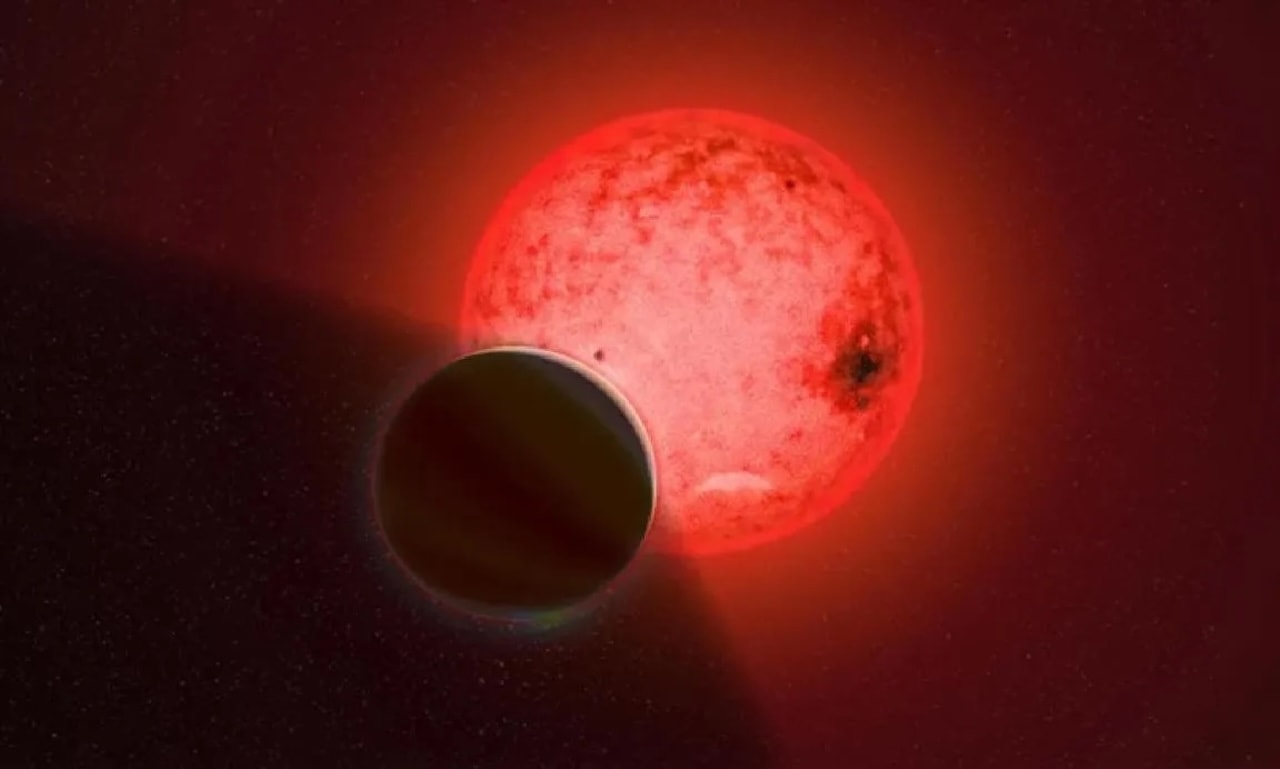
The mystery of TOI-5205 b lies in its sheer existence. It is a Jupiter-sized gas giant orbiting a small red dwarf (M-dwarf) star that possesses only about 40% of our Sun's mass.
According to standard planetary formation theories—specifically the Core Accretion Model—this shouldn't happen. A star’s protoplanetary disk (the swirl of gas and dust from which planets form) is typically proportional to the star's mass. A red dwarf should not have enough "building material" to construct a Jupiter-sized core before the disk evaporates.
The JWST Findings: A Chemical Paradox
While previous observations confirmed the planet's size and mass, JWST’s Near-Infrared Spectrograph has now allowed researchers to peer into its atmosphere. The results, led by researcher Simon Muller, are startling:
Low Heavy Element Abundance: The data reveals that the atmosphere of TOI-5205 b is surprisingly depleted of heavy elements (metals).
The Interior-Atmosphere Conflict: Logic dictates that to form such a massive planet around such a small star, the core would need to be exceptionally efficient at vacuuming up heavy materials. However, the atmosphere doesn't reflect this expected enrichment.
"This mismatch between the atmospheric composition and the internal models challenges our current framework," Muller noted. "The planet didn't follow the 'recipe' we've written for gas giant formation."
Why This Matters for the Future
The "Forbidden Planet" is more than just a celestial oddity; it is a vital data point for the next decade of astronomy.
Challenging the "Standard Model": If TOI-5205 b can form in such a resource-poor environment, we may be missing a fundamental mechanism in planet formation—perhaps a faster, more violent collapse of gas rather than a slow accumulation of dust.
Red Dwarf Systems: Red dwarfs are the most common stars in our galaxy. Understanding what kind of planets they can host—even "impossible" ones—is crucial in our search for habitable worlds.
Solar System Origins: By studying these extreme outliers, we gain a better "calibration point" for our own solar system's history. It helps us understand whether Jupiter's birth was a standard cosmic event or a lucky stroke of chemistry.
Final Thoughts
The James Webb Space Telescope continues to do exactly what it was designed for: breaking our models to build better ones. As we analyze the chemical fingerprints of TOI-5205 b, we aren't just looking at a distant gas giant; we are looking at a crack in the foundation of modern astrophysics, inviting us to explore a more complex and diverse universe.