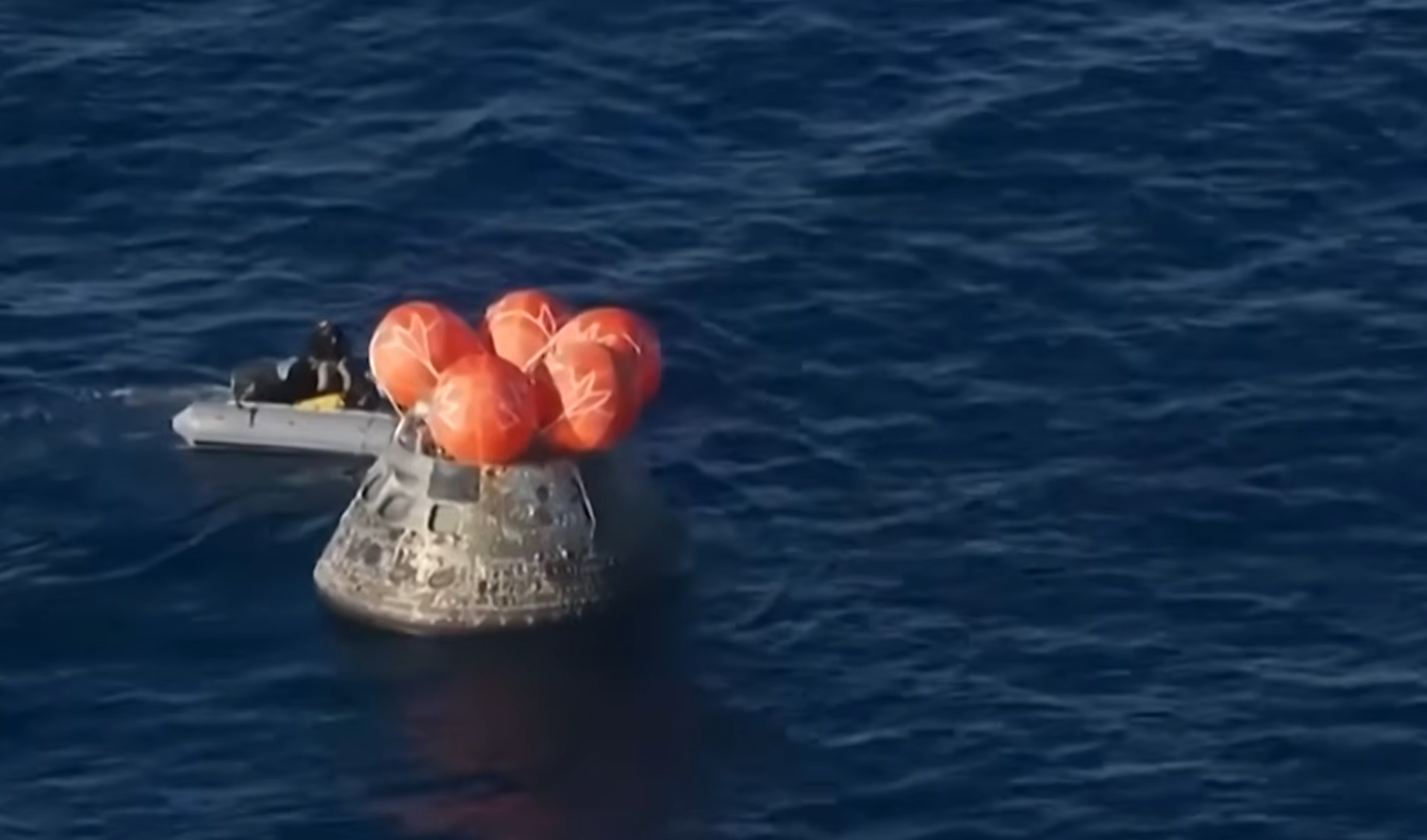
Earlier today, the Pacific Ocean—just southwest of San Diego—became the stage for a historic conclusion to the Artemis II mission. At 00:07 UTC, the Orion spacecraft successfully splashed down, marking the first time a human-rated vehicle has returned from the vicinity of the Moon since the conclusion of the Apollo program in 1972.
While the primary objective was the safe return of the four-person crew, the technical data gathered during the re-entry phase provides the most critical answers for NASA’s long-term lunar ambitions.
1. Mission Metrics: Breaking the 50-Year Silence
Artemis II was more than a repeat of its predecessor; it was a grueling stress test of the life-support architecture required for long-duration deep space travel.
Total Distance Traveled: Approximately 694,481 miles (1.1 million km).
Peak Re-entry Velocity: Mach 32 (~25,000 mph / 40,230 km/h).
Peak Heat Flux: Temperatures on the heat shield reached roughly 5,000°F (2,760°C).
The Crew: Commander Reid Wiseman, Pilot Victor Glover, Mission Specialist Christina Koch, and Mission Specialist Jeremy Hansen (CSA).
2. Technical Post-Mortem: The Heat Shield Performance
The "elephant in the room" throughout this mission was the Avcoat ablative heat shield. Following the unexpected "char loss" observed during Artemis I, engineers implemented a revised atmospheric entry profile for this mission.
Industry Perspective & Third-Party Analysis
Independent Aerospace Engineering Brief: Analysis suggests that NASA opted for a modified "skip-entry" trajectory that prioritized thermal stability over landing precision. By adjusting the angle of attack during the initial atmospheric dip, the mission team managed the pressure build-up within the Avcoat material. Early telemetry suggests that the "pitting" seen in the 2022 unmanned flight was significantly mitigated. However, materials scientists will now conduct an extensive "destructive analysis" of the recovered shield to determine if this success was due to the gentler trajectory or improved manufacturing consistency.
3. Recovery Operations: Precision at Sea
The recovery, led by the USS John P. Murtha, followed a rigorous protocol designed to protect both the crew and the highly sensitive hardware.
Hazard Mitigation: EOD (Explosive Ordnance Disposal) teams and divers confirmed no residual hydrazine vapors before approaching the capsule.
Crew Egress: Unlike Apollo-era splashdowns where crews were often retrieved via hoist, the Artemis protocol utilized a more stable "cradle" system to bring the entire capsule into the ship’s well deck before crew extraction, minimizing physical strain on the astronauts after 10 days in microgravity.
Environmental Anomalies: Reports indicate the crew managed a minor ECLSS (Environmental Control and Life Support System) sensor glitch on Day 8, which required a manual override of the cabin’s CO2 scrubbers. The crew’s ability to troubleshoot this in real-time proved the necessity of human pilots in deep space.
4. The Path Forward: Artemis III and Beyond
With the "human-rating" of the Orion capsule effectively complete, the focus shifts to the infrastructure required for a lunar landing.
Software vs. Hardware: The mission confirmed that the Orion’s flight software is robust enough to handle deep-space radiation resets, a major concern for the avionics suite.
The "Starship" Factor: While Orion is ready, the Artemis III landing (currently targeted for 2028) remains contingent on the development of the SpaceX Human Landing System (HLS) and the next-generation Axiom extravehicular suits.
Final Verdict
Artemis II has bridged the gap between "experimental" and "operational" deep space flight. The flawless splashdown today confirms that the SLS/Orion stack is a viable vehicle for the next generation of explorers. The moon is no longer just a destination for telescopes; it is once again a destination for humanity.
Technical data compiled from NASA Mission Control Center (MCC) logs and Lockheed Martin Space Systems briefings.