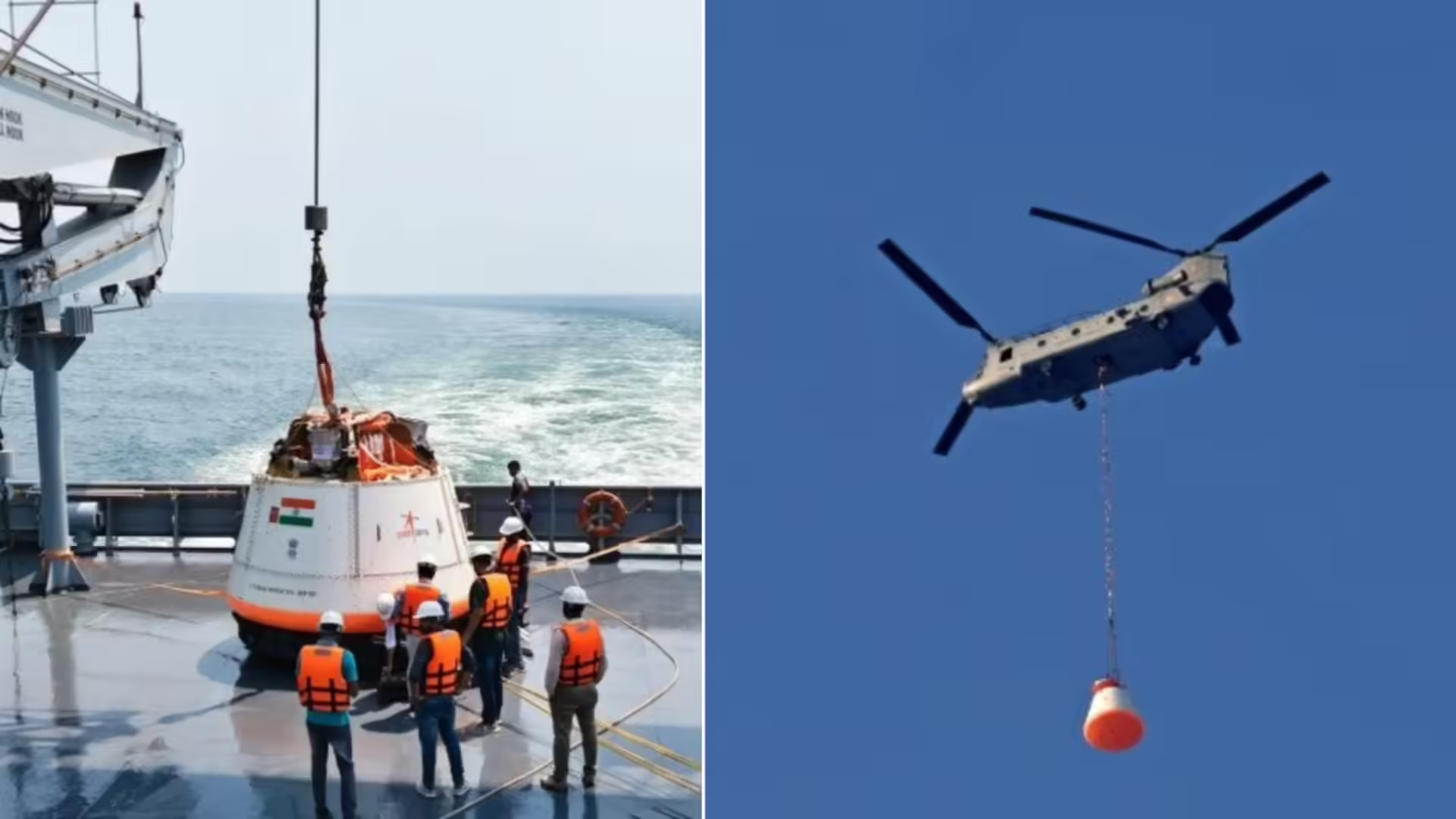
When we talk about space missions, the "fire and fury" of the launch usually grabs the headlines. But for India’s ambitious Gaganyaan human spaceflight mission, the most critical moment happens not on the way up, but on the way down.
Recently, the Indian Space Research Organisation (ISRO) hit a major milestone by successfully completing the Integrated Air Drop Test-02 (IADT-02) at the Satish Dhawan Space Centre. To the casual observer, it looked like a 5-ton tank falling out of a plane with some parachutes. To the global aerospace community, it was a masterclass in safety engineering.
Here is a breakdown of what happened and why it matters for India’s journey to the stars.
The "Drop" That Defines Safety
The IADT-02 wasn't just a simple parachute test. ISRO utilized an Indian Air Force C-17 Globemaster to drop a Crew Module Requirement (CMR) mass — essentially a dummy of the actual cabin where Indian astronauts (Gaganyatris) will sit.
The test focused on the sequencing. In the vacuum of space, things are predictable. In the chaotic, thick atmosphere of Earth, deploying multiple parachutes at high speeds is a nightmare of physics. The test successfully demonstrated:
The deployment of Pilot and Drogue parachutes (the smaller ones that stabilize the capsule).
The deployment of the Main parachutes (the giant ones that slow it down to a "soft" splashdown speed).
Expert Insight: The Challenge of "Cluster" Parachutes
One of the hardest things to master in recovery systems is cluster dynamics. When you have three massive main parachutes opening simultaneously, they can easily tangle or interfere with each other’s airflow.
ISRO’s success here proves that their "Sequencing and Deployment" logic is robust. More importantly, this test simulated "off-nominal" conditions. In plain English: they tested if the system works even when things go wrong. For a manned mission, you don't design for the perfect day; you design for the worst-case scenario.
Why This Matters: The TRL Leap
In the world of R&D, we talk about Technology Readiness Levels (TRL). Before this test, there were still lingering questions about whether India’s indigenous parachute materials (developed by ADRDE) could handle the shock-loading of a 5-ton module.
IADT-02 effectively clears the path for the unmanned orbital flights. It moves the parachute system from the "experimental" phase to the "qualified" phase. Without this "green light," the entire program would be on standby.
The Bigger Picture: India’s "Calculated" Space Race
Unlike the Cold War-era space race, India’s approach with Gaganyaan is characterized by extreme frugality paired with extreme safety testing. They aren't rushing to the finish line; they are building a "fail-safe" architecture.
By completing this integrated test, ISRO has checked off one of the most nerve-wracking boxes on the pre-flight checklist. The message to the world is clear: India isn't just looking to get to space; they have mastered the art of bringing their people back home safely.
What’s Next?
With the recovery system validated, the focus now shifts to the G1 mission — the first of two planned unmanned flights. This will likely feature Vyommitra, the humanoid robot designed to monitor life-support systems.
The Takeaway: If you ever doubted India's timeline for a 2026/2027 crewed launch, this test should change your mind. The "landing" was the biggest technical hurdle, and ISRO just stuck the transition.
Source Reference: Analysis based on reporting from The Times of India regarding ISRO's IADT-02 mission milestones.