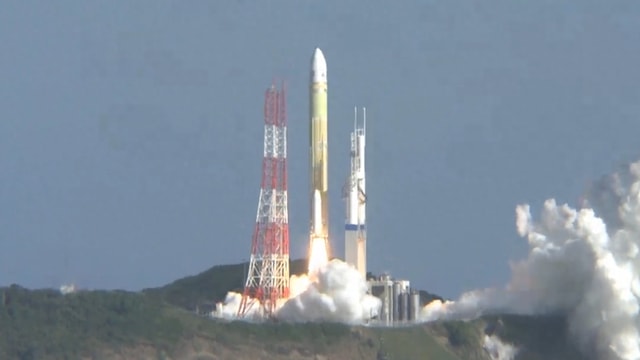
In April 2026, the Japan Aerospace Exploration Agency (JAXA) formally finalized its core roadmap: to resume launch operations of its flagship H3 heavy-lift launch vehicle as early as June this year. The mission marks a critical return to flight for Japan’s space sector, six months after the failed launch of the H3 Flight 8 vehicle in December 2025. This upcoming mission will not only serve as the final validation of JAXA’s fault remediation plans, but will also directly dictate the timeline of Japan’s space missions over the coming years, as well as its viability in the global commercial launch market.
Core Details of the Relaunch Mission: Risk-Controlled Validation with a Minimal Configuration
Per the proposal JAXA submitted to Japan’s Ministry of Education, Culture, Sports, Science and Technology (MEXT), the upcoming relaunch has a deliberately conservative mandate: its core objective is to fully eliminate systemic risks, rather than deliver operational payloads to orbit.
The mission will use the H3’s 3-0 configuration — a new variant of the rocket that flies without solid rocket boosters, marking the first orbital validation flight of this design. No operational satellites will be aboard the vehicle; instead, it will carry a mass simulator as a dummy payload. The test will focus exclusively on validating end-to-end reliability of the rocket’s core stage, second stage, and payload adapter interface, minimizing extraneous risks to the greatest extent possible.
JAXA formally presented this launch roadmap to the relevant MEXT committee on April 13, 2026. Once approved by the committee, the program will enter final launch preparation operations at the Tanegashima Space Center.
Unpacking the Root Cause: A Preventable Manufacturing Process Failure
On December 22, 2025, the H3 Flight 8 vehicle lifted off carrying Japan’s Quasi-Zenith Satellite System (QZSS) "Michibiki-5" navigation satellite. Just over 20 minutes after liftoff, the second stage engine suffered a premature cutoff, and the satellite failed to reach its intended orbit, resulting in a mission failure. This marked the second major mission failure for the H3 rocket since its botched debut in 2023, and pushed industry skepticism over the vehicle’s reliability to an all-time high.
After nearly four months of closed-loop investigation, JAXA finalized the full failure chain. Critically, the root cause was not a flaw in the rocket’s engine system — which had plagued earlier development — but a low-level manufacturing defect in the payload-to-rocket interface:
Initiating Failure: Structural failure of the Payload Support Structure (PSS) between the satellite and the rocket’s second stage. This component, a carbon fiber reinforced plastic (CFRP) skin and aluminum honeycomb core sandwich panel assembled via bonded splicing of four panels, is the critical structure that secures the payload and transfers flight loads.
Root Defect: Dual process errors during manufacturing. On one hand, localized temperatures during the splicing and bonding process exceeded design limits, causing a significant drop in bond strength between the CFRP skin and honeycomb core. On the other, the panels were stored in a high-temperature, high-humidity environment prior to bonding; moisture absorption further degraded bond performance. During heat curing, air trapped inside the honeycomb core expanded, exerting sustained peel loads on the skin and creating an initial disbond defect between the skin and core material.
Cascading Failure: Shock loads generated during fairing separation caused catastrophic propagation of the initial disbond, triggering localized skin buckling. This led to full-circumference structural instability and complete fracture of the adapter. Driven by inertial flight loads, the satellite and upper adapter structure directly impacted the second stage, damaging the liquid hydrogen tank pressurization lines. The resulting rapid loss of liquid hydrogen pressure caused the second stage engine to shut down prematurely, ending the mission in total failure.
What makes this failure particularly notable is that it stemmed not from a fundamental technical challenge in core systems, but from human error in manufacturing and quality control. It has also sparked industry-wide questions over the H3 program’s cost-reduction-first design philosophy, and the integrity of its end-to-end quality management system.
The Tumultuous History of the H3 Rocket: Japan’s Space Sector Transition Dilemma
The H3 is a next-generation flagship launch vehicle co-developed by JAXA and Mitsubishi Heavy Industries, with the program officially launched in 2013. Its core mandate was to replace the H-IIA rocket, which had served for over 20 years with a 98% success rate. The program’s ambitious design goals were clear: to cut per-launch costs by 50% compared to the H-IIA (to approximately 5 billion yen) via simplified engine architecture and automated manufacturing techniques, while boosting payload capacity to compete with the global disruption of SpaceX’s Falcon 9 in the commercial launch market.
Yet the program was mired in setbacks from the development phase. Its maiden launch, originally scheduled for 2020, was repeatedly delayed due to technical hurdles with its core engine. The H3’s first stage uses the LE-9, the world’s first high-thrust expander-cycle liquid oxygen-liquid hydrogen (LOX/LH2) engine, with a vacuum thrust of 1471 kN — a 40% increase over its predecessor, the LE-7A. But this much-anticipated engine suffered multiple catastrophic failures during ground testing, including turbine blade cracking and combustion chamber wall damage, pushing the maiden launch back by three full years.
The rocket’s launch history has been equally turbulent:
March 7, 2023: The H3 Test Flight 1 maiden launch. The first stage and boosters performed nominally, but the second stage LE-5B-3 engine failed to ignite due to a power system electrical leak, forcing flight controllers to issue a flight termination command. The maiden launch ended in failure.
February 17, 2024: The H3 Flight 2 completed its first successful validation flight, followed by five consecutive successful missions, leading the industry to believe the rocket had passed its technical teething phase.
December 22, 2025: The Flight 8 launch failure plunged the H3 program back into a crisis of confidence, forcing the delay of all core missions scheduled for fiscal 2026, including QZSS constellation replenishment, the HTV-X next-generation cargo resupply spacecraft, and the Martian Moons eXploration (MMX) mission.
To date, the H3 rocket has completed 8 launch missions, with 2 failures — a success rate of just 75%. This stands in stark contrast to the Falcon 9’s over 98% mission success rate, and the vehicle’s commercial competitiveness has been severely eroded by its consecutive failures.
The June Relaunch: More Than Just a Make-or-Break Flight for a Single Rocket
For Japan’s space sector, the upcoming June launch extends far beyond the technical scope of a single rocket flight. It is a make-or-break moment for Japan’s independent space access capabilities and its long-term space development strategy.
First and foremost, this mission is a lifeline defense for Japan’s sovereign access to space. The legacy H-IIA rocket is in its final retirement phase, with only 2 remaining vehicles in production and no plans for additional builds. If the H3 cannot quickly return to flight and achieve stable, high-frequency launch operations, Japan will imminently lose its independent ability to reach orbit. All government and commercial space missions would be forced to rely on foreign launch vehicles — a strategically untenable position for a nation seeking to secure a foothold in deep space exploration and lunar development.
Second, this is the last chance to salvage the H3’s commercial value. The rocket was developed from the outset to capture a share of the global commercial launch market. But consecutive launch failures have driven away potential commercial customers. A flawless return to flight in June will be a critical step in rebuilding market confidence; another failure will all but eliminate the H3’s commercial viability, putting the program’s over 200 billion yen in upfront research and development investment at risk of being written off.
Most importantly, this mission is the ultimate validation of Japan’s aerospace industry’s ability to balance cost reduction and quality control. Both of the H3’s major failures stemmed not from fundamental design flaws in core technologies, but from gaps in manufacturing and testing oversight. To meet its cost-halving target, the H3 program simplified portions of the ground testing process and relaxed controls on certain process steps, attempting to replace end-to-end validation with past engineering experience. This latest failure has exposed the fatal flaw in that approach. The remediation plan for the relaunch includes not just process optimization for a single structural component, but a full recalibration of the program’s end-to-end quality control system. Its outcome will directly shape the future development path of Japan’s aerospace industry.
This June, Tanegashima will host the H3 rocket’s defining flight. The fate of this vehicle is not just a microcosm of Japan’s space sector transition, but a defining case study for traditional global aerospace industries navigating the disruption of the commercial space age.