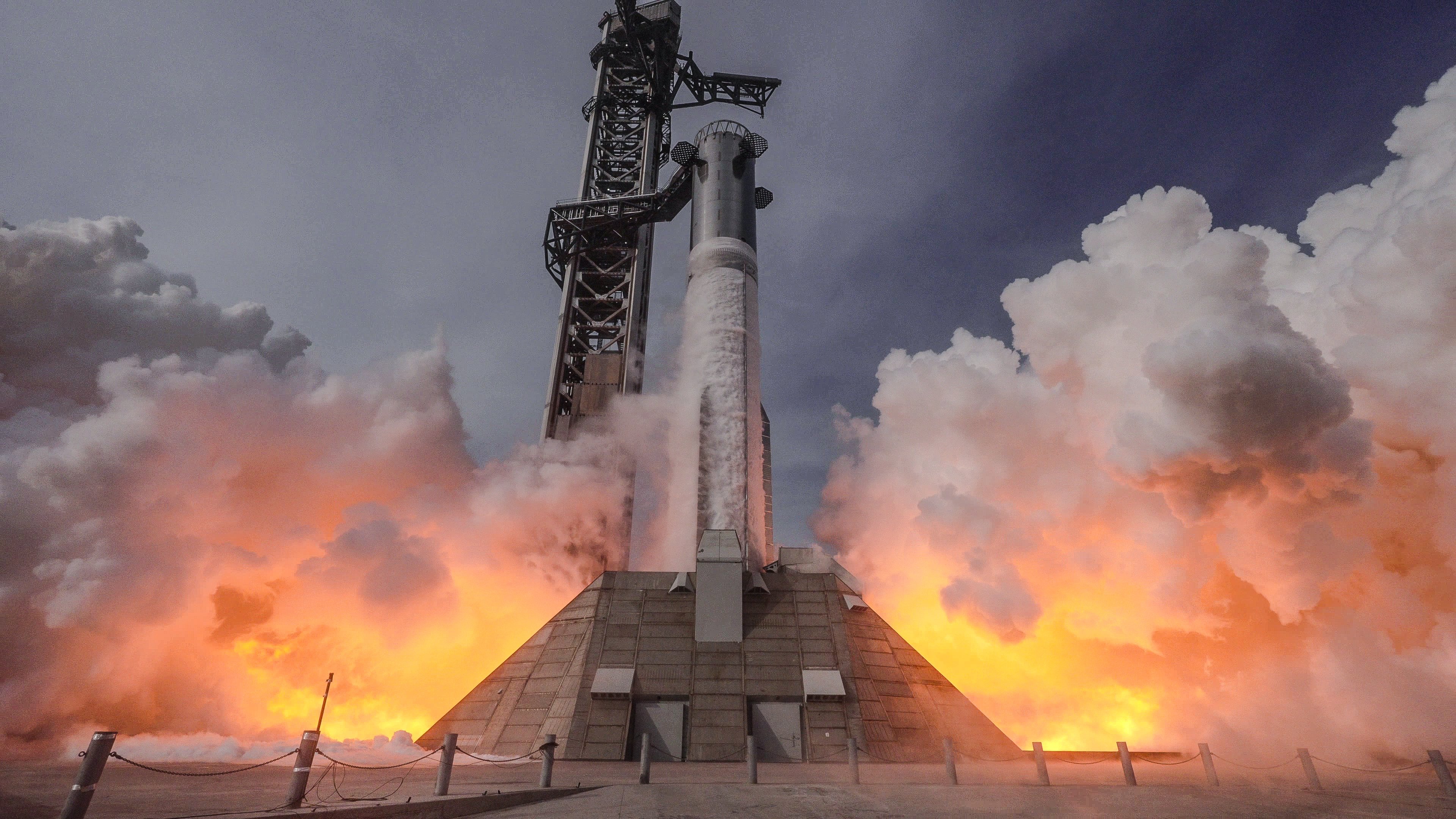
On April 15, 2026, Elon Musk, founder of SpaceX, officially announced that the next-generation Starship V3 super heavy booster successfully completed a full-duration static fire test of 33 Raptor engines. This marks a landmark ground verification milestone in the development of the Starship V3 variant, clearing key power obstacles for subsequent orbital test flights, crewed lunar landings, and deep-space cargo missions.
Core information about this test is derived from official disclosures by SpaceX and reports from authoritative industry media, with test progress tracked and recorded by aerospace vertical platforms such as Teslarati and Solarzoom. This achievement signifies the steady transition of the Starship program from iterative verification to engineering mass production.
I. Full-Duration Static Fire: The "Ground Final Exam" Before Rocket Launch
Full duration static fire is a core ground verification link before the launch of a launch vehicle: the rocket is fixed on the launch pad, and the engines are ignited continuously for a preset duration to fully simulate the power output, thermal shock, and system coordination during the takeoff phase. It mainly verifies three core indicators:
Whether the engine thrust, specific impulse, and combustion stability meet the standards;
The reliability of system coordination such as multi-engine parallel control, propellant delivery, and thermal protection;
The adaptability of the launch pad and the effectiveness of the ground measurement and control as well as data collection links.
For super heavy-lift launch vehicles like Starship, static fire is a critical checkpoint to avoid in-flight risks and identify design flaws. Previously, the Starship V2 variant completed a full-duration static fire test with 6 Raptor engines, while the V3 variant directly achievedsynchronous full-load test runs of 33 engines this time, representing an exponential increase in technical difficulty.
II. Technical Breakthroughs in This Test of Starship V3
As the third-generation iterative model of the Starship family, the successful static fire test of the V3 variant embodies its core value in three aspects:
1. Landing of Multi-Engine Coordination Control
The synchronous ignition and stable operation of 33 Raptor V3 engines have overcome industry challenges such as thrust balance, vibration coupling, and timing control for parallel operation of a large number of liquid rocket engines, making it a top-tier verification achievement in the global launch vehicle power system.
2. Comprehensive Upgrade of Power Performance
Compared with the previous generation, the Raptor V3 engine has significantly improved in thrust, thrust-to-weight ratio, and specific impulse, supporting the Starship V3 to achieve a low-Earth orbit (LEO) payload capacity of over 100 tons, far exceeding the V2 variant’s approximately 35 tons. This makes it suitable for heavy mission requirements such as large-scale satellite constellation deployment, lunar base cargo transportation, and Mars exploration.
3. Maturity of Ground System Adaptation
The test verified the full-system compatibility between Starbase Launch Pad 2 and the V3 booster, laying an infrastructure foundation for subsequent high-frequency testing and rapid launch iteration.
III. Profound Impact of the Test Success on the Aerospace Industry
1. Supporting NASA’s Artemis Program
Starship is the designated lander for NASA’s Artemis III crewed lunar landing mission. The full verification of the power system this time directly accelerates the engineering progress of crewed lunar landings, providing core launch support for crewed operations and base construction on the lunar surface.
2. Reshaping the Heavy-Lift Launch Market Pattern
The Starship V3’s ultra-large payload capacity combined with its reusable design will significantly reduce the cost per payload launch, subverting the business model of traditional heavy-lift rockets and exerting a technological dimensionality reduction impact on global deep-space exploration and commercial space launches.
3. Accelerating the Process of Deep-Space Exploration
A stable and reliable super heavy-lift capacity is a prerequisite for Mars permanent base construction, deep-space unmanned exploration, and space infrastructure deployment. This test brings the goal of human interplanetary navigation one step closer.
IV. Outlook on Subsequent Progress
After the completion of this full-duration static fire test, the Starship V3 will enter the final preparation phase before launch, carrying out rocket integration and system joint debugging as planned. It is expected to launch its first orbital test flight in May 2026, verifying core capabilities such as inter-stage separation, re-entry and return, and precise recovery.
As SpaceX’s model positioned as a "mass-produced heavy-lift rocket", the technical maturity of the Starship V3 is not only a research and development breakthrough for a single enterprise but also represents a new height in liquid rocket power and reusable space launch technology. It will continue to push human space exploration from low-Earth orbit to farther regions of deep space.
https://x.com/SpaceX/status/2044590183761277386