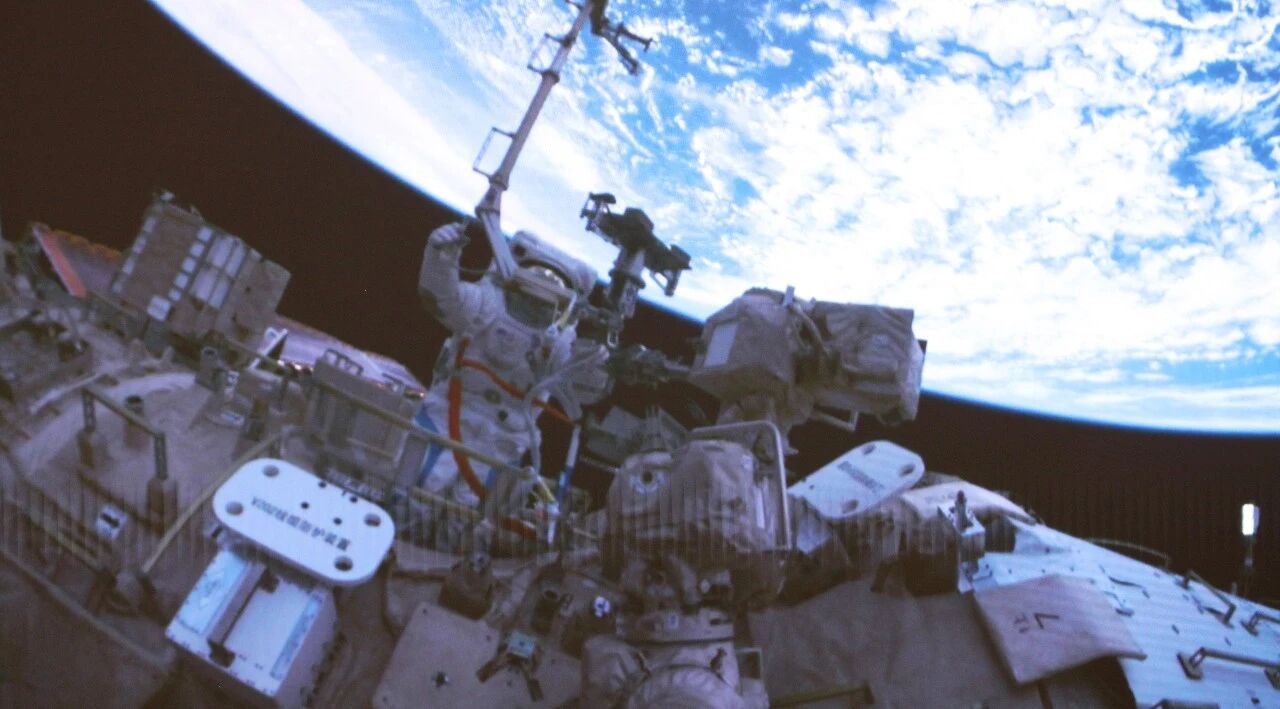
At 01:36 Beijing Time on April 17, 2026, the Shenzhou-21 taikonaut crew successfully completed their third extravehicular activity (EVA) after approximately 5.5 hours of spacewalk operations. Taikonauts Zhang Lu and Wu Fei safely returned to the Wentian Laboratory Module after fulfilling all scheduled tasks, with full in-cabin coordination from taikonaut Zhang Hongzhang and close support from the ground flight control team throughout the entire process.
5.5-Hour Spacewalk: Precision Delivery of Core Missions
The core objectives of this EVA centered on the long-term safe operation of the China Space Station (CSS). The crew completed the installation of space debris shielding devices, routine inspection of extravehicular equipment and facilities, and other pre-defined tasks, each of which is directly tied to the on-orbit safety and stability of the space station.
For a space station in long-term low-Earth orbit operation, space debris protection is an indispensable core priority. Even millimeter-sized space debris traveling at hypervelocity can cause irreversible damage to the station's hull structure and extravehicular equipment. The newly installed shielding devices will further enhance the CSS's capability to mitigate space debris risks. Regular extravehicular equipment inspections, meanwhile, are a critical step to identify potential faults in a timely manner and ensure the stable operation of all station systems, laying a solid hardware foundation for the upcoming space science experiments.
During the entire spacewalk, the station's robotic arm provided stable support for the taikonauts' extravehicular movement and operations, while ground researchers provided full-time technical support and status monitoring. The well-established model of seamless space-ground collaboration and crew coordination once again served as the core guarantee for the full success of this EVA.
7 EVAs: A New National Record for Chinese Taikonauts
With the successful completion of this spacewalk, mission commander Zhang Lu has accumulated a total of 7 EVAs, setting a new record for the most extravehicular activities by a Chinese taikonaut.
Spacewalks are widely recognized as one of the highest-risk and most technically challenging segments of human spaceflight missions. During an EVA, taikonauts must not only withstand the harsh space environment of weightlessness, vacuum, and extreme temperature fluctuations, but also complete high-precision manual operations within a limited operation window. This places near-strict requirements on taikonauts' physical and mental resilience, emergency response capabilities, and professional operational skills.
Every successful EVA is backed by thousands of simulation training sessions on the ground, as well as meticulous preparation and drills on orbit. This 7-EVA record is not only the highest recognition of Zhang Lu's individual professional competence, but also a testament to the continuous maturity and iteration of EVA technologies for China's taikonaut corps.
Over 5 Months On Orbit: Mission Duration to Be Extended by Approximately 1 Month
As of the completion of this EVA, the three taikonauts of the Shenzhou-21 mission have been in orbit for more than 5 months, and are currently in good working and living condition.
In the month since the successful completion of their second EVA on March 16, the crew has maintained a compact and orderly on-orbit work schedule. In addition to completing the full-process preparation and drills for this EVA, they have steadily advanced experiments in fields including space life science and human body research, as well as microgravity physical science. They have also carried out routine station operations including in-cabin environmental monitoring, equipment inspection and maintenance, and cargo sorting, while completing a full-system pressure emergency drill, on-orbit emergency rescue training, and other safety-critical exercises to maintain readiness for on-orbit contingencies at all times.
According to official announcements, after rigorous demonstration and evaluation, the Shenzhou-21 crew's on-orbit stay is planned to be extended by approximately 1 month. This extension serves two core objectives: first, to further deepen the verification of technologies related to long-term taikonaut on-orbit stays, accumulating key data and engineering experience for subsequent longer-duration human spaceflight missions; second, to fully leverage the comprehensive benefits of the Shenzhou-22 spacecraft's emergency launch capability to resupply the space station, maximizing the scientific and engineering value of this mission.
Upcoming Journey: On-Orbit Celebration of China Space Day and Continued Scientific Experiments
During the extended mission, the Shenzhou-21 crew will continue to carry out various space science experiments and technology tests. They will also celebrate the 7th China Space Day and the annual International Workers' Day while on orbit.
From day-in and day-out training on the ground to minute-by-minute operations in space, the perseverance of Chinese aerospace professionals runs through every segment of the human spaceflight mission. Each successfully completed EVA, each steadily advanced scientific experiment, and each continuously refreshed on-orbit record are not only a vivid reflection of the technological maturity of the China Space Station's construction and operation phase, but also a solid footprint of China's human spaceflight program steadily advancing toward the stars.
We look forward to the Shenzhou-21 crew successfully completing all follow-up on-orbit tasks and returning home safely.
https://www.spacechina.com/n25/n2014789/n2888836/c4589338/content.html