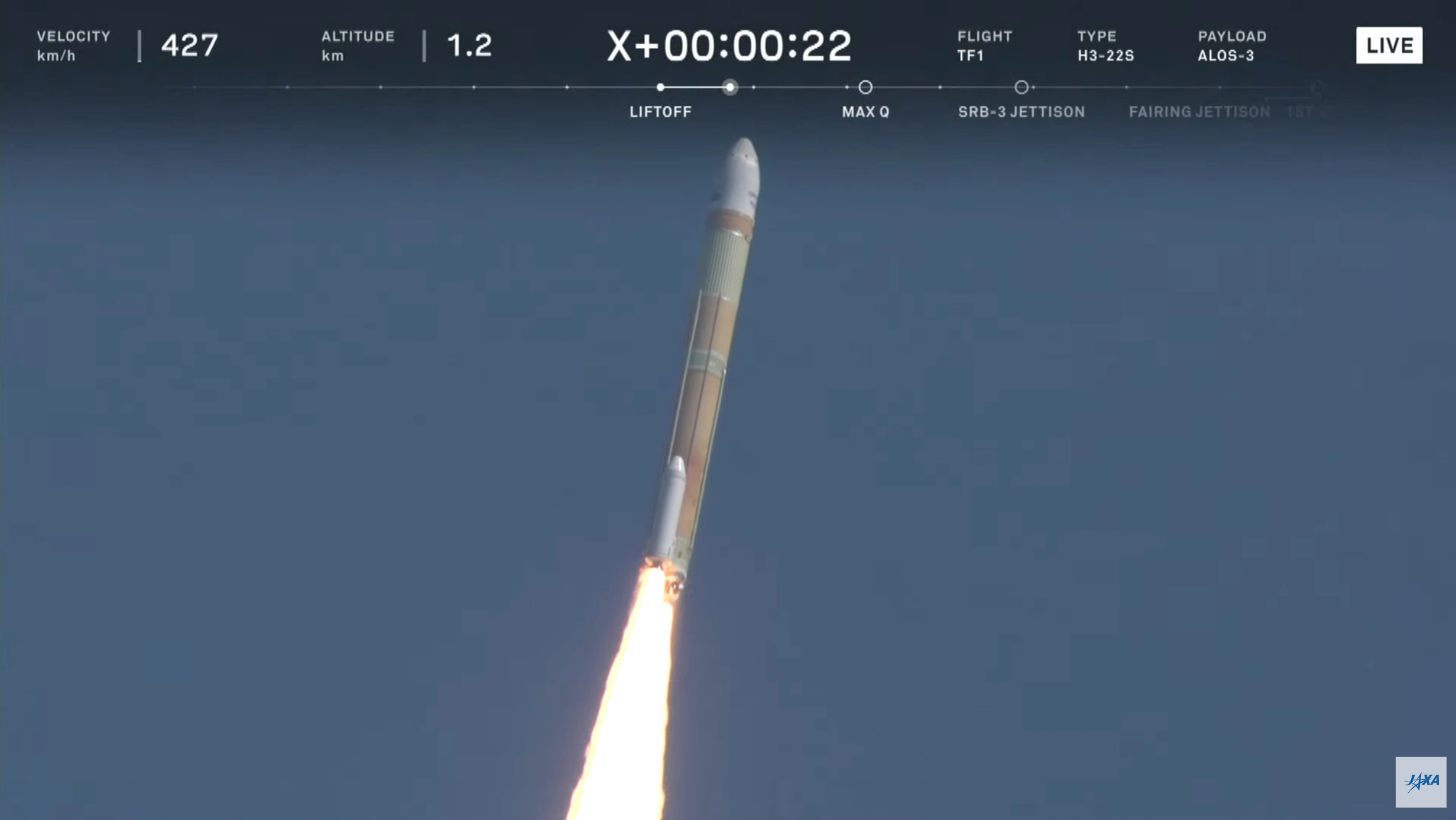
On December 22, 2025, at the Tanegashima Space Center in Japan, the H3 Rocket No.8 lifted off smoothly, but the launch mission ultimately failed — the "Michibiki 5" navigation satellite it carried failed to enter the predetermined orbit and was later confirmed to have crashed into the Earth's atmosphere and been completely destroyed. This is another major setback for Japan's new-generation main rocket, the H3, following its first launch failure in March 2023, and has once again drawn the attention of space enthusiasts around the world to this rocket that Japan has high hopes for.
More than two months later, on February 25, 2026, at a meeting of the Investigation and Safety Subcommittee held by Japan's Ministry of Education, Culture, Sports, Science and Technology, the Japan Aerospace Exploration Agency (JAXA) finally announced key findings of the investigation: the most likely cause of the H3 Rocket No.8 launch failure lies in a core component called the "Payload Support Structure (PSS)". What is even more worrying is that this defect is not unique to this single component; it may affect all H3 rockets that have already been built, making the subsequent launch plans uncertain.
Tracing the Fault: From "Satellite Separation" to Identifying the PSS Defect
In fact, as early as the investigation meeting in January 2026, JAXA had already mentioned the special nature of this failure: during the flight of the rocket's first stage, the mounting structure used to fix the satellite malfunctioned, causing the satellite to fall off the rocket, with part of the structure remaining attached to the rocket body. However, the specific damaged part had not been identified at that time.
After more than a month of careful analysis, the investigation team finally narrowed down the scope of the fault — the problem is most likely in the upper part of the PSS that connects the satellite to the rocket's second stage. This seemingly unremarkable component is a conical base specifically designed to support the satellite. The part above it that comes into contact with the satellite is called the Planar Actuator Fixture (PAF), and the part below is the PSS itself, with each joint connected by a special bonding method.
The reason for confirming that the PSS was the problem mainly relies on two key pieces of evidence: first, the PAF on top of the PSS was still able to normally collect temperature and acceleration data after the accident, indicating that the data transmission line was not damaged, ruling out the possibility of a line failure; second, in the images taken by the camera installed at the bottom of the PSS, the appearance of the Earth did not change significantly before and after the accident, and the camera did not move, indicating that the damaged part was in the PSS area above the camera.
Core Cause: Manufacturing Defects + Design Changes, Laying a Fatal Hidden Danger
As the investigation deepened, the "innate problem" of the PSS was gradually uncovered. As a core component supporting the satellite, the PSS has a "sandwich structure" — two layers of carbon fiber reinforced plastic (CFRP) outer skin, with an aluminum honeycomb core in the middle. During manufacturing, four panels need to be spliced together, then bonded with CFRP splice sheets and fixed by heating.
However, after testing 5 PSS samples stored on the ground, JAXA found that 4 of them had a serious "delamination problem" — that is, the outer skin and the middle aluminum honeycomb core were not firmly bonded, resulting in gaps. This defect was discovered through hammering and cutting inspections. More dangerously, when a vacuum test was conducted on one of the samples, the gaps at 3 locations became larger, which is the same as the vacuum environment during rocket flight.
The root cause of this defect is actually related to the design improvement of the H3 rocket. Previously, Japan's H-IIA rocket used bolts to fix the spliced parts of the PSS. Although it was a bit more expensive and heavier, it was stable and reliable. However, in order to save money, reduce weight, and improve launch capacity, the H3 rocket adopted a new bonding process instead of bolts — this adjustment made for optimization ultimately left a fatal hidden danger.
Restoring the Damage Process: A Chain Reaction from Minor Delamination to Satellite Fall
Combining the flight data and the defect situation of the PSS, JAXA restored the damage process of the H3 Rocket No.8. At present, this scenario is considered the most likely truth of the accident:
Innate hidden danger: When the PSS of Rocket No.8 was manufactured, the outer skin and the core material were not firmly bonded, resulting in delamination, which was not detected during factory inspection;
Gaps gradually widen: When the rocket ascends, the air inside the fairing escapes through the exhaust valve, forming a vacuum environment. However, the air inside the aluminum honeycomb core of the PSS still maintains 1 atmosphere of pressure. The pressure difference between the inside and outside constantly "pushes outward" the gap, making the gap larger and larger;
Impact exacerbates the problem: When the gap reaches a certain size, the impact force generated when the fairing separates causes local bending of the PSS material, and the gap spreads rapidly;
Chain damage: The strength of the bent component will be greatly reduced, unable to support the weight of the satellite and the acceleration during rocket flight. The force will be transmitted to the surrounding structures, causing other parts to bend as well, and finally the entire PSS is damaged;
Satellite falls: The completely damaged PSS cannot support the 4.7-ton satellite, breaking into two parts: upper and lower. The upper part falls into the rocket along with the satellite, eventually causing the rocket's second-stage engine to stop burning in advance, and the satellite fails to enter the predetermined orbit.
It is worth noting that the investigation team also ruled out two other possibilities: one is that the fairing collided with the rocket body when separating (it takes 0.4 seconds from separation to collision, but the accident occurred 0.06 seconds after separation, which does not match the time); the other is that the fuel of the micro-engine on the satellite leaked and exploded (after testing, no explosion occurred, so this assumption is not valid).
Affecting the Entire Series: H3 Rocket's Subsequent Launch Plans Face a "Shutdown Crisis"
What is most worrying about the discovery of the PSS defect this time is not the failure of Rocket No.8 itself, but the universality of this problem — 4 out of 5 PSS samples have problems, and the remaining 1 has not been tested (stored at the Tanegashima Space Center), which is likely to have the same problem. This indicates that this is not an individual case, but a common problem in the manufacturing of H3 rocket PSS.
This means that all H3 rockets that have been built and are waiting for launch may have potential safety hazards in their PSS. Yuji Mori, General Manager of the JAXA Project Promotion Department, also clearly stated that the 4 tested PSS "did not meet the design requirements" and cannot be used for launch preparation. All subsequent PSS need to be re-inspected and evaluated.
This has a great impact on the subsequent launch plans of the H3 rocket. According to the plan, there are many H3 rockets waiting for launch starting from the 2026 fiscal year: Rocket No.9 will launch the Michibiki 7 quasi-zenith satellite (the seventh satellite of the "Japanese version of GPS"), Rocket No.6 will conduct a test flight of the "30 configuration" (a new configuration without boosters), and Rockets No.10 and beyond will also launch missions such as the HTV-X 2 space station resupply spacecraft and the Martian Moons eXploration (MMX) mission.
Among them, HTV-X 2 may not be affected by the recent domestic PSS defect because it uses a foreign-made PSS system, but whether it can be launched normally in the end still needs to be further confirmed; for other rockets using domestic PSS, when they can be launched depends entirely on the progress of PSS rectification — if it can be used only by repairing, the launch may resume soon; if all need to be scrapped and re-manufactured, each PSS will take several months to manufacture, and all launch plans will be delayed for a long time.
Future Outlook: JAXA Fully Promotes Verification to Strive for an Early "Return to Flight"
At present, JAXA is still conducting further investigations, with two core objectives: first, to confirm whether PSS delamination is the direct cause of the failure of Rocket No.8, and to analyze the damage process of PSS in a vacuum environment, combined with flight data, to see if the restored scenario is correct; second, to figure out why this defect first appeared only on Rocket No.8 and not on previous H3 rockets. Finding this reason will help determine the conditions under which such situations are likely to occur.
At the same time, JAXA is also conducting a Fault Tree Analysis (FTA), disassembling the cause of the accident step by step, and eliminating other potential hidden dangers. As for the rectification plan of the PSS, Mori said that the possibility of repair is still being considered, and the specific plan has not been determined, which will be gradually announced according to the investigation results.
As Japan's new-generation main launch vehicle, the H3 rocket carries many expectations for Japan's space program — its launch capacity is much stronger than the previous H-IIA rocket, which can send a satellite of about 8 tons to the geosynchronous transfer orbit. It is the core equipment for Japan to achieve independent navigation and explore deep space. The discovery of the PSS defect this time is not only a setback in technology, but also a reminder that "details determine success or failure" in space engineering — a seemingly small manufacturing defect and a compromise made for optimization ultimately led to the failure of a complete launch mission, and even affected the development of the entire rocket series.
In the future, I will continue to pay attention to the progress of JAXA's investigation to see if this rocket that Japan has high hopes for can quickly solve the PSS defect problem and return to the launch orbit. After all, on the road of space exploration, setbacks and breakthroughs have always been accompanied. Every summary of experience and improvement of problems after failure is an important step towards the stars and the sea.