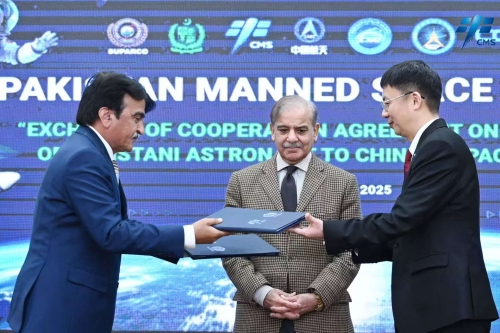
On April 22, 2026, the China National Space Administration (CNSA) confirmed a development that space analysts have been anticipating for years: two Pakistani astronauts have officially entered the training pipeline for a mission to the Tiangong Space Station (CSS).
While the headline might seem like a standard bilateral update, the implications reach far beyond a simple seat on a rocket. This move marks the transition of the CSS from a national asset to a truly international laboratory, reshaping the landscape of Low Earth Orbit (LEO).
The "Iron Brotherhood" Takes Flight
The selection of Pakistani candidates isn't just a political gesture; it is the culmination of decades of deep-tier aerospace cooperation. From the launch of the PRSS-1 remote sensing satellite to shared satellite navigation infrastructure, Islamabad and Beijing have long been "Iron Brothers" on the ground.
However, manned spaceflight is a different beast entirely. By integrating these astronauts into the CSS training regimen—a grueling process involving centrifuge runs, neutral buoyancy EVAs (Extravehicular Activities), and intensive Mandarin language immersion—both nations are signaling a level of strategic trust that is rare in the high-stakes arena of space.
Tiangong as a Global Alternative
For years, the International Space Station (ISS) was the only game in town. As the ISS nears its sunset years, Tiangong is positioning itself as a more inclusive, "post-Cold War" alternative.
Standardization of Cooperation: These astronauts aren't just passengers; they are being trained to Chinese standards. This creates a technical "gravity well"—as more nations train on Chinese systems and interfaces, the CSS ecosystem becomes the de facto standard for a new generation of spacefaring nations.
Democratizing the Cosmos: This partnership proves that the "club" of space-traveling nations is no longer restricted to those with independent launch capabilities. It offers a blueprint for the "Global South" to participate in high-end orbital research.
What’s Next: The Road to Shenzhou
Based on the typical 18-to-24-month training cycle, we should expect to see the first Pakistani "Payload Specialist" featured on a crew manifest around the Shenzhou-25 or Shenzhou-26 missions.
In the cabin of the CSS, at an altitude of 400 kilometers, the focus will be on tangible science—biotechnology, material physics, and earth observation. But the subtext will be purely diplomatic. When a Pakistani astronaut looks down at the Hindu Kush from a Chinese-made porthole, the message to the world will be clear: the monopoly on the stars has officially ended.
The Bottom Line
The announcement on the eve of China’s National Space Day is no coincidence. It serves as a powerful prologue to the 2026 Space Conference in Chengdu, reminding the global community that while some are focused on "de-risking" and "de-coupling" on Earth, the view from orbit is becoming increasingly interconnected.