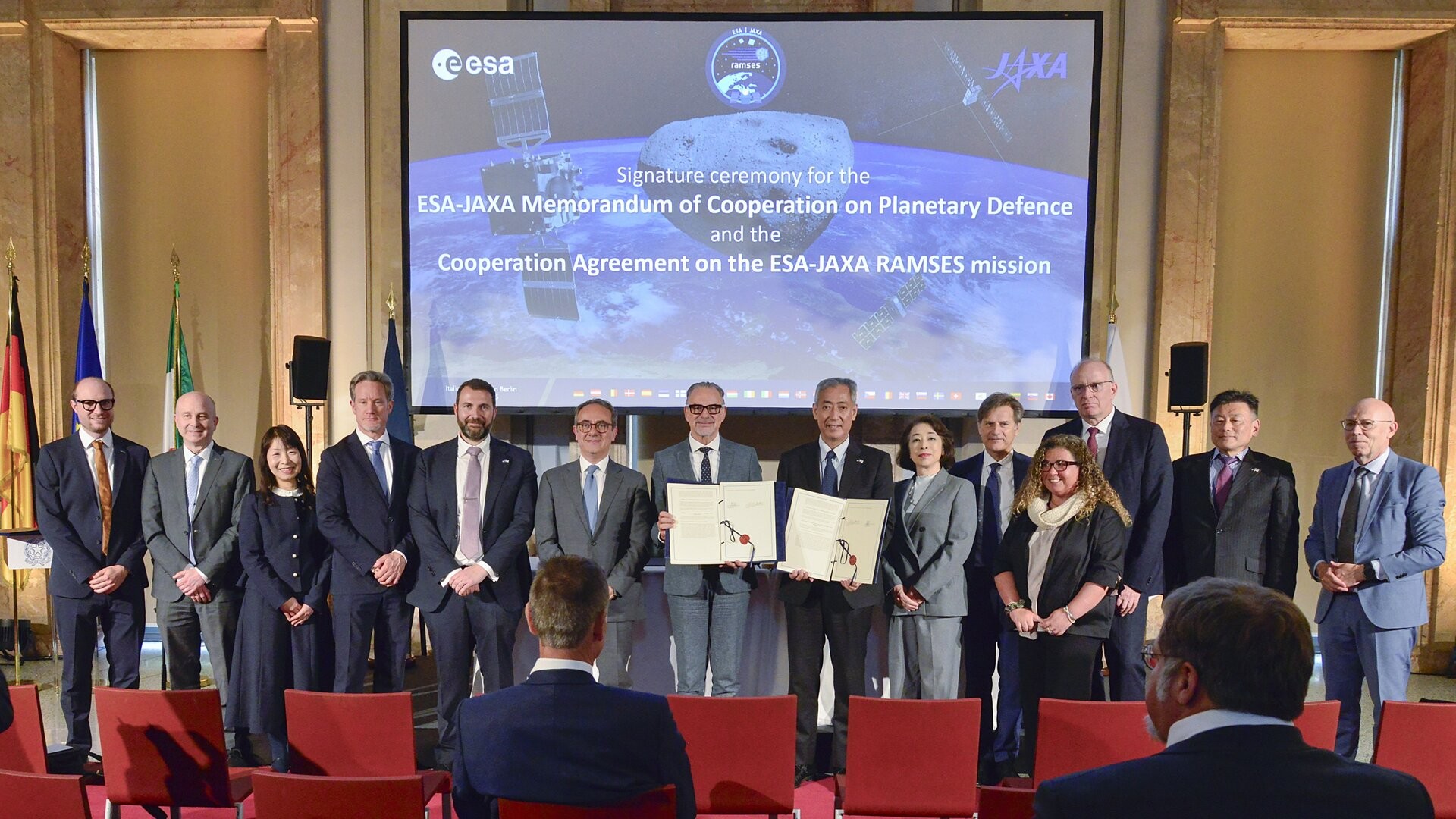
On 7 May 2026, the European Space Agency (ESA) and the Japan Aerospace Exploration Agency (JAXA) signed two key agreements in Berlin, Germany: a Memorandum of Cooperation for planetary defence and a dedicated partnership deal for the Rapid Apophis Mission for Space Safety (Ramses)European Space Agency. The signing took place at the Italian Embassy, with support from the Italian Space Agency (ASI); OHB Italia has been selected as the prime contractor for the missionEuropean Space Agency. This step formalizes large‑scale collaboration first outlined in a joint statement from November 2024European Space Agency.
Planetary Defence: A Global Responsibility
Planetary defence focuses on early detection, tracking, risk assessment, and mitigation of near‑Earth objects (NEOs) that could threaten EarthEuropean Space Agency. ESA leads this work through its Space Safety programme, which runs the Near-Earth Object Coordination Centre (NEOCC) for threat monitoring and orbit refinement, and develops rapid reconnaissance and deflection technologies via space missionsEuropean Space Agency.
JAXA already contributes to ESA’s Hera mission, which will reach the Didymos binary asteroid system later in 2026 to validate kinetic impact deflection as a reliable planetary defence techniqueEuropean Space Agency. The Ramses partnership extends this proven cooperation modelEuropean Space Agency.
Ramses Mission: Core Objectives and Timeline
Ramses is the first major mission delivered by the new ESA–JAXA allianceEuropean Space Agency.
Launch: Scheduled for 2028European Space Agency.
Rendezvous: Will meet asteroid (99942) Apophis ahead of its historic close flyby of Earth in April 2029European Space Agency.
Mission role: Escort Apophis during the flyby to measure changes in its shape, surface, and motion caused by Earth’s gravityEuropean Space Agency.
Data use: Pre‑and post‑flyby measurements will improve understanding of asteroid structure, composition, and behaviour—critical data for future deflection operationsEuropean Space Agency.
Key Facts About Asteroid Apophis (99942)
Diameter: Approximately 375 metresEuropean Space Agency.
Closest flyby distance: 32,000 km above Earth’s surface on 13 April 2029—about one‑tenth the distance to the Moon and closer than geosynchronous satellitesEuropean Space Agency.
Impact risk: No collision risk for at least the next 100 years; Apophis was removed from ESA’s impact Risk List in March 2021European Space Agency.
Rarity: A flyby of a similarly sized asteroid this close happens only once every 5,000–10,000 yearsEuropean Space Agency.
Visibility: The flyby will be visible to the naked eye for up to two billion people worldwideEuropean Space Agency.
ESA–JAXA Roles and Technical Contributions
The two agencies split responsibilities to deliver Ramses efficiently:
ESA: Manages spacecraft design, integration, and mission operationsEuropean Space Agency.
JAXA: Provides lightweight solar arrays, an infrared imager, and launch aboard its H3 rocketEuropean Space Agency.
This collaboration builds on prior joint missions including Hera, EarthCARE, and BepiColomboEuropean Space Agency.
Scientific and Strategic Value
Until Apophis, studying asteroids required missions deep into the Solar SystemEuropean Space Agency. The 2029 flyby brings a large asteroid within close reach, letting scientists observe tidal‑force reshaping in real timeEuropean Space Agency. Ramses will turn this natural event into a controlled experiment to refine planetary defence capabilities for future hazardous NEOsEuropean Space Agency.
Conclusion
The ESA–JAXA Ramses mission turns international commitment to planetary defence into operational actionEuropean Space Agency. By combining technical expertise and mission experience, the two agencies will capture unique data during Apophis’s once‑in‑a‑lifetime flyby, strengthening global capabilities to protect Earth from asteroid threats.