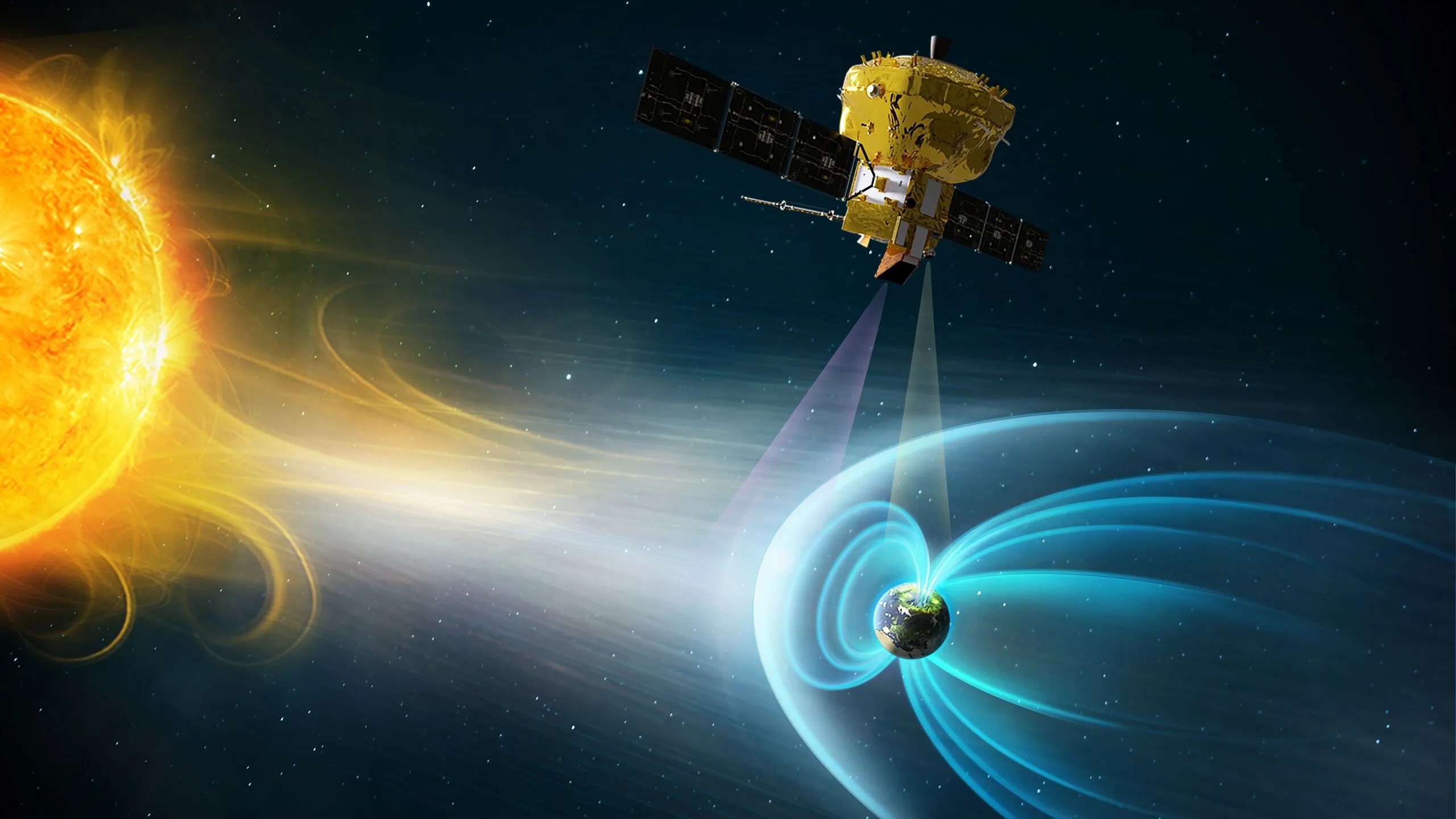
At 11:52 Beijing Time on May 19, 2026, the Solar Wind-Magnetosphere Ionosphere Link Explorer (SMILE) (nicknamed the "Smile Satellite"), jointly developed by China and Europe, was successfully launched by a Vega-C carrier rocket from the Kourou Space Centre in French Guiana. The satellite has smoothly entered its predetermined orbit, with solar arrays fully deployed and platform systems functioning normally, marking a complete success of the launch mission.
The SMILE satellite serves as the concluding project of the Strategic Priority Program on Space Science (Phase II) of the Chinese Academy of Sciences (CAS). It is also the first space science exploration mission featuring full-scale, mission-level in-depth cooperation between CAS and the European Space Agency (ESA), and ranks among China’s aerospace engineering projects with the deepest international collaboration and highest participation to date. Its core scientific goal is to conduct the first global imaging observation of the solar wind-magnetosphere interaction and dynamically reveal the solar wind-magnetosphere coupling process, filling the gap in global panoramic magnetosphere observation.
China-Europe Collaboration on Development and Payloads
A clear division of work has been established for engineering development and payloads:
The Chinese side is responsible for satellite platform development, telemetry, tracking and command (TT&C), ground support and scientific application system construction, and leads the development of three payloads: the Ultraviolet Aurora Imager (UVI), Low-energy Ion Analyzer (LIA) and Magnetometer (MAG).
The European side undertakes the development of the payload module and the world’s first space-borne Soft X-ray Imager (SXI), and provides support for the carrier rocket, launch site and TT&C during the boost phase.
As the prime system integrator for the SMILE mission, the National Space Science Center (NSSC) of CAS leads cooperation with ESA and oversees the development and construction of ground support and scientific application systems. The Innovation Academy for Microsatellites of CAS is responsible for the overall development of the satellite platform; Airbus Spain leads the payload module development; and Avio (Europe) handles the design and manufacturing of the Vega-C rocket. Multiple institutions from China and Europe have participated in the mission development.
On-orbit Operation Plan
Following launch, the SMILE satellite will perform orbit maneuvers for approximately 42 days to reach its scientific observation orbit, followed by two months of on-orbit testing. Upon completion of testing, it will enter a three-year routine scientific observation phase. During operation, Chinese and European scientists will jointly process and analyze data, and all scientific data will be open to global research institutions to promote an international collaborative research framework.
The solar wind-magnetosphere interaction is the core physical process driving space weather. Observation data from SMILE will directly support improvements in space weather forecasting, providing critical support for near-Earth space security, including on-orbit spacecraft safety, stable navigation and communications, and ground power grid operations. Long-term stable observations are expected to fundamentally advance humanity’s understanding of the solar wind-magnetosphere coupling mechanism.
The successful launch of the SMILE satellite inaugurates a new era of global imaging and collaborative observation in Earth magnetosphere exploration for China and Europe, and sets a new benchmark for international cooperation in space physics basic research and aerospace engineering.