A metaphorical bombshell rocked the aerospace community last night.
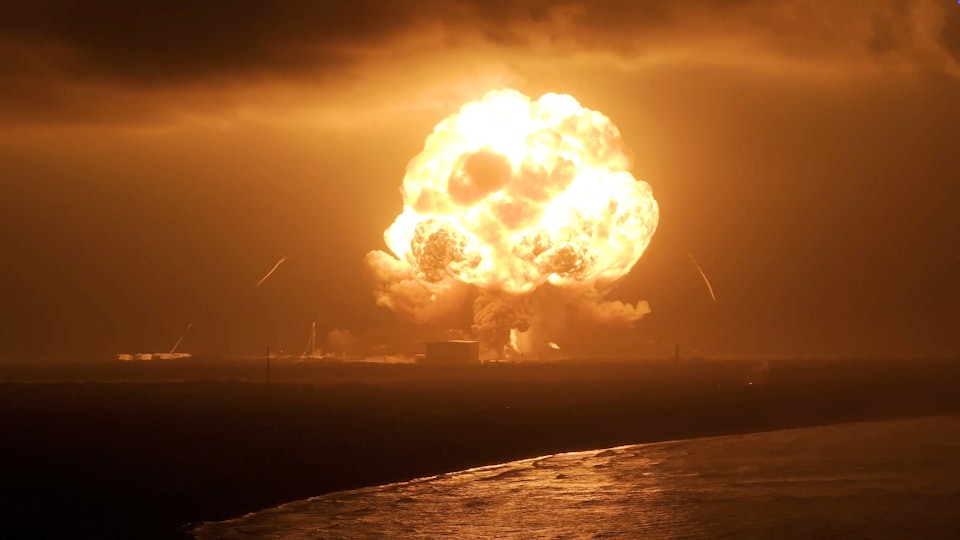
On the evening of May 28, 2026, the skies over Cape Canaveral Space Force Station in Florida lit up with a catastrophic fireball. Blue Origin’s flagship heavy-lift vehicle, the New Glenn, suffered a massive explosion during a routine static fire test of its engines.
Fortunately, no injuries were reported. In another stroke of luck, the 48 Project Kuiper internet satellites—originally scheduled to launch aboard this very rocket on June 4—had not yet been integrated into the vehicle.
Even so, for Jeff Bezos and Blue Origin, this is a devastating setback.
Live from the Pad: The Steep Cost of an "Anomaly"
Shortly after the incident, Blue Origin took to social media to confirm that the vehicle had experienced an "anomaly"—the aerospace industry's preferred euphemism for a major failure or explosion.
Bezos himself was quick to release a statement:
"It is too early to determine the root cause of the incident, but a full investigation is already underway. Today was a very tough day, but we will rebuild what needs to be rebuilt, and we will fly again."
While Bezos’s words carry a tone of defiant resilience, they do little to mask the underlying anxiety. The stakes for the New Glenn could not be higher.
Why New Glenn is a "Must-Win" for Bezos
For anyone following commercial spaceflight, Elon Musk’s SpaceX—with its ubiquitous Falcon 9 and next-generation Starship—is the undisputed giant. Bezos’s Blue Origin has long been positioned as SpaceX's primary, deep-pocketed rival.
The New Glenn is the ultimate weapon Blue Origin designed to go toe-to-toe with Musk.
Massive Scale: Standing at over 90 meters tall, this heavy-lift rocket features a reusable first stage designed to drastically undercut traditional launch costs.
Imposing Capacity: It boasts a massive Low Earth Orbit (LEO) payload capacity of 45 metric tons.
Critical Mandates: Beyond launching Amazon's "Project Kuiper" to compete with SpaceX’s Starlink, New Glenn holds lucrative, high-stakes launch contracts with both the U.S. Department of Defense and NASA.
Simply put, if New Glenn stalls, Bezos's entire cosmic empire is forced to hit the pause button.
A String of Misfortunes: Blue Origin's "Mercury Retrograde"
This explosion is not an isolated incident for the New Glenn program. A look at the vehicle's recent track record reveals a compounding technical and credibility crisis:
DateMission / Test StatusOutcome & ImpactApril 2026Third Official Launch MissionFailure. A second-stage malfunction prevented the rocket from deploying AST SpaceMobile satellites into their designated orbits.May 28, 2026Static Fire Test (Preparing for June 4 Launch)Catastrophic Explosion. The upcoming launch is indefinitely postponed, derailing the deployment schedule for the 48 Kuiper satellites.
Going from an upper-stage failure in orbit last month to a catastrophic explosion on the launchpad this month raises serious, uncomfortable questions about the New Glenn's reliability.
Space is Hard, But Time is Running Out for Bezos
In aerospace development, explosions are par for the course. SpaceX’s Starship prototypes blew up repeatedly during early testing—failures that Elon Musk famously rebranded as "successful data-collection events." However, the critical difference lies in development philosophy.
SpaceX champions a "fail fast, iterate faster" agile methodology—they fly, they blow up, they tweak the hardware, and they fly again. Blue Origin, by contrast, has always operated under its Latin motto, Gradatim Ferociter ("Step by Step, Ferociously"), favoring a meticulous, conservative, and traditional development path.
Yet, this "step-by-step" approach delayed New Glenn’s debut for years (it was originally slated to fly in 2020). To suffer a catastrophic pad explosion now, well into its commercial operational phase, suggests deep-seated issues in either traditional quality control supply chains or fundamental hardware design that have yet to be resolved.
With SpaceX already exercising a near-monopoly over the global commercial launch market, Amazon's Project Kuiper is facing a brutal regulatory countdown. Under FCC licensing rules, Amazon must deploy half of its planned satellite constellation by a strict deadline, or risk losing its spectrum license entirely.
This explosion did not just destroy a rocket; it incinerated Blue Origin’s already razor-thin timeline.
The road to space has never been a smooth one. One can only hope Blue Origin diagnoses the root cause quickly, rebuilds, and gets back to the pad as Bezos promised. The commercial space sector desperately needs competition. After all, the journey to the stars will only move faster and more reliably when SpaceX has a true rival keeping it on its toes.