For China's aerospace industry, 2026 is destined to be an anticipated year — China's Tianwen-2 probe is steadily flying towards 2016HO3, an asteroid that is Earth's "quasi-satellite". According to the plan, it will successfully reach the target in July this year, kicking off a months-long exploration and sampling mission. This is not just a simple space voyage, but a crucial step in China's first asteroid exploration and sample return mission, as well as another important attempt by humans to explore the "living fossils" of the solar system up close.
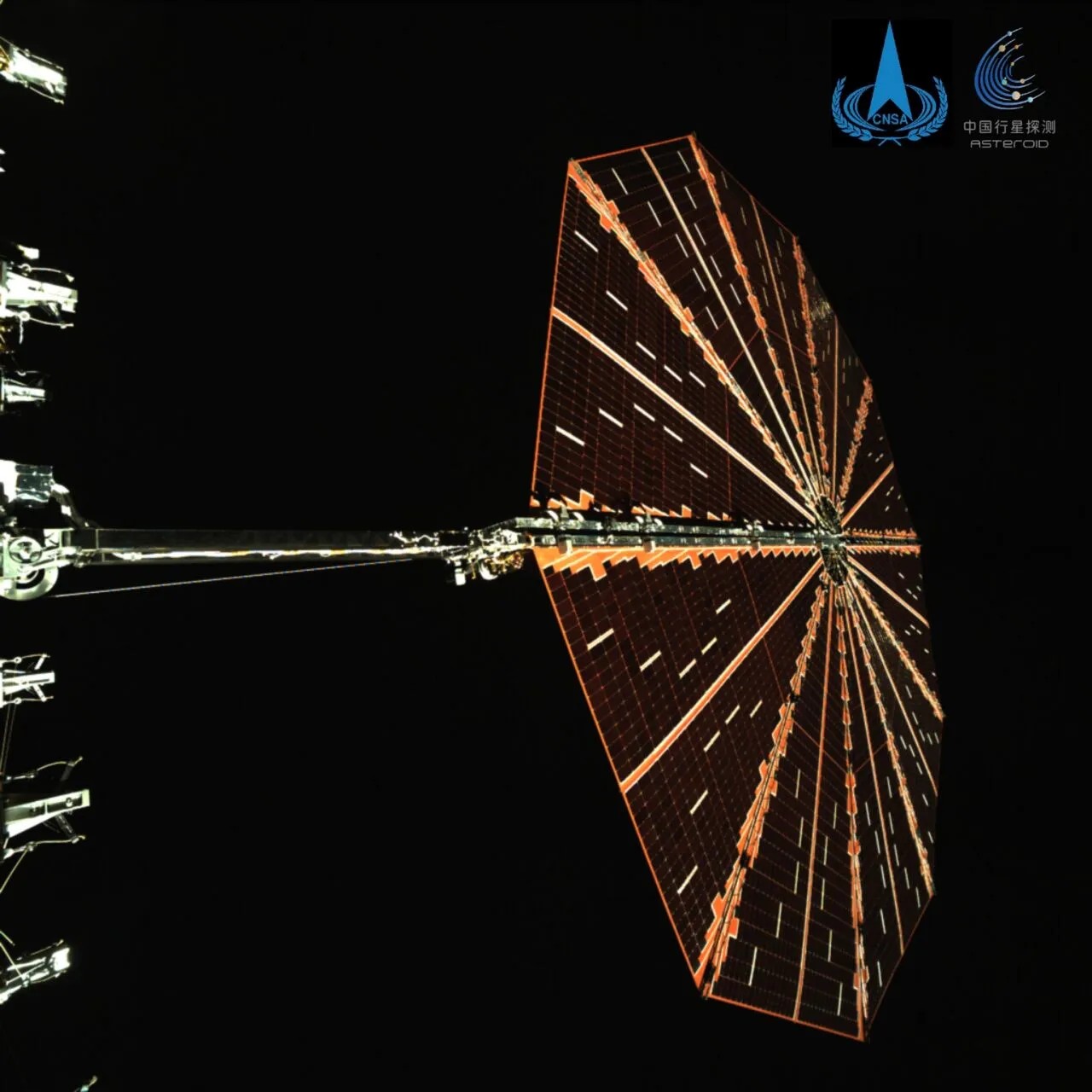
Many people may be familiar with Tianwen-2. It was lifted into space by a Long March 3B carrier rocket at the Xichang Satellite Launch Center in the early morning of May 29, 2025, heading straight for the distant deep space. Since its launch, this probe, weighing about 2.1 tons, has been flying in space for nearly ten months. During this period, it has successfully completed a series of operations such as solar wing deployment, deep space maneuvering, and mid-course corrections. Currently, it is in normal operation and steadily approaching the 2016HO3 asteroid along the predetermined orbit.
Some people may ask, why is China's aerospace industry spending so much effort to explore a small asteroid? This asteroid named 2016HO3 is actually quite extraordinary. Discovered by a telescope in Hawaii, the United States in 2016, it is the first Earth "quasi-satellite" found by humans — simply put, although it is not a natural satellite of the Earth, it is like a loyal "little partner" that always orbits near the Earth's orbit. Its orbital period is about 366 days, almost the same as the Earth's orbital period, just like a "small moon" following the Earth.
This asteroid is not large, with a diameter of only about 40 meters, roughly the length of a large passenger bus, and its rotation period is very short, taking only 28 minutes to complete one rotation. However, its scientific research value is immeasurable, and it is known as a "living fossil" for studying the origin of the solar system by scientists. Because it formed in the early days of the solar system 4.5 billion years ago, it has not experienced complex physical and chemical changes like the Earth, and has always retained the original information of the early solar system, just like a "time capsule" that seals the secrets of the early universe. More interestingly, through spectral analysis, scientists found that its composition is very similar to lunar rocks, and there is even a guess that it may be a fragment splashed out after the Bruno crater on the far side of the moon was hit. After a long cosmic evolution, it became a "quasi-satellite" of the Earth.
Tianwen-2 has an arduous and important task when it goes to 2016HO3 this time. After arriving near the asteroid, it will not land immediately, but first conduct a period of accompanying flight exploration. In accordance with the principle of "exploring while flying and approaching gradually", it will fully understand the asteroid's orbital parameters, shape and size, surface morphology, material composition, etc., just like "taking photos and checking in" in space, recording every detail of this asteroid. After that, it will choose an opportunity to carry out sampling work — due to the extremely small gravity of the asteroid, it cannot land by relying on gravity like on a planet. Tianwen-2 will use a multi-arm collaboration method to fix itself on the asteroid's surface, and then collect at least 100 grams of samples through touching, hovering or attaching.
After the sampling is completed, the return capsule of Tianwen-2 will take the precious asteroid samples and embark on the journey back to Earth, which is expected to land on Earth at the end of 2027. The main probe will continue to fly to the main-belt comet 311P between Mars and Jupiter to carry out subsequent exploration tasks. The entire mission cycle of Tianwen-2 is expected to last nearly 10 years.
This mission can not only help us understand the origin and evolution of the 2016HO3 asteroid, but also deepen human understanding of the early formation process of the solar system. For example, many scientists believe that the initial water on Earth may have been brought by asteroid impacts. Studying the material composition of 2016HO3 may provide strong evidence for this conjecture. At the same time, Tianwen-2 will also verify and break through key technologies such as microgravity asteroid sampling and high-precision autonomous navigation and control, accumulating valuable experience for China's future deep space exploration missions.
From Tianwen-1 exploring Mars to Tianwen-2 visiting asteroids, the pace of China's aerospace industry is stepping further into the distant deep space. In July this year, when Tianwen-2 really arrives at 2016HO3, we will see the appearance of this Earth "quasi-satellite" up close for the first time, and also start a new journey to unlock the mysteries of the universe. Let us look forward to this "space messenger" from China bringing us more surprises and answers about the universe.