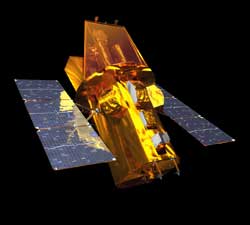
On June 5, 2026, NASA's Wallops Flight Facility in Virginia received a very special visitor: the LINK in-orbit servicing satellite from Katalyst Space Technologies. Built from scratch in just nine months, this 400-kilogram spacecraft carries an unprecedented mission: to save NASA's Neil Gehrels Swift Observatory as it plummets toward Earth's atmosphere.
A Space Crisis Accelerated by the Sun
Launched in November 2004 at a cost of approximately $500 million, the Swift Observatory is one of the most successful gamma-ray burst observatories in human history. Over the past 21 years, it has captured more than 1,500 gamma-ray bursts with its remarkable slewing speed—hence its name—and provided irreplaceable data for astronomers studying the most violent explosions in the universe.
However, this venerable telescope was never designed with a propulsion system. This means it cannot adjust its orbital altitude on its own, leaving it at the mercy of atmospheric drag that gradually pulls it toward Earth. After the Sun entered its solar maximum phase in 2024, intense ultraviolet radiation heated and expanded Earth's upper atmosphere, causing a dramatic increase in atmospheric density in low-Earth orbit. As a result, Swift's orbital decay rate accelerated several times faster than predicted, dropping rapidly from its original 600 kilometers to its current altitude of approximately 370 kilometers.
Orbital predictions from early 2025 indicated that without intervention, Swift would burn up in the atmosphere sometime between summer and fall of 2026. To buy more time for a rescue mission, the operations team at NASA's Goddard Space Flight Center made the difficult decision in February 2026 to suspend most of Swift's scientific observations and reorient the spacecraft to minimize atmospheric drag. In April, they went a step further, shutting down its core gamma-ray burst alert telescope and positioning its solar panels at the optimal drag-reducing angle. These measures successfully pushed Swift's "death line" back to September 2026, creating a precious window for the rescue mission.
A $30 Million Gamble: A Startup Takes on the Impossible
In September 2025, NASA awarded a $30 million contract to Katalyst Space Technologies, a startup based in Flagstaff, Arizona, to perform the Swift orbital reboost mission. This marks the first time NASA has entrusted the rescue of a scientific satellite entirely to a commercial company, and the first attempt in human history to perform in-orbit capture and reboost of a satellite not designed to be serviced.
The challenges facing Katalyst are nearly unprecedented. They had just nine months to design, build, test, and launch an entirely new in-orbit servicing spacecraft. By comparison, traditional space missions typically take years, if not decades, to prepare. Katalyst's 40-person team employed a rapid iterative development approach, making extensive use of proven commercial off-the-shelf (COTS) space components while retaining in-house development of core technologies.
The resulting LINK spacecraft is a highly autonomous robotic "space tow truck". It is equipped with three robotic arms and an advanced optical navigation system, allowing it to approach, identify, and capture target satellites without human intervention. Since Swift has no standard docking interface, LINK will use its robotic arms to directly grab structural bolts or the launch adapter ring on the satellite. Once successfully captured, LINK will activate its Hall effect thrusters to raise Swift from its 370-kilometer orbit to a safe altitude of 550-600 kilometers, extending its operational life by an estimated 10 years or more.
Northrop Grumman's Critical Role: Air-Launch Rocket Delivers Precision Orbit Insertion
Northrop Grumman plays a critical role in this rescue mission, providing the launch services. They will launch the LINK satellite aboard their iconic Pegasus XL air-launched rocket, carried aloft by the modified L-1011 "Stargazer" aircraft.
Air-launch offers unique advantages. The carrier aircraft can transport the rocket to an altitude of 39,000 feet (approximately 12 kilometers), avoiding most atmospheric drag and thus increasing the rocket's payload efficiency. More importantly, air-launch systems offer exceptional flexibility, allowing launch time and location to be adjusted at any time based on weather conditions and changes to the target orbit. This is crucial for the Swift rescue mission, which has an extremely tight time window.
According to the latest plans, the Pegasus XL rocket will take off from the Kwajalein Atoll in the Marshall Islands in late June 2026. The carrier aircraft will release the rocket over the Pacific Ocean, inserting the LINK satellite into an initial orbit close to that of Swift.
A Historic Mission with High Stakes and Higher Rewards
While all preparations are proceeding on schedule, the mission remains fraught with uncertainty. John Van Eepoel, Swift mission manager at NASA Goddard, put it bluntly: "This is a fast, high-risk, high-reward mission."
The greatest risk comes from the autonomous capture phase. LINK must precisely identify Swift's structure in space and then control its robotic arms with millimeter-level accuracy to perform the grab. Any minor error could result in a collision, which would not only doom the rescue mission but also generate significant amounts of space debris. In addition, the performance of LINK's propulsion system, the precision of orbital rendezvous and docking, and the unpredictability of solar activity could all affect the mission's final outcome.
However, if successful, the mission's significance will extend far beyond saving a single telescope. It will demonstrate that commercial in-orbit servicing technology has matured and can extend the lifespan of existing satellites at a relatively low cost. This would not only save NASA and other space agencies billions of dollars in satellite replacement costs but also lay the groundwork for future space debris removal, space station maintenance, and deep space exploration missions.
Latest Developments and Future Outlook
As of June 6, 2026, the LINK satellite has arrived at Wallops Flight Facility and is undergoing final integration and testing with the Pegasus XL rocket. NASA will hold a media preview event at Wallops on June 17 to showcase the rocket and carrier aircraft that will soon embark on this historic mission.
If all goes well, LINK will launch in late June. Once in orbit, it will spend approximately one week performing orbital adjustments and system checks before beginning its pursuit of the Swift Observatory. The entire rendezvous and docking process is expected to take 3-5 days, after which LINK will spend several weeks gradually raising Swift to its target orbit.
For astronomers around the world, the next month will be a period of intense anticipation and nervousness. The fate of the Swift Observatory is not just about the next decade of gamma-ray burst research—it's about how humanity explores and utilizes space. If this commercial rescue mission succeeds, it will usher in a new era of space exploration—one where satellites are no longer disposable commodities, but valuable assets that can be repaired, upgraded, and recycled.
We will continue to follow the mission's latest developments and bring you updates as they happen.