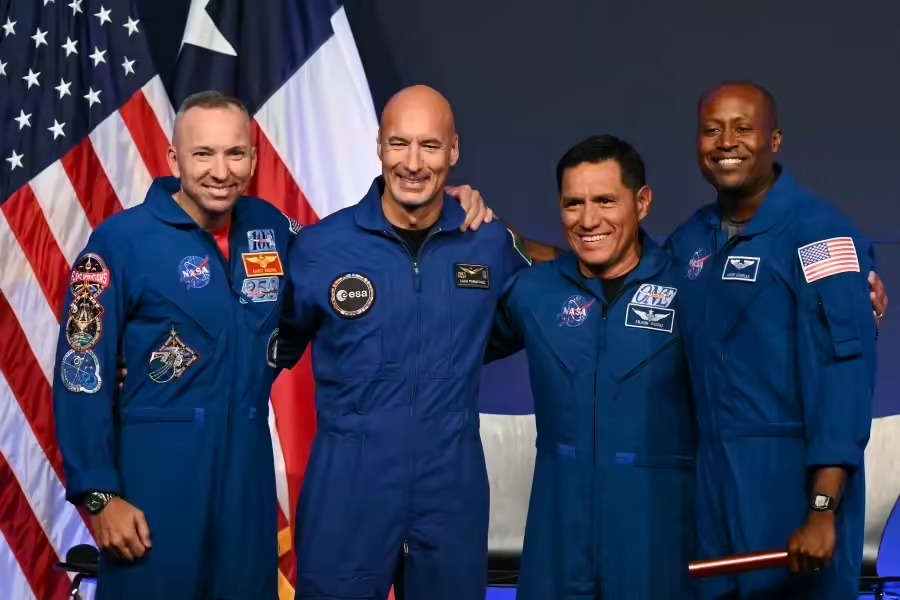
In 2028, humans are expected to set foot on the lunar surface again — 56 years after the last Apollo moonwalk. Artemis III is a key milestone on the way there. On June 10, NASA officially announced the four-person crew for this mission at the Johnson Space Center in Houston.
A Moon-Landing Mission That Won't Go to the Moon
It sounds contradictory, but Artemis III won't actually fly anywhere near the Moon. Instead, the spacecraft will conduct a series of rendezvous and docking tests in low-Earth orbit, verifying whether the Orion crew vehicle can reliably dock with lunar landers built by two commercial companies — SpaceX and Blue Origin.
Why does this matter? The Artemis program aims to return humans to the lunar surface, but landing on the Moon isn't something a single rocket or spacecraft can accomplish. Orion is responsible for transporting crew from Earth to lunar orbit, but the actual descent to the surface requires a dedicated lander. Before anyone flies to the Moon, these two systems must be proven capable of precise docking — otherwise the entire landing sequence falls apart.
As NASA official Jeremy Parsons put it: "Testing in the low-Earth environment versus testing in lunar orbit, days away from Earth, are very different things." In low-Earth orbit, problems can be addressed quickly; a docking failure near the Moon would have far more serious consequences. Running through the full sequence close to home first is the pragmatic approach.
Four People, Four Histories
Commander: Randy Bresnik
A U.S. Marine Corps veteran with two previous spaceflights totaling 149 days in orbit. As commander, he is the central decision-maker for this mission.
Pilot: Luca Parmitano
An Italian astronaut from the European Space Agency (ESA), also with two flights on his record. He has an unusual space story — during a spacewalk in 2013, water began filling his helmet from the inside, nearly causing him to drown in space. The spacewalk was cut short. NASA later classified the incident as one of the most dangerous situations an astronaut has ever faced in orbit.
Mission Specialist: Frank Rubio
A retired U.S. Army officer who is also a licensed family physician and flight surgeon. After launching to the International Space Station aboard a Russian Soyuz spacecraft, the vehicle designated for his return developed a fault. He was forced to stay in space and wait for a replacement. He ended up spending 371 consecutive days in orbit — the longest single spaceflight by any American astronaut.
Mission Specialist: Andre Douglas
The only spaceflight rookie among the four. A U.S. Coast Guard Reserve officer with a Ph.D. in systems engineering from George Washington University, he was selected into NASA's astronaut corps in 2021. He previously served as a backup crew member for the Artemis II mission.
How the Mission Unfolds
The mission can be broken down into several phases:
Step 1: Blue Origin's Blue Moon lander launches first. This is an uncrewed lander that will wait in low-Earth orbit for up to 90 days, leaving a generous window for the crewed launch that follows.
Step 2: The SLS rocket launches the Orion spacecraft. Lifting off from Kennedy Space Center in Florida, the Space Launch System — NASA's most powerful operational rocket and the backbone of the Artemis program — carries the four astronauts into orbit.
Step 3: Orion docks with Blue Moon. The crew pilots Orion to catch up with the lander already waiting in orbit and completes docking. The two vehicles remain mated for about two days, during which the crew opens the hatch and runs comprehensive tests on Blue Moon's life support, controls, and other core systems before undocking.
Step 4: Orion docks with SpaceX Starship. SpaceX subsequently launches Starship into low-Earth orbit, and Orion performs a second docking, with both vehicles flying together for roughly one day.
Step 5: Return home. After all testing is complete, Orion separates, carries the full crew back to Earth, and splashes down in the Pacific Ocean near California.
Two dockings, two landers, one mission to validate them all — that is the core value of Artemis III.
Uncertainties Along the Way
The timeline is not encouraging.
NASA Administrator Jared Isaacman wants the launch to happen before the end of 2027. But Blue Origin suffered a serious accident last month at Cape Canaveral — its New Glenn rocket exploded on the launch pad, damaging the launch infrastructure. The Blue Moon lander was originally scheduled to fly on New Glenn. The accident will inevitably affect the schedule, though Parsons struck a measured tone: "Setbacks are also part of building experience."
SpaceX faces its own challenges. The Starship system has completed 12 test flights but has yet to achieve orbital insertion. To carry out the Artemis III mission, Starship still needs a meaningful leap in reliability.
With both companies advancing their respective lander programs in parallel, delays on either side could slow the overall timeline.
A Symbolic Handover
At the crew announcement ceremony, the Artemis II astronauts completed a handover — passing a baton that had traveled with them on their circumlunar flight to the Artemis III crew.
Artemis II Commander Reid Wiseman said: "This baton has been with us for a long time. Now, the Artemis II crew officially passes it to you."
From circumlunar flight to low-Earth orbit docking tests to a crewed lunar landing in 2028, each step narrows the gap between humanity and a return to the Moon. The job of these four astronauts is to make sure that final step doesn't fail on the technical side.
As Bresnik put it: "In the Artemis program, the next mission is always the most important one."