Launch Pads Are Running Out — And the Ocean May Be the Answer
Overview With global satellite launch demand surging and launch pad schedules increasingly congested, sea-based launch — once considered a commercial dead end — is making a dramatic comeback. Florida startup Seagate Space is building a purpose-built offshore launch platform, defense giant Lockheed Martin is actively involved, and China has already accumulated substantial experience with 13 orbital launches from the sea. Offshore launch is emerging as a serious path to expand global launch capacity.
The Traffic Jam Nobody Expected The space industry has a bottleneck problem — and it's not about rockets.
It's about where to launch them. The United States currently relies on three primary launch sites: Cape Canaveral Space Force Station in Florida, Vandenberg Space Force Base in California, and Wallops Flight Facility in Virginia. But with mega-constellations like SpaceX's Starlink and Amazon's Kuiper accelerating deployment, plus growing military demand for responsive launch capabilities, scheduling at these ranges is approaching saturation. A May 2026 report commissioned by the Commercial Space Federation warns that expanding satellite constellations could strain existing launch infrastructure and force policymakers to consider "non-traditional" launch sites — including inland and sea-based spaceports.
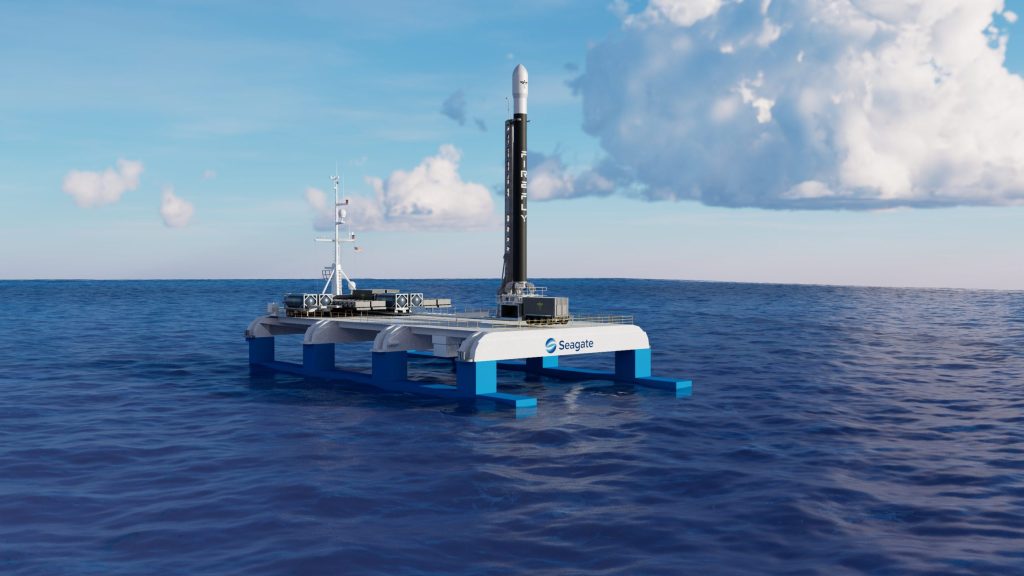
Seagate Space: Purpose-Built for the Ocean Enter Seagate Space, a Florida startup founded in early 2025 by former maritime industry executives Michael Anderson and Sean Fortener, who previously worked at Crowley Maritime.
The company is developing the Gateway Series, a semi-submersible offshore launch platform designed specifically for uncrewed launches of liquid-fueled orbital rockets. Rather than repurposing oil rigs or barges — as previous ventures attempted — Seagate is building from the ground up.
Key milestones:
Received Approval in Principle from the American Bureau of Shipping under new offshore spaceport guidelines - Signed collaboration agreements with Firefly Aerospace and Lockheed Martin - Completed subscale hydrodynamic and platform stability tests - Targeting a first demonstration launch in 2028 "We got to know some of the customer needs in the space industry, and we had a very strong belief that there was an opportunity for an upstart to fill in this void within the maritime and space domains," Anderson told SpaceNews.
More Than Commerce: The Defense Angle The revival of offshore launch isn't just commercially driven — it has significant defense and security implications. Lockheed Martin VP Johnathon Caldwell points out that launch-range congestion affects not just commercial satellite deployment, but also missile-defense testing and weapons development. The Pentagon's planned "Golden Dome" layered homeland missile-defense architecture requires more diverse and distributed test ranges. The Defense Innovation Unit (DIU) invested $2.5 million in The Spaceport Company back in 2024 for offshore launch infrastructure development. DIU's justification was clear: "A sea-based launch platform is a strategically significant capability that increases equatorial launch access while enabling responsive launch coordination by avoiding high-traffic airspace." The Spaceport Company CEO Tom Marotta said demand for launch pads and test ranges is rising faster than infrastructure capacity: "The supply of facilities that can support those launches is essentially static." The company has already conducted six launches from the Gulf Coast for defense agencies and commercial customers, including Lockheed Martin.
Not a New Idea: Lessons from Sea Launch Offshore orbital launch isn't new.
The multinational Sea Launch venture, created in the 1990s, used a converted oil platform to conduct commercial launches from equatorial Pacific waters. Between 1999 and 2014, it completed dozens of missions, proving technical viability. But the venture ultimately collapsed — weighed down by financial struggles, launch failures (including a devastating platform explosion in 2007), and geopolitical pressures. Anderson argues the market has fundamentally changed: "Sea Launch was built around the economics of launching large geostationary communications satellites from the equator. Today's market is dominated by proliferated low Earth orbit constellations, defense launches, and growing concerns over launch-range congestion." The company has brought in Sea Launch's former president Jim Maser (2001-2006) as an advisor.
Global Progress in Sea-Based Launch Multiple countries are actively exploring offshore launch capabilities:
China: Has completed 13 orbital sea launches since 2019, deploying 75 satellites. The Eastern Space Port in Haiyang, Shandong province integrates rocket manufacturing, launch operations, and maritime infrastructure. Current missions use solid-fueled rockets, with plans to support reusable liquid-propellant vehicles. - United States: Startups like Seagate Space and The Spaceport Company are pushing toward commercial viability, targeting demonstration launches around 2028.
The Promise and the Peril **Advantages:
** - Reduced airspace disruptions, enabling higher launch frequency - Optimal positioning for direct orbital trajectories (no dogleg maneuvers) - Distributed infrastructure enhances resilience against single points of failure - Equatorial launches maximize the Earth's rotational boost Challenges: - Cryogenic propellant handling at sea is extremely complex - Licensing and maritime safety regulations are still evolving - Late-stage technical fixes are harder when payloads are integrated onshore - Business model still needs commercial validation --- ## Sources - Original: Spaceport crunch reviving interest in sea-based launch — SpaceNews, June 2026