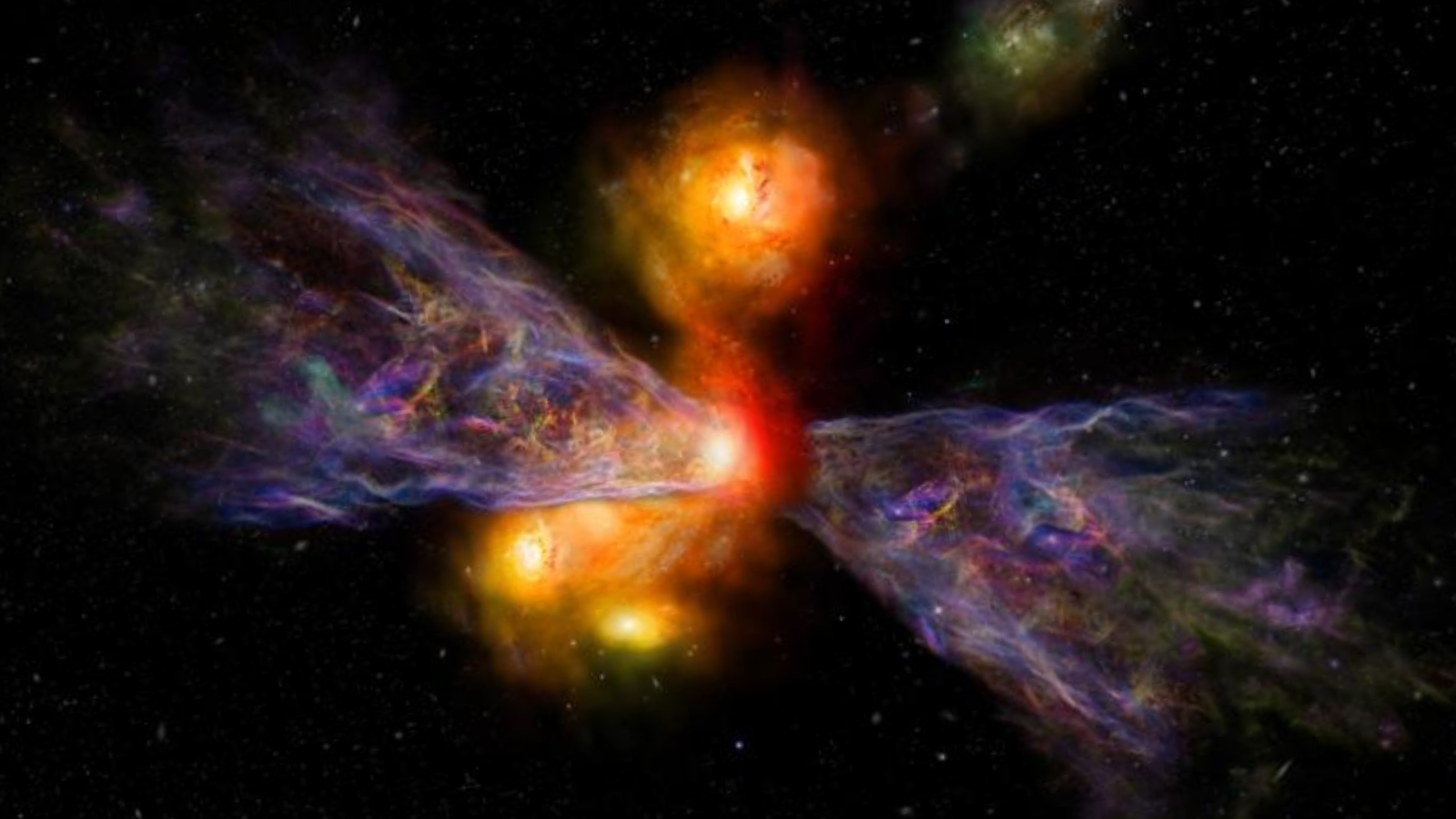
James Webb Telescope Discovers "Galaxy-Killing Wind": Why Some Early Galaxies Lived Fast and Died Young
The James Webb Space Telescope (JWST), working in tandem with the Atacama Large Millimeter/submillimeter Array (ALMA), has identified powerful gas outflows in early massive galaxies that researchers describe as "galaxy-killing winds." The discovery may explain why many of the universe largest galaxies shut down star formation shortly after the Big Bang.
The findings, reported by Samantha Mathewson on Space.com, were published on June 11, 2026.
Background
Standard galaxy evolution theory predicts that massive galaxies should steadily form stars over billions of years. Yet observations show that the number of massive galaxies in the universe falls far short of theoretical expectations, and many of those that do exist appear to have "died" -- stopped producing new stars -- within just a few billion years after the Big Bang.
Astronomers have long suspected that some mechanism expels or heats the gas within these galaxies, preventing it from cooling and collapsing into new stars. Direct observational evidence, however, has been scarce.
What JWST and ALMA Saw
JWST infrared sensitivity allows it to peer through the dust of the early universe and observe the internal structures of distant galaxies. ALMA excels at detecting millimeter and submillimeter radiation, which traces the motion of cold gas and dust.
The joint observations revealed that in certain early massive galaxies, extremely fast gas outflows are present. These outflows are triggered by cosmic-scale galaxy merger events -- when two galaxies collide, their central supermassive black holes become active, and the energy released drives large quantities of gas out of the galaxy.
The research team estimates that these outflows can deplete a galaxy available gas supply within a few hundred million years, rapidly halting new star formation.
Why It Called a "Galaxy-Killing Wind"
Star formation requires cold gas to collapse under gravity. If that gas is blown out of the galaxy at high speed or heated to temperatures where it can no longer collapse, the process stops.
The researchers liken the phenomenon to a "galaxy-killing wind": the outflow acts like a powerful gust that strips away the galaxy fuel, effectively "killing" it on a cosmic timescale. Unlike the gradual consumption of gas, this is a rapid, violent process.
Implications for Galaxy Evolution
The discovery supports the "rapid quenching" model within star formation quenching theory. Astronomers had been uncertain whether galaxies fade slowly by exhausting their gas supply or shut down abruptly through catastrophic events. The JWST and ALMA observations suggest that, at least for massive galaxies in the early universe, rapid quenching is the dominant mechanism.
It also means that galaxy merger events played a more significant role in cosmic evolution than previously thought -- not only triggering bursts of star formation but also, through the outflow mechanism, bringing star formation to an end.