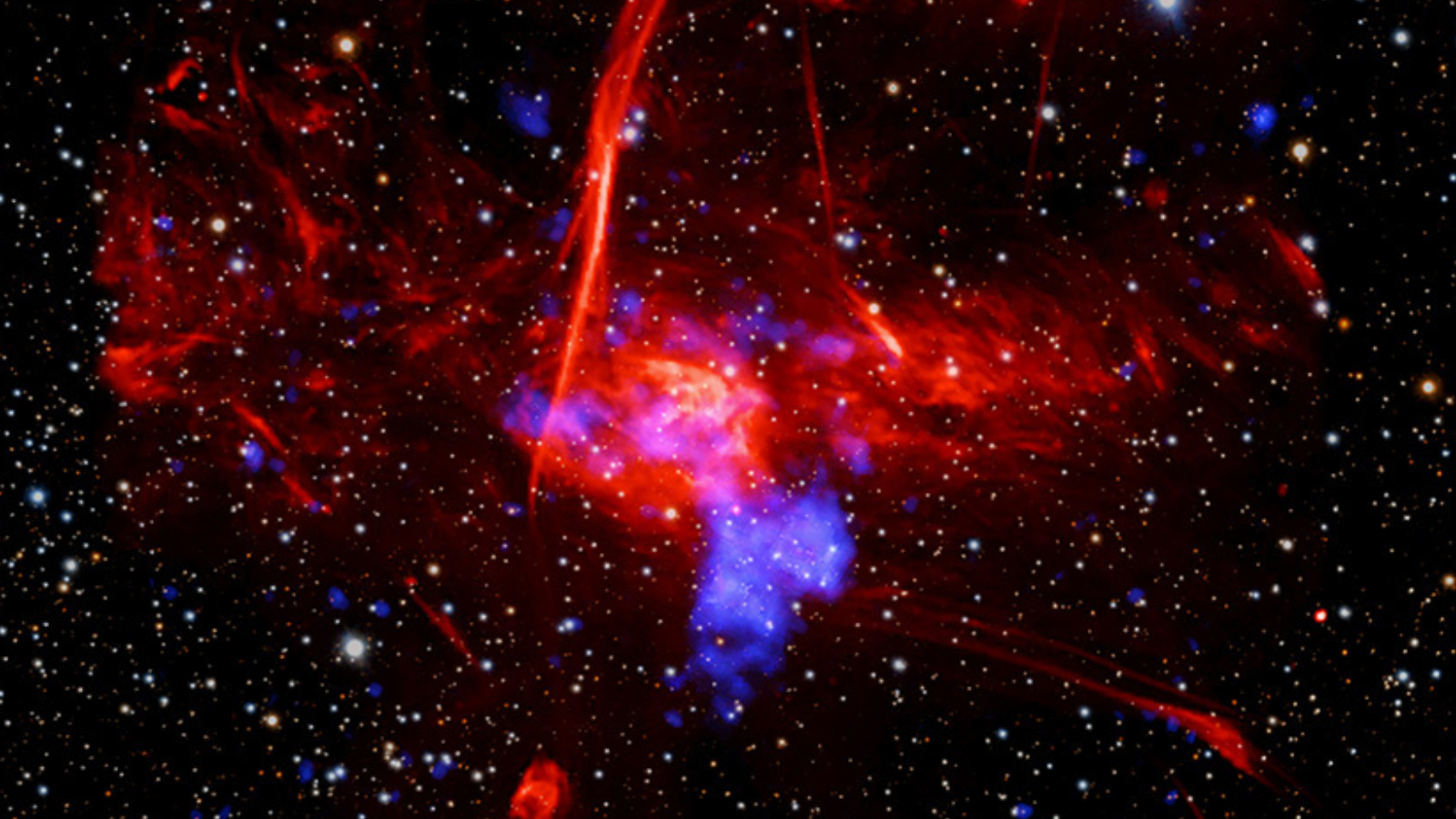
NASA Chandra Detects 1,700-Year-Old Supernova Wreckage Near Milky Way Center
NASA's Chandra X-ray Observatory has detected the remnants of a supernova explosion near the supermassive black hole at the heart of the Milky Way. The star that created this wreckage erupted roughly 1,700 years ago, and its ejected material is expanding at approximately 3.2 million kilometers per hour. This represents the closest supernova debris ever found to the galaxy's central supermassive black hole.
The wreckage sits near Sagittarius A* (Sgr A*), about 26,000 light-years from Earth. Using both Chandra and the European Space Agency's XMM-Newton X-ray telescope, the research team detected a blob of X-ray emission within an ionized hydrogen bubble known as Sagittarius C (Sgr C), a bright source of radio waves.
Supernova explosions mark the violent end of massive stars. Elements forged through nuclear fusion inside the star — iron, silicon, oxygen, and others — are hurled into surrounding space, mixing with interstellar gas and dust. Over time, these enriched materials cool and collapse to form new stars and planets. In this sense, supernova remnants are a critical link in the cosmic cycle of matter.
However, the team did not detect the elevated elemental abundances typically associated with stellar explosions. Two explanations are possible: either the ejected material has already mixed thoroughly with its surroundings, diluting the signature, or the X-ray emission originates not from a supernova but from gas heated by the massive young stars in the region. The researchers consider the latter explanation unlikely, as the observed X-ray brightness is roughly ten times greater than typical emissions from clusters of hot massive stars.
The findings have been published in The Astrophysical Journal, providing new observational evidence for understanding the history of stellar evolution near the center of our galaxy.
Further Reading
Source: NASA X-ray spacecraft discovers supernova wreckage at the heart of the Milky Way