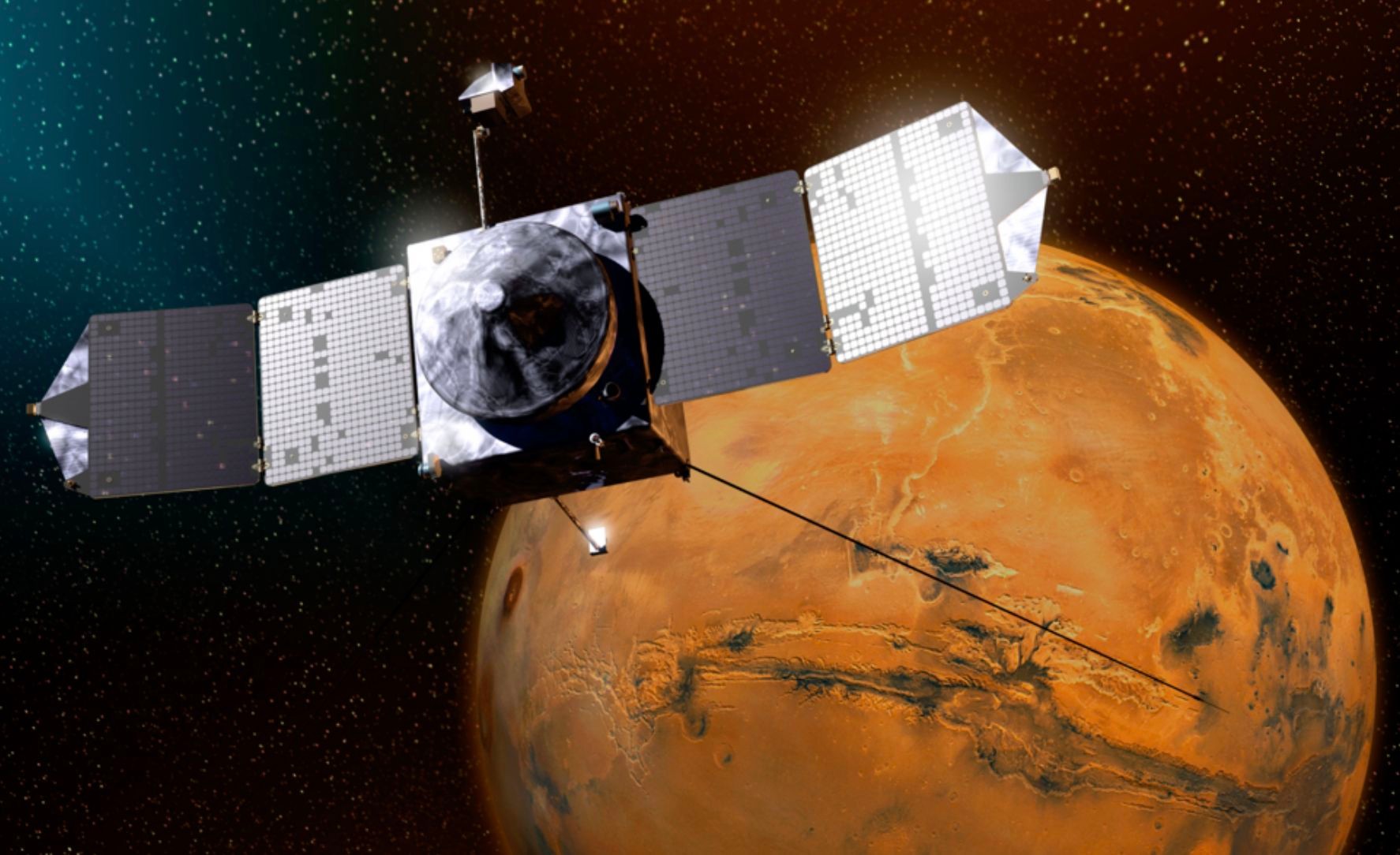
NASA MAVEN Mars Orbiter Retires After 12 Years Following Loss of Control
NASA's MAVEN (Mars Atmosphere and Volatile EvolutioN) orbiter has officially retired after 12 years of service. In December 2025, the spacecraft lost contact with Earth after entering an uncontrolled spin during a routine pass behind Mars, ultimately running out of battery power.
MAVEN launched in 2014 with a planned mission duration of approximately one year, tasked with studying the structure and evolution of the Martian atmosphere. The spacecraft remained in excellent health, and NASA extended its mission multiple times. Over 12 years, MAVEN produced a series of important scientific findings.
The orbiter confirmed that Mars' atmosphere erodes significantly faster during solar storms, establishing a direct link between the planet's thin atmosphere and solar activity. MAVEN also detected proton auroras across the entire Martian globe — on Earth, such auroras appear only in narrow regions near the magnetic poles. During the planet-encircling dust storm of 2018, MAVEN documented the storm's profound impact on Mars' upper atmosphere, providing valuable data for understanding the Martian climate. The spacecraft also imaged interstellar visitor 3I/ATLAS in multiple wavelengths.
MAVEN holds a solar system record: the most data transmitted from any single planet. As part of the Mars communications relay network, MAVEN collaborated with other Mars orbiters to beam scientific data back to Earth via the Deep Space Network's radio antennas.
During a routine Mars occultation in December 2025, MAVEN lost contact as it passed behind the planet. Telemetry fragments recovered from Deep Space Network open-loop recordings indicated the spacecraft was tumbling at high speed and had entered safe mode. Engineers believe the solar panels could not maintain proper sun-pointing orientation due to the spin, and the batteries eventually depleted. After multiple recovery attempts, the mission was declared over.
Over its 12-year tenure, MAVEN supported the publication of more than 800 scientific papers, making significant contributions to our understanding of Martian atmospheric evolution.
Further Reading
Source: OUR SPACE: Farewell to MAVEN