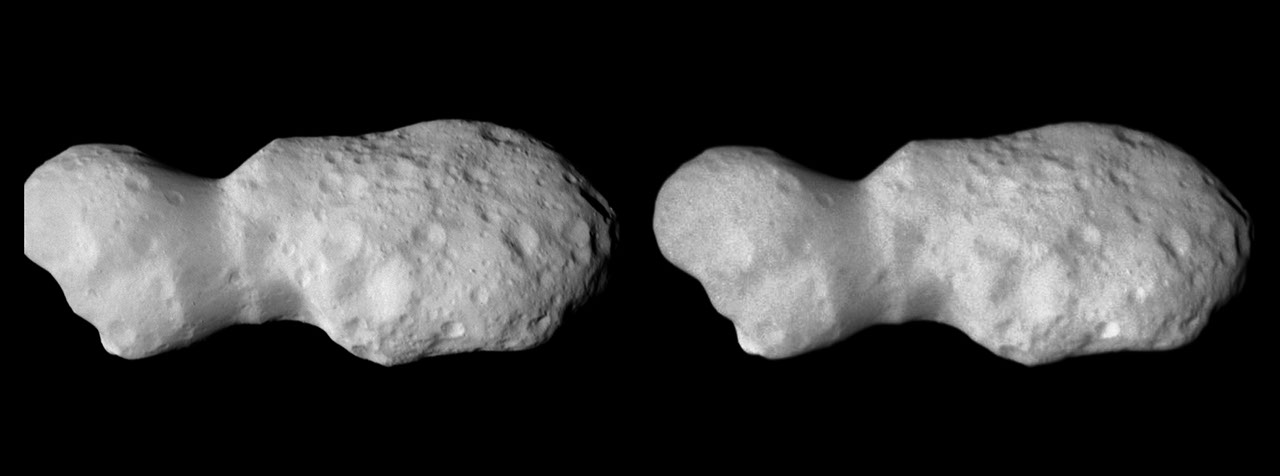
NASA's Lucy Reveals Wobbling, Peanut-Shaped Asteroid
On April 20, 2025, NASA's Lucy spacecraft zipped past the asteroid Donaldjohanson at 30,000 miles per hour, passing within 650 miles of the surface. The flyby was intended as a dress rehearsal before the spacecraft reaches its primary targets — Jupiter's Trojan asteroids — but the data turned out to be far more interesting than expected.
The asteroid, roughly five miles across, turned out to be peanut-shaped: two lobes connected by a narrow neck. It also doesn't spin the way most asteroids do. Instead of rotating neatly around a single axis, Donaldjohanson tumbles end-over-end once every 10.5 Earth days while simultaneously wobbling back and forth around its long axis once every 26.5 days. Ground-based observers had previously detected the 10.5-day brightness cycle, but the dual-axis rotation was invisible until Lucy got close enough to see it clearly.
Scientists believe the two lobes are fragments from a violent collision that gently came back together under their own gravity. That collision happened 155 million years ago, making Donaldjohanson far younger than Bennu and Ryugu — two similar asteroids that formed one to two billion years ago. The comparison is scientifically useful: all three are thought to originate from larger, carbon- and water-rich parent bodies in the main asteroid belt, but their different ages and orbital histories have produced distinct surface characteristics.
Donaldjohanson likely rotated at least ten times faster when it first formed. Over the past 20 to 60 million years, a phenomenon called the YORP effect has been gradually slowing it down. The effect works like this: sunlight heats the asteroid's uneven surface, which re-radiates that energy as infrared light. The radiation imparts a tiny recoil force, and because the shape isn't symmetric, the forces don't cancel out. The result is a net torque that can either speed up or slow down the spin. Bennu and Ryugu, by contrast, have been spun up by YORP and now rotate much faster than they once did.
As Donaldjohanson's rotation slowed, the balance between centrifugal force and gravity shifted. Loose rocky material slid down slopes, filling in craters and giving the surface its worn-down appearance — a feature clearly visible in Lucy's flyby images.
The spacecraft's infrared spectrometer detected iron-rich clay minerals on the surface. These clays can only form with the help of liquid water, indicating that Donaldjohanson's material was briefly exposed to water in the distant past. The exposure was short-lived, though: iron in clays tends to be replaced by magnesium when water lingers, and Donaldjohanson's clays still retain their iron. Bennu and Ryugu show magnesium-rich clays, suggesting their parent bodies had prolonged water contact lasting millions of years.
This difference in water exposure, combined with the age gap, may mean that the parent bodies of these asteroids formed at different times or in different regions of the solar system before eventually migrating to the main asteroid belt.
"It's helpful for scientists to compare Donaldjohanson with asteroids like Bennu and Ryugu, which are seemingly similar asteroids, because every subtle difference is another clue to our origin story," said Simone Marchi, Lucy deputy principal investigator and lead author of the study at the Southwest Research Institute in Boulder, Colorado. "Once we start learning more about the Trojans, a completely different population of space rocks with very different histories, our understanding of solar system formation is destined to be challenged."
The study was published June 18 in the journal Science. Lucy's next target is the Trojan asteroid Eurybates, with a flyby scheduled for August 12, 2027.