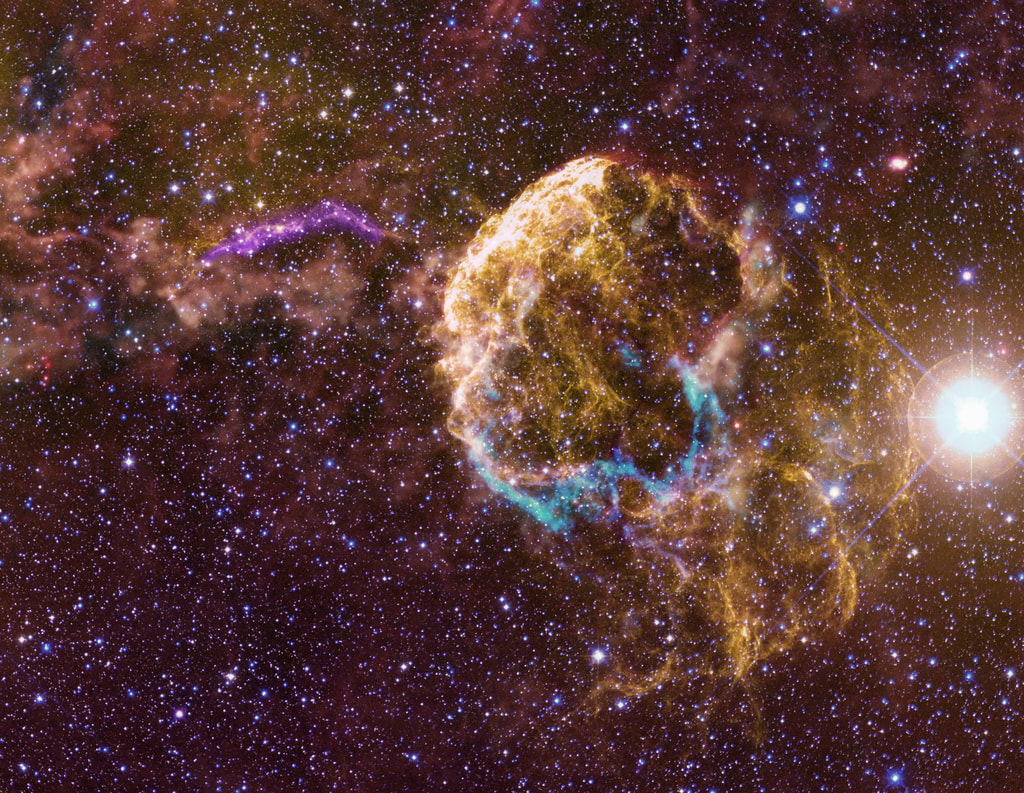
Fermi Telescope Reveals First Known 'Sibling Supernovae': Two Companion Stars That Exploded in Succession
Astronomers using 16 years of data from NASA's Fermi Gamma-ray Space Telescope have identified two supernova remnants in the constellation Gemini — the Jellyfish Nebula (IC 443) and G189.6+3.3 — as the products of two stars that once orbited each other and each detonated as a supernova. This marks the first known case of a binary system in which both stars left behind individually detectable supernova remnants.
The findings were presented on June 18 at the 248th meeting of the American Astronomical Society in Pasadena, California, by postdoctoral researcher Miltiadis Michailidis of Stanford University. A paper describing the results will appear in Nature Communications.
Sixteen years of data uncover a hidden neighbor
The Jellyfish Nebula is one of the brightest gamma-ray-emitting supernova remnants in the sky, located about 6,000 light-years from Earth. Its fainter neighbor, G189.6+3.3, was first discovered in 1994 during the German-led ROSAT X-ray survey. The two remnants partially overlap as seen in X-rays, and they had long been treated as unrelated objects.
"Using 16 years of data from NASA's Fermi Gamma-ray Space Telescope, our analysis uncovered gamma rays associated with a supernova remnant that was hidden in the glare of its neighbor, the Jellyfish Nebula," said Michailidis. "There are so many striking connections between the two remnants that we conclude they're likely related, giving us the first known example of a binary system where both stars have undergone supernova explosions."
From binary companions to sibling supernovae
The team reconstructed a timeline: two massive stars, each 25 to 40 times the mass of the Sun, once formed a binary system. The more massive star exploded first, and the resulting "kick" sent its companion hurtling through space. After traveling alone for roughly 20,000 to 100,000 years, the surviving star exhausted its own fuel and detonated as a second supernova.
The two remnants now overlap in space, their explosion centers separated by roughly 40 light-years projected onto the plane of the sky. The Jellyfish Nebula is estimated to be 8,000 to 9,000 years old, while G189.6+3.3 ranges between 20,000 and 110,000 years old — meaning up to 100,000 years may have elapsed between the two explosions.
A key piece of evidence came from a bright gas filament between the overlapping remnants. New observations showed that the shock wave from G189.6+3.3 slammed into dense interstellar gas there and slowed dramatically, indicating that both remnants are interacting with the same molecular cloud system.
To further test their hypothesis, the team ran computer simulations of a million massive binary systems. Systems in which the stars orbited close enough to exchange material during their lives readily produced dual supernova explosions with separations and time delays consistent with the observations. The team also calculated the probability of the two remnants randomly aligning so closely at compatible distances — less than 1% — strongly supporting a physical association.
New clues to cosmic-ray origins
The discovery also sheds light on the origin of cosmic rays. A decade ago, Fermi observations confirmed that the Jellyfish Nebula's shock waves accelerate particles to near the speed of light. Researchers believe the Jellyfish Nebula may be a "PeVatron" — a cosmic particle accelerator capable of boosting protons to peta-electron-volt (PeV) energies.
Now, with the discovery that its sibling G189.6+3.3 is also interacting with the same gas cloud, scientists have a new laboratory for studying how supernova remnants evolve into PeVatrons. The environment where two remnants coexist may accelerate particles more efficiently than either remnant alone.
"Fermi's gamma-ray observations of supernova remnants continue to reveal the dynamic lives of stars," said Elizabeth Hays, the Fermi project scientist at NASA's Goddard Space Flight Center. "We can now connect the glowing remains of two massive stars to a powerful pair that evolved together over thousands of years."
Further reading
- Original article: NASA's Fermi Mission Uncovers Possible Sibling Supernova Remnants
- NASA Scientific Visualization Studio: Images and videos