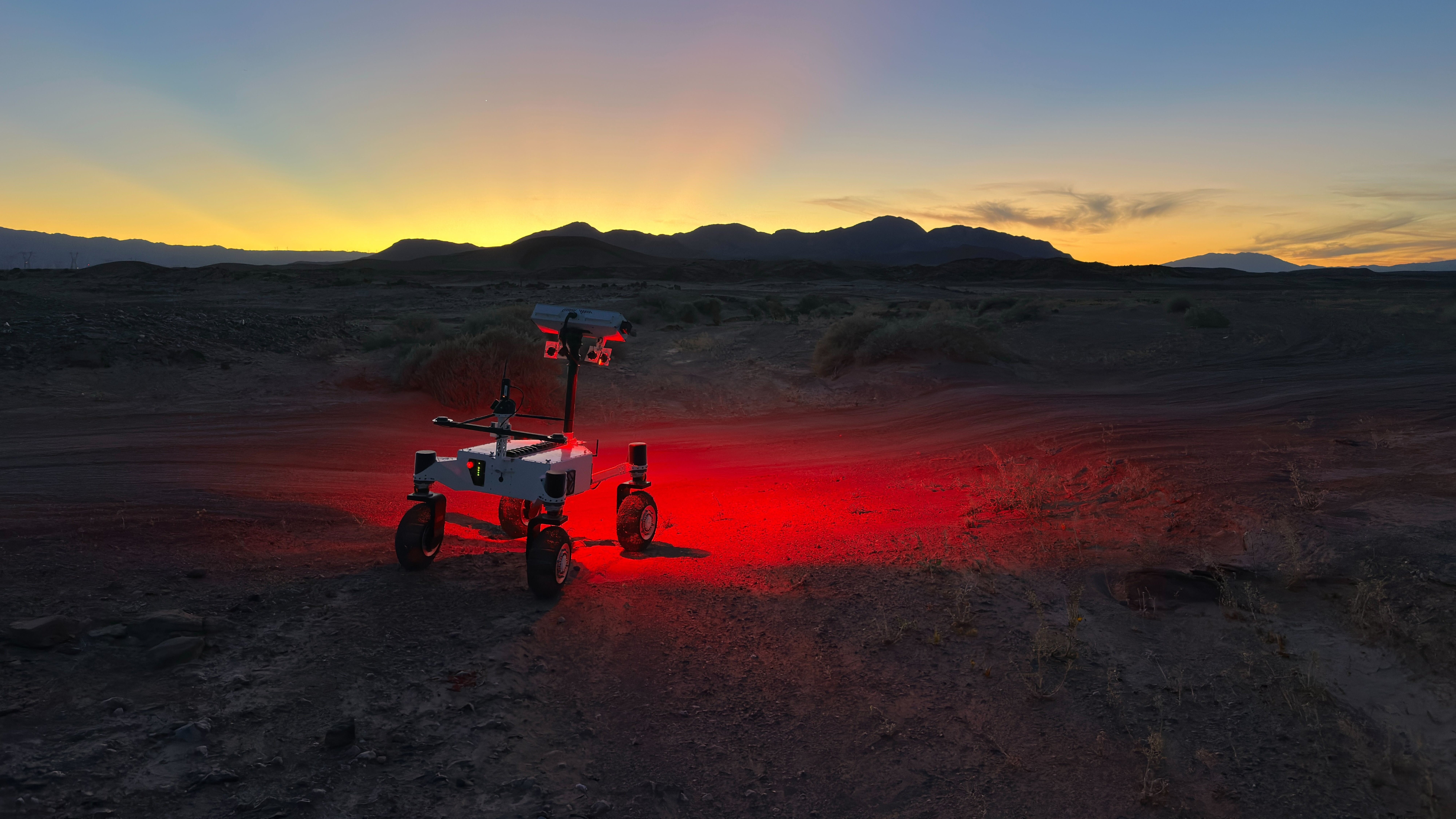
NASA's New Rover Prototype Drives 26 Kilometers Autonomously in Desert Test — 10 Times Faster Than Perseverance
In March 2026, NASA's Jet Propulsion Laboratory conducted a seven-day field test in Southern California's Colorado Desert. The star of the campaign was ERNEST — the Exploration Rover for Navigating Extreme Sloped Terrain — a compact four-wheeled prototype that covered approximately 26 kilometers (16 miles) over 37 hours of driving with minimal human intervention. Its top speed reached about 1 kilometer per hour, an order of magnitude faster than NASA's current Mars rovers Perseverance and Curiosity can navigate.
More than just fast
ERNEST measures 1.2 meters (4 feet) in length and features a fundamentally new active suspension system. Unlike the passive rocker-bogie suspension used by every Mars rover since Sojourner in 1997, ERNEST can independently lift each of its mesh wheels to clear obstacles. Two powered joints at the front articulate a gimbal that allows the rover to move in multiple gaits — squirming, wheel-walking, and climbing. A clutch mechanism lets it switch between active and passive suspension modes, trading terrain capability for energy efficiency when conditions allow. With four steerable wheels, ERNEST can drive in any direction, including sideways.
"We started by postulating that we could do better in designing a planetary surface robotic mobility system," said Hari Nayar, a JPL principal technologist leading the ERNEST team. "While the rocker-bogie system has been very successful over the past 30 years, there's been a lot of research in that time on mobility and understanding terrain interaction."
Teaching a rover to think for itself
The bigger challenge was autonomous decision-making. The JPL team turned to reinforcement learning, a form of artificial intelligence in which a robot learns by interacting with its environment. They built a high-fidelity virtual testing environment that replicates the rover's behavior, fed it with data from the actual hardware's responses to various terrain types, and ran thousands of hours of simulations on a high-performance computing cluster — sometimes completing an entire weekend's worth of testing in a single batch.
After months of virtual training, ERNEST was ready for real-world obstacles. In JPL's Mars Yard outdoor proving ground, the rover autonomously navigated courses featuring sand ripples, rubble piles, steps, and steep slopes.
The desert campaign also deliberately included dawn, dusk, and nighttime tests — simulating the long shadows cast by low-angle sunlight in the Moon's polar regions. The team brought illuminators to the field to verify the rover's navigation capabilities under extreme lighting conditions.
Paving the way for future Moon and Mars missions
ERNEST serves as a technology demonstrator for a potential future long-range lunar rover mission. "You could do a science road trip across the Moon — or Mars — with this vehicle," said James Keane, a JPL planetary scientist working on lunar missions.
Work on ERNEST began in 2022, initially supported by JPL internal research and development funds. It is currently funded by NASA's Mars Exploration Program and the Exploration Science Strategy and Integration Office within the agency's Science Mission Directorate.
Further reading
- Original article: NASA Testing Advanced Capabilities for Moon, Mars Rovers
- JPL image details: Desert Field Test With NASA Advanced Rover Prototype